To think about what different acts of “speaking out” have been across hemisphere and across history, this places a great deal of significance on that concept of Lorca’s duende, because acts of voice have not always been received without a violent and immediate silencing. Either a silencing that is directed purely at voice or voicing, as in forms of structural disenfranchisement, or worse, forms of violence directed more generally at bodies such that they can no longer voice. And in a way that makes violence pedagogical as it teaches others to fear-to-speak in the future. While educating others on how to enact tactics of silencing on their own authority as privileged subjects. So when I affect/effect voice in a textual field I’m thinking of the sieves and torture devices voices have historically had to physically be pushed through by the momentum of history, violence, by colonialism, positionalism. And I keep in mind that even in the aesthetic celebration of various artforms by previously silenced communities there is still great gloss, irredeemable violence, uncertain futures.
“It” is truly broken in other words. When that “It” is an experiential even if subperceptible encounter with Voice, with language. Even as it works. It works as Being, in rebellion, in demonstration, in subversion, in intimacies. The broken times are those times which still meet Being with skepticism or selective enfranchisement. This could become a very long answer, but that we still have to hear people say “All Lives Matter” is fucking infuriating and a reflection of It being Broken. What I suppose really frustrates me is that Voice, when I engage it, is then forced into the pressure or having to both educate and express Being, whereas for the entitled, throughout our History, Voice has always been a “window into the soul,” so to speak. Purely and without skepticism or refusal.
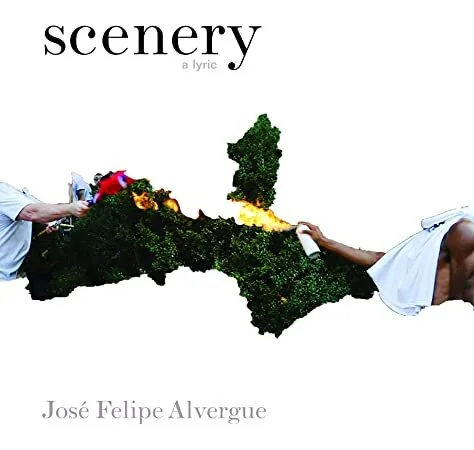
AZ: Typographically, with the combination of text and its voice, the, “blocks, pillars, and slabs or beams” from pg. 12 make me think about the construction of each page through text, image, or their combination. Pages which you refer to as being textually radical—where text intersects text to form contrapuntals, where slabs are jointed to horizontal pillars, where text forms blocks, where text can be italicized, bolded, and greyed depending on the light read in—this makes the reader read and re-read sections by rotating the book. From the act of flipping the book around to read certain portions, there’s an awareness of the act of reading, as well as the physicality of the book and its pages. Some people will say that a work “touched” them, but that refers more to an emotional sense, whereas reading scenery couples the emotional with an actual tangible sense of “touch” with holding the book that I’m not sure I’ve been aware of while reading before. Where has your interest in the meta-ness (maybe sentience is the better word that you’ve mentioned) of actually “reaching” out to “touch” the reader come from, making them aware of what they are doing, where they are, and creating a reality that exists both within and without the book?
JFA: My reaching out to touch comes from the primacy of the book-object, and my experiences with handmade chapbooks and poetic community/-ies. I think it’s also pretty magical how books survive, and you can come across books either in an archive, a grandparent’s home, a library, or any other space, and from an entirely different moment. My quote in that section is from Wittgenstein’s language games. And my take is the impossibility of a pure experience with the creation of a language, in the sense of an impossibility of language ever being manifested in a context not overdetermined by power or colonization. The embodiment or physicality that you are describing in scenery, and especially what you’re noting as the counterpuntal rhythm of it, is that “touch” as an intimacy that remains in pure difference. My lyric relationship to parenting, and the parts of the book that are memoir, and deal with my child and my partner giving birth, these are rather obvious examples of this pure difference as intimacy. But they are also the building blocks of more complex differences that require intimacy. A reaching out that is not touch or refuses the grasp as a concept of power’s will-to-know, but instead a reaching out that stops each time in the extension of an openness. As if to touch were not to grasp but to be both reception and reach at the same time. There is a decolonial undercurrent to all my work that truly seeks to understand Power, even while wishing at all times to draw a light on it so as to walk away from it, to see it in a nihilistic light.
AZ: In gist : rift : drift : bloom (Further Other Book Works, 2015) and precis (Omnidawn, 2017), there are no page numbers. scenery then approaches its pacing differently with having some pages numbered and some unnumbered. Similarly to your previous books, there is no table of contents. This brings to mind again the awareness of reading, but also the emphasis on where there are no numbers, in addition to how scenery can be read as one continuous work, or sectioned by the unnumbered, “blank” pages. On pg. 45 you confront your aesthetics, and also the confines of genre, and (potentially?) theorizing of a post-poetics, one which, “would give form / to the collaborative, cooperative / speech from scenery as an act / against the humming of continu / ity”, and how, “Such a poetics is elusive.” This focus on what can be counted or quantified makes me wonder how you envision the future (and present history) of the lyric? Also how your understanding of ontology relates to the lyric? As I will admit, I am still struggling with my own understanding of ontology.
JFA: It was tough because I never want page numbers. Fordham being a bigger press didn’t really want that, but the compromise actually worked in many ways because it does allow for “pacing” as you note. And as I describe above, I don’t write discreet poems. The work is an engagement with a question that I explore to its ontological limit. I think there will always be lyric as it might be conventionally defined. My hope is that experiencing the ontological limit of lyric begins to untrain our senses, and begins to truly open an inclusive space of the poetic commons. I think it’s easy for emotional exhibition to formulate shared conclusions on emotional being, literally bound limits on what can be known as lyric emotion, its conclusions and expression. We tend to fear what is possible outside of bounded limits. That’s the settler-colonial remainder that serves as the foundation of our American literary canon. This remainder can be extreme, but it can also work into benign interactions with text/s. I mean just see question 1, right. Another person’s consciousness might very well present itself as an unknown territory. Do we listen when others speak, when they speak on what they have concluded about what they feel?
AZ: In my own attempt at bringing in other influences to this interview, I did what may seem strange, but I let my Rider-Waite tarot deck charge on top of your book (Bob Kaufman’s collected poems were nearby however), then I read a few pages from your book to the deck before drawing a card. The card I drew was the Ten of Pentacles. The formation of the pentacles on this card comes from the same structure as the Tree of Life’s ten sefirot in the Kabbalah (Kaufman’s influence perhaps?) and its pillars. I know this may sound silly to a certain degree, but taking a prompt from this card, are you influenced by anything supernatural in your work? This could be “ghosts” or “spirits”, but also going back to duende, unseeable, “intangible” forces which cannot be observed, but still can be felt, potentially like music? You’ve mentioned that you’re sometimes a nihilist, so maybe that nullifies this question, but then, what does it mean to you to create meaning out of having nihilistic feelings, which can be optimistic and pessimistic?
JFA: I like this question. What I find interesting is that the “intangible” also encompasses pre-lingual/non-lingual events that form our consciousness. But I’m also culturally sensitive to the idea of spirits, and academically sensitive to the making of, and persistence of ghosts. Music is definitely a medium through which they travel, and one of my favorite experiences while composing is listening to music. Other poets have historically thought about other technologies as mediums for ghosts, like Kamau Brathwaite and his video Sycorax style which alluded to his computer as a medium for the ghost of Sycorax. I think if, in a hemispheric context, the “natural,” or nature exists as a contested space of settler-colonial occupation and simultaneously an opportunity for alternative epistemologies, for an indigenous ontology, then the “super-natural” must be included as a way of approaching decolonial research via an engagement like poetry. And not “super” as in an escape from, but literally a supernatural ability to leave the plane so as to look down upon it the ways ghosts or spirits can, and get a whole picture of it. Ghosts and spirits are only ghosts and spirits because they have chosen or are bound to stay with us. If it were truly an issue of a complete break or escape, we wouldn’t have these words in our vocabulary. That’s the nihilism I’m working from, a leaving behind of that which does not serve us, but very much also the labor of experiencing that leave-behind; from the decision to do so, to the anxiety of experiencing uncertainty, and the joy of the new. Burning it. Breaking it. Revealing it for its counterfeit reality and listening to/for the intangible in that there is something there worth considering in our attempt to exist towards shared realities––like Nation.