
Sam Hasse
The ongoing rise of book bans across the United States has inspired many bookstores to create dedicated displays for banned books. Some have gone further, creating traveling bookmobiles that provide access to banned books across the United States.
Among these traveling bookmobiles is The Noctua Nook Trailer, owned and run by bookstore-owner and historian Gilda Bour, with the assistance of her son, Holden Bour. The trailer debuted this summer in the Chippewa Valley, and continues to make stops across Wisconsin and Minnesota, stocked with books available for purchase. The trailer features banned and challenged books, historical texts, and books of fantasy, mythology and folklore.
I had the pleasure of visiting Bour’s brick-and-mortar bookstore, The Noctua Nook (and taking a peek at the Noctua Nook Trailer parked out front), where we discussed her passion for sharing and providing knowledge, history, and escapism to fellow readers.
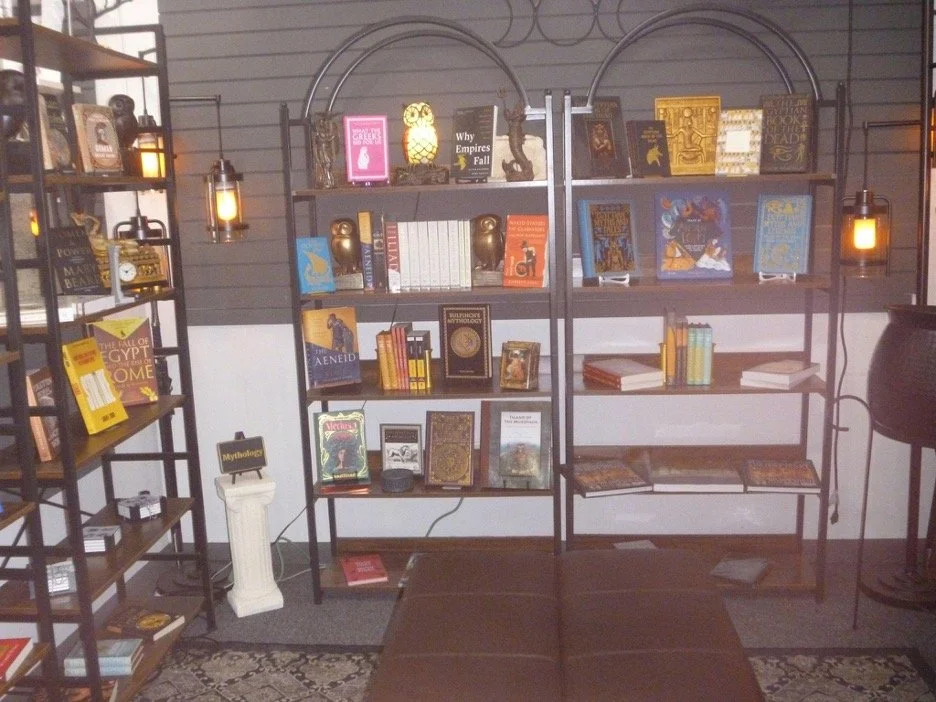
Bour was inspired to create her own traveling book trailer when she noticed the lack of bookmobiles in Wisconsin. She recalled growing up in California, and looking forward to the local bookmobile’s visit to her small school. She wanted to bring one to Wisconsin. “I saw a couple pop up, but nowhere near…and I thought, ‘that's a really cool idea.’" The more she thought about it, the more she was motivated to create a space for youth to access informative texts and literature.
Once she made the decision to open her own trailer, she considered every little detail, hoping to curate an escape for visitors. Bour explained, “I wanted it to feel warm and magical. So, even just picking the paint, something that reflects a little bit of a gold sparkle, and little things like that. How do I marry banned books and mythology and history and romantasy? How do I take my favorite things and put them together and share them with someone else?”
The curation of her trailer did not stop at aesthetics, however; as a historical scholar, Bour felt it was important to provide not only entertainment, but also readers’ access to critical informational literature—especially historical texts and banned books. She explained, “I was looking at American history. When did we have that revolutionary spirit again? Was it just that one time? And then I kept seeing that it never ended, that some people got rights and others didn't. That even though we had a constitution, due process and rights aren't guaranteed, and they're not there for everyone.”
Bour was interested in researching history from a young age, but that interest grew when she learned more about her family history—and the more she learned, the harder it was for her not to speak about historical and current events and share them with the public. She shared, “my great-grandfather and great-grandmother were Italian immigrants during the time of the Palmer Raids. Learning about what their experiences may have been, about what their fears and how what we're experiencing right now is the same thing. That we've already been through this parallel once. And so, I am political…I couldn't learn more about the Progressive Era and stay silent. It's hard to stay silent when you learn more.”
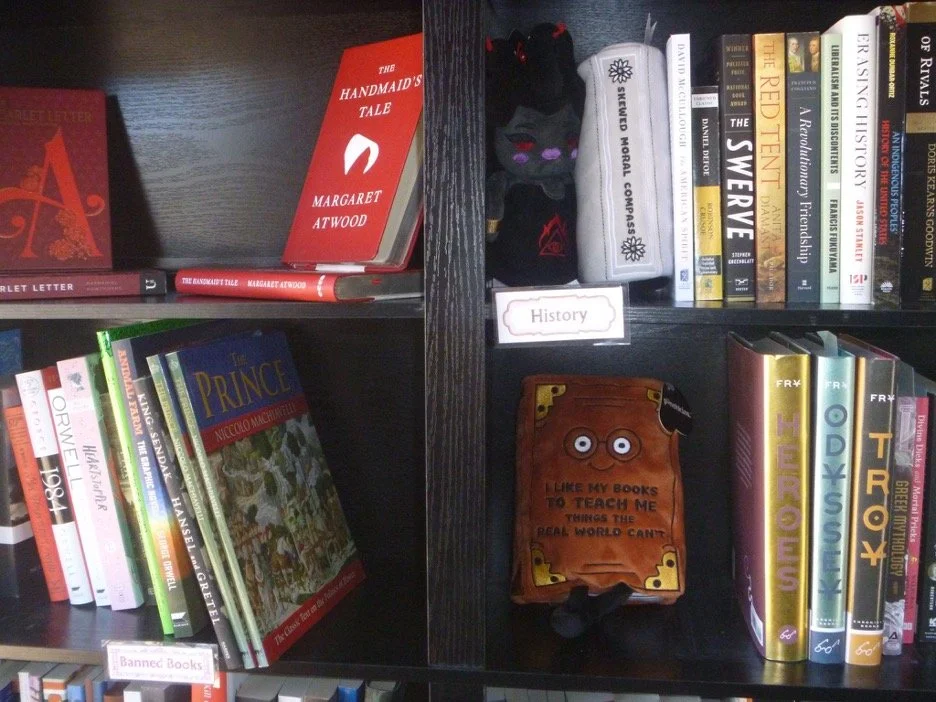
The American Library Association’s (ALA) Office for Intellectual Freedom found that there were 4,235 unique titles challenged in 2025 — the second highest number of book ban attempts ever documented by ALA. In a time where information is being restricted to the public, especially to young adults, the refusal to stay silent about political issues is crucial, and that is why these book trailers, which feature banned books, are so important.
Bour is one among those who are refusing to stay silent. “Especially being a young woman... sometimes it's hard to find your voice. Once I found my voice and found that it's important to speak up, I speak up more,” she explained. “You learn to speak no matter what, and to say, “no, that's wrong, and I'm gonna fight for better.’ That equality's important for everyone—justice, due process, for everyone.”
According to the ALA, of the 4,235 books challenged to be banned in 2025, 39% of them were representations of LGBTQIA+ people and people of color. Bour stressed the importance of access to a diverse range of perspectives in literature. “You don't know what you're going to see in someone else's perspective that is either similar to yours, and makes you feel less lonely,” she stated, “or a perspective that's gonna make you reconsider your own.”
Reading literature can help people understand the world around them a little more, build empathy, and discover new perspectives and ways of living that they might not have access to in their own lives. For many, it can also be a mode of escapism.
Bour stressed the value of escapism in literature. “I just had a couple tough weeks, and I took a day…all I did was read. All I did was just escape into a story…and, I think that sometimes we can find things that bring us joy,” she said. “The ability to travel when we can't travel is in a book. The ability to learn something from the perspective of another is in a book.”
This type of escapism can be particularly beneficial to younger readers, especially to those who may feel like they’re trapped in their own lives. “I've met younger people here who feel like there's nothing else in the world. And their view is so cynical at fifteen, sixteen years old. And it's, you know, look at this book. Look at what this brings, that this town isn't everything. What you see here and experience in here—there's more to the world. The world is huge, and vast, and this isn't forever,” Bour expressed. “And I think that type of escapism—sometimes the desire never leaves us.”
Book bans affect young adults the most, especially those who rely on school libraries for access to books. These are young readers who might not be able to afford buying books, or who live in rural areas that don’t have a local bookstore. Bour is aware of this, and makes an effort to help those who don’t have the means for a purchase. “One of the things I do with banned books is, if there are teenagers that come into the trailer and they're looking…they're not sure about buying it or can't afford it, we give it to them. So if they're interested and they have a desire to read it, we let them have the book,” she said. “When they're curious about something, it's helping to give them the tools to expand that curiosity into knowledge.”
“To Bour, the backbone of her business, above all, is human connection.”
To Bour, the backbone of her business, above all, is human connection. Another feature of Bour’s carefully crafted bookstore is that everyone who enters, even without purchase, is given the option to be given a scroll with a prophecy on it, crafted by Bour, based on research of mythological legends. She described an interaction she had with a customer who pulled a prophecy that they ended up heavily relating to, which resulted in a conversation between them and Bour about their shared experiences. Bour shared, “It’s those types of experiences, you know, the human-to-human connection…I don't feel like there's this drive to run a business so much as provide something to the world that's part of me, if someone wants to come into it.”
Gilda Bour’s bookstore, the Noctua Nook, and its traveling counterpart, the Noctua Nook Trailer, are havens of magic and knowledge that I would encourage anyone to visit, if not for the banned books, fantastical literature, or the escapist feel, then for the human to human connection with someone who wants to listen.
The Noctua Nook, located in Elmwood, is open every Sunday, and you can catch Gilda and Holden Bour’s traveling book trailer at one of their upcoming events, with one event currently scheduled in Chippewa Falls at “Vendors in the Vines” at the River Bend Winery on November 21st.