
Samantha Hasse
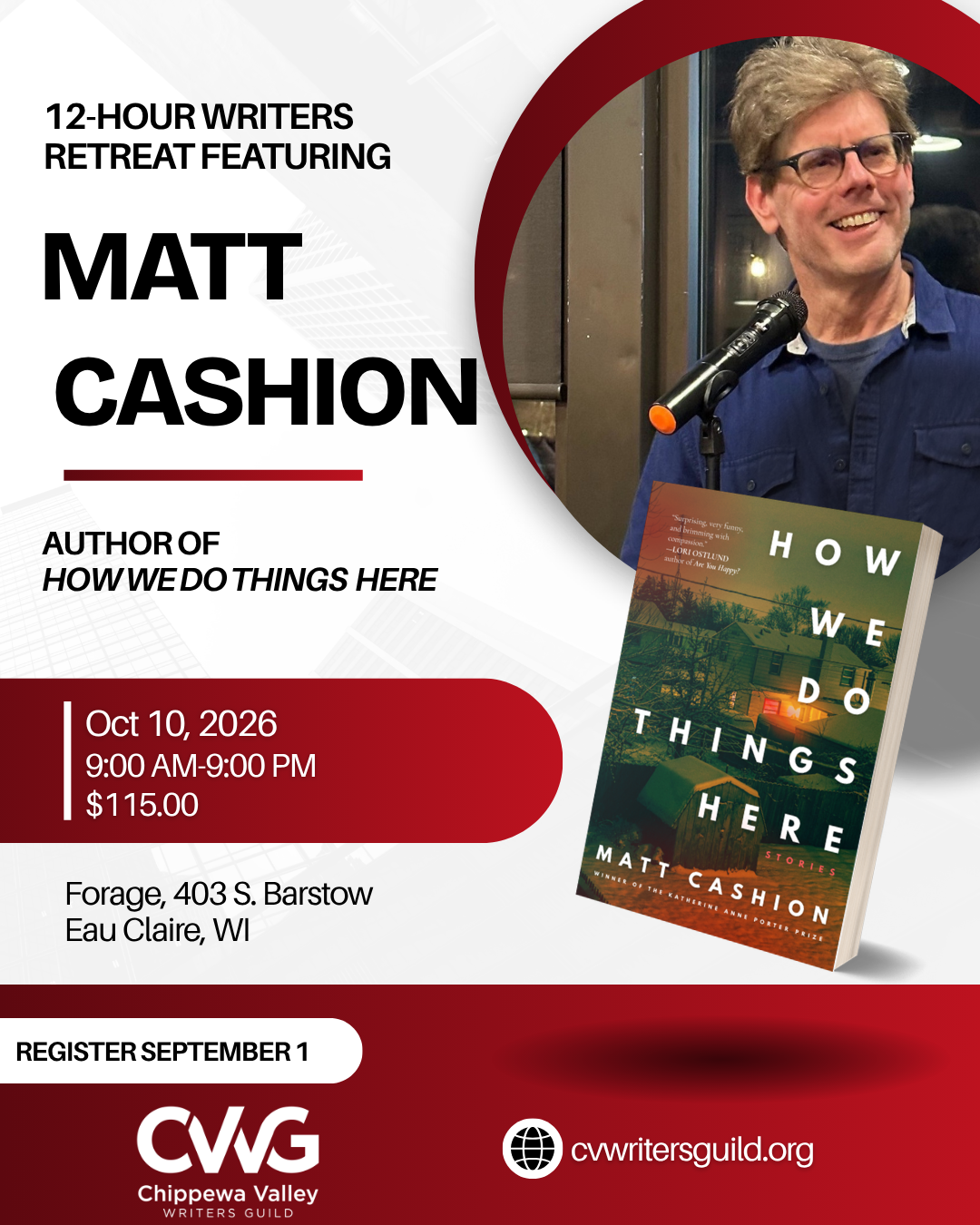
On Saturday, October 10th, 12-Hour Writers Retreat participants will gather for a day of guided writing exercises, freewriting time, and a live reading of their works.
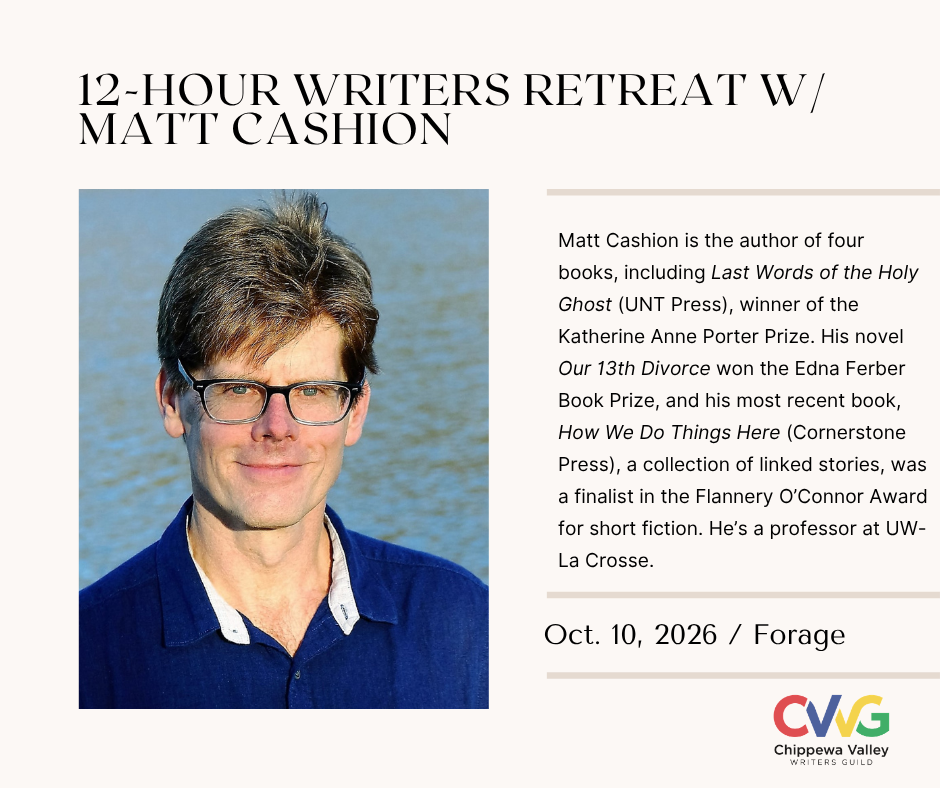
The Writer-in-Residence, Matt Cashion, will serve as a guide and mentor to the participating writers. Cashion is an acclaimed author and Creative Writing professor at the University of Wisconsin-La Crosse. He is the author of two novels, How the Sun Shines On Noise and The 13th Divorce (winner of the Edna Ferber Fiction Award), as well as two short-story collections, Last Words of the Holy Ghost (winner of the Katherine Anne Porter Prize), and How We Do Things Here, which was published in February of this year.
I had the pleasure of asking Cashion what he most looks forward to for the retreat, what collaboration means to him as an author, and how he approaches the writing process, especially during those “messy” first drafts.
Samantha Hasse: Your works seem to often feature a cast of characters with a diverse mix of personalities and perspectives. You are about to collaborate with a group of writers with different life experiences, interests, and work styles. How has building relationships with other creatives influenced you as an author?
Matt Cashion: I need to be inspired by diverse perspectives and unique personalities and artists of all types whose distinct experiences and perceptions are different than my own. I love feeding off the collective energy that fills the air when like-minded creatives get together. I love listening and watching more than I love talking and “performing,” and I always end up feeling enriched by people who care deeply about making something meaningful from nothing—not for profit, but because the making of it itself is what we know best nourishes our souls.
SH: You’ve lived in multiple places - Georgia, North Carolina, Oregon, and now Wisconsin. Has living in the Midwest influenced your writing?
MC: When my wife and I moved to Wisconsin 20 years ago, everything was fresh and interesting and new, which allowed us to be good observers of what was unique about the people and the place. The Driftless area of where we live in western Wisconsin is especially unique; it’s a beautiful and special place. And the weather! Can we talk about the weather? There’s a lot of Wisconsin weather in my latest book, and there are many characters who (as in real life) are quick to help neighbors in whatever ways they can, including shoveling three feet of snow.
The idea of “place as character” is an essential part of every story I write, capturing the complex personalities and histories of places. For a long time I didn’t feel qualified to write stories set in Wisconsin, but after 20 years, it’s home, so I hope I’m writing about Wisconsin with the kind of love and honesty and compassion one might employ when writing about any complex relationship that will continue to mature.
SH: What made you interested in featuring this event?
MC: I’ve long admired BJ Hollars and the CVWG for creating such a genuine community of writers who are thriving in and around Eau Claire. I’m honored to have been invited to participate in the 12-hour Writing Retreat that I know will attract many talented and disciplined writers who are serious about improving their own crafts and even more serious, perhaps, about supporting and encouraging the work of fellow writers.
SH: What do you think makes a good mentor? How do you plan, or hope, to mentor other writers during the retreat?
“My own mentors are great listeners. I try to imitate them in the ways I hear and see the specific strengths every writer is working with as well as the occasional challenges every writer is working to solve. I deeply respect the efforts of every writer who is invested in improving their craft because I know how humbling and challenging it can be. ”
MC: My own mentors are great listeners. I try to imitate them in the ways I hear and see the specific strengths every writer is working with as well as the occasional challenges every writer is working to solve. I deeply respect the efforts of every writer who is invested in improving their craft because I know how humbling and challenging it can be. I avoid being too prescriptive in saying what someone should or shouldn’t do, so I listen to writers’ goals and encourage them to pursue whatever process works best for them. I’m an advocate for writers who (like me) encounter too many doubts along the way. Ultimately, I want to inspire writers to continue working on the stories they care most about, stories only they can write. In these ways, I’m both cheerleader and coach (in one outfit).
SH: In your short-story collection How We Do Things Here, your characters are described as “mess-makers.” How do you approach mistakes and setbacks in the writing process?
MC: I make peace with my own messy process, especially in the first five or fifty (give or take) drafts, when I’m trying to zero in on the voice and tone and real subject matter I’m working to locate as honestly and as precisely as I can. Which takes time. For me, at least. Trusting this process and cultivating the patience I know I’ll need is important as I consistently revise, delete, and develop while simultaneously (somehow) reminding myself to abandon any notion of perfectionism. I may also remind myself to re-embrace some notion of play I want to keep at the heart of what I’m doing that will keep me invested in the challenge of making something interesting for me, first, and maybe for a few readers next.
SH: Can you tell me more about the guided writing exercises?
MC: The exercises I have in mind will allow us to surprise ourselves. I’ll encourage us to generate new material (or to continue working on old material in new ways) by expanding the skill sets we need to write with both vulnerability and imagination. I’ll encourage us to tap directly into our most meaningful experiences and write about them with a level of intimacy readers find rewarding because of the courage required to do so. And I’ll ask us to exercise our imaginations in ways that allow us to build empathy and create connection. There will be freedom and flexibility for writers to pursue what they find most meaningful. Along the way, we’ll play.
SH: What do you hope that the other writers, and yourself, will gain from this experience?
MC: Sharing a day like this with like-minded creative and supportive people will energize us all. Some writers will walk away with new projects they’re excited to continue, some writers will find new levels of inspiration to continue what they’ve already started, and I anticipate walking away feeling deeply enriched from a community of writers who remind us all that the act of writing doesn’t have to be a solitary (sometimes lonely) undertaking. We’ll remind ourselves that we thrive best as humans when we come together to create and to share, and that when we leave, ultimately, we’ll feel excited to continue doing so.
Though tickets are sold out, interested folks can join Matt Cashion and the Chippewa Valley Writers Guild for an open reading at the 12-Hour Writers Retreat at Forage on Saturday, October 10th at 7 PM.