What 2016 Gave Me

Note: This is a great submission from our
January 2017 Scribble writing exercise.

By Jason Spraitz

Maybe I’m to blame. As 2015 became 2016, I made a single plea, “Please let the new year be better than the one just completed.” How could it be worse, I thought.

Professionally, 2015 began with a state budget proposal to slash $300 million from my employer; this was reduced to a cut of only $250 million. Personally, 2015 ended with the Black Friday revelation that my mother-in-law was battling Stage 4 pancreatic cancer. My wife spent the final five weeks of 2015 traveling from our Eau Claire home to her childhood house in western Pennsylvania. I was alone in my living room with a shihtzu on my lap and crumpled McDonalds wrappers at my side when I made my New Year’s Eve proclamation.

One month later, January 31, 2016, I received the call from my wife – my mother-in-law died in her sleep after a short valiant fight. Personal tragedy gave way to professional loss in March when a gubernatorial-appointed board voted to strip true tenure protections from all Wisconsin state university faculty. My colleagues across the state responded by declaring no confidence in system leadership.

All of that happened before the end of May. At that point, I was certain my wish for the new year wouldn’t come true. And, as 2016 concluded, that mid-year intuition was proven correct, thanks to Mariah Carey, no less. I even apologized to a friend for my awry request from a year prior.

But, in 2016, one moment of pure beauty gave me pause and allowed me to forget personal and professional tribulations, if only for a few fleeting minutes.

In early June, I visited Rocky Mountain National Park with my wife and a close friend. We spent a sun-soaked morning hiking short trails near the Bear Lake Trailhead. We circled Nymph Lake and ascended the trail to Dream Lake. At Dream Lake we paused so our friend could cast a few flies, much to the delight of families and young children who passed by us. Continuing past Dream Lake at more than 9,900 feet of elevation we encountered a deepening snowpack, for it was still fairly early in the season. We decided to turn back and meander up a different trail to Alberta Falls.

The trail leading to Alberta Falls peaked at 9,400 feet. Just above the tree line. With the falls rumbling through the gorge to my right, I sat perched on granite that had taken millions of years to get to that moment with me.

Looking north, over the aspen groves and pine forests, to the snow-capped mountain ranges, I forgot about everything. I was caught in a moment in time; entranced by the wonder of the expansive vista in front of me. I felt grand yet small. Inferior as a single speck in 265,000 acres of pristine wilderness. But, powerful for being able to traverse this landscape at this altitude. And grateful, to that place, for its infinite power.

I return to that memory often. When morale drops at work. When elected representatives aren’t representative. When Thanksgiving gave way to Black Friday and the one-year anniversary of my mother-in-law’s diagnosis. Or, when I just want to smile.

It’s during these times that I remember: despite loss and disappointment and anger and sadness, there are places that have withstood all that pain – for millennia – and continue to inspire and provide opportunities for reflection and escape, if only for the briefest of moments.

Despite taking so much, 2016 gave me that, thankfully.

Learning to Write, Again and Paterson

Alex Tronson (center)

Alex Tronson (center)

By Alex Tronson

Dear Past Self,

About a year after you graduate from UW-Eau Claire, you may find that your general willpower to write has begun to slip a bit. It won’t be for lack of time, (trust me, you’ll have plenty of that), but because you’ll be afraid. (Who was it who said there is no such thing as writer’s block, only fear?)

Maybe that sounds silly to you, Past Self, to be afraid of writing. But with time I’m sure you’ll come to understand that it’s a necessary hurdle in any creative process, and you’ll learn to overcome it. Which isn’t to say you won’t be writing at all during this time, but surely not as much as you once did, and surely not as well. Right?

During this time, you’ll remember your writing workshops, and how there was always a consistent source of feedback. You were never more than a few weeks away from finding out what was wrong with your work. Even if you didn’t always agree with your peers, there was still a supportive group of like-minded individuals committed to helping you improve your craft.

But when you graduate, Past Self, it will be intimidating to write on your own. Until you’ve embedded yourself in the literary community, how will you know if your characters are underdeveloped? Or if your narrative is too slowly paced? Or if your dialogue is unrealistic? You will find yourself asking these questions often, creating a disconnect between your ambitions and your execution. You won’t have trouble getting butt-in-the-chair, (again, trust me, you sit a lot) but you will struggle with overcoming the fear of writing a bad story.

All right, Past Self, allow me to pivot for just a moment to inspiration, which you already know we cannot wait for, but have to find for ourselves.

Sometime in the future, you will pinch your jacket shut against the cold (the zipper on our favorite jacket will be broken) and you will go out to see the new Jim Jarmusch film called Paterson.

The film shows a week in the life of Paterson, a bus driver living in New Jersey, with his wife, Laura and their English Bulldog, Marvin. Paterson drives around, eavesdropping on passengers—a pair of lonely construction workers, two anarchistic college students—and when he finds some time, he breaks out the small, moleskin notebook to write poems, though he does not show these to anyone. (This will feel very familiar to you, Past Self, just wait.)

As someone currently struggling with maintaining a proper work ethic, you will find Paterson to be exactly the kick in the pants you need to begin journaling again, which will then fuel your next poems and short stories. The film will reinforce things you once knew to be true, but had forgotten. That writing can serve as a reflection, an interpretation of the little things, the day-to-day moments and adventures that make us feel the most human.

Though maybe, at this moment, a film won’t do the trick for you. Perhaps a trip to the museum is in order, or a good and spontaneous conversation with a stranger or a friend. Perhaps you need only to put on a good record (try Otis Blue) to find some inspiration. But in the future, this film will help you. And though it may not be the classroom full of inspiration you and I are used to, you can rest assured that everything will be all right, because, Past Self, we will learn to write all over again, and that’s going to be just fine, as long as we let it be.

Sincerely,
Your Future Self

P.S. Oh, and you should probably start jogging again.

Nature Nurture: A Celebration of the Arts and Environment

John Hildebrand

John Hildebrand

by Jeana Conder

On Tuesday, February 28, writers B.J. Hollars, John Hildebrand, Steve Betchkal and Dr. Kathie Schneider will be hosting an evening of reading and conversation on the importance of nature, art, and the convergence of the two for the benefit of both. This celebration will be held at 7:00 pm at the State Theatre. Price for attendance will be $10, and all proceeds will go towards the local Sierra Club Chippewa Valley chapter and the Eau Claire Regional Arts Council. In addition to reading and conversation, a cash bar will be available, and a book signing will follow the celebration.

"This is really a great opportunity for our community to come together in common cause," said Hollars, the event's organizer. "Here in the Chippewa Valley, we value the environment and the arts, and this is a night to come together to celebrate and defend them both." Hollars himself will be reading out of his new memoir, Flock Together: A Love Affair with Extinct Birds. John Hildebrand will also be reading from his novel, The Heart of Things.

The Nature Nurture event is a great way to celebrate the arts while also supporting the beautiful environment the Chippewa Valley is known for. The celebration is a great opportunity to meet and listen to local authors while also enjoying conversation over a few drinks. Tickets can be purchased online at the Eau Claire Regionals Arts Center website.

We hope you’ll keep warm with us at the State Theatre on February 28.

Scribble (January): “The Great Dumpster Fire of 2016”

Each month we’ll offer a low-stakes writing prompt applicable to all genres. Upon completing the prompt, send your piece (500 words or less please) to chippewavalleywritersguild@gmail.com for potential publication in next month’s newsletter!

Without further ado, here is your January Scribble challenge...

It’s official: dumpster fire, including its associated trashcan and fire emojis, has been declared by the American Dialect Society to be the 2016 Word of the Year. The ADS defines dumpster fire as “an exceedingly disastrous or chaotic situation,” and if there’s one thing we can collectively agree on in 2017, it’s that 2016 was a bit of a dumpster fire. But somehow, we subdued the flames long enough to find moments of peace, progress, and dare I say it, joy. 

As we move into this next year of ours, your task is to reflect on a time in 2016 that you were able to find a moment of good in a difficult situation. Savor it. Write about it. And don’t just send it to us—share it with your friends, family, and community. We could all use a reminder that even through the fire, it is, after all, our dumpster. 

Image: Timothy Wildey, CC 2.0

The Power of Poetry: How to Be an Advocate Through Your Writing

Rebekah Palmer

Rebekah Palmer

By Rebekah Palmer

When I was 14, I started keeping a composition notebook I used to write down everything I felt and knew about current events in the world. I had written about my day to day activities in journals before, but there was a different feel about this blue lined, wide margined notebook that housed thoughts beyond my personal experience. Suddenly my world expanded. I found myself writing about the September 11th attacks, the treatment of veterans, and other issues I wanted to advocate for as an American teenager.  

Several years later, while taking a creative writing class taught by professor Karen Loeb at the University of Wisconsin-Eau Claire, I started another notebook. This one centered on issues I had kept hidden in my heart in high school: sexual assault awareness and living as a single woman in 21st century America. 

The scrawls within those notebooks I kept as a younger person would become the rough drafts for the advocacy poems I used in my first and second books.

If you’re unfamiliar with the genre, an advocacy poem includes lyrics on causes, events, effects and news that lack adequate public awareness. Advocacy poems can be written about anything in the world that the poet wants to provide a different perspective on, call more attention to, or create new solutions about. 

How do you write an advocacy poem? Here are a few good tips:

  • Seek out resources that agree and disagree with your position, especially thoseabout how an issue is handled specifically in your community. This will help you garner better specifics and empathy in your advocacy writing. 
  • Attend rallies and events for the causes you want more awareness on.
  • Free write in a notebook exactly how you and others see, define and feel about the cause. 
  • Free write about the atmosphere and happenings at any gatherings you have attended. 
  • Write down personal memories and/or interviews from others that could help explain your stance to your readers.
  • When writing your poem, try to answer these questions: Is there a physical metaphor I can liken the way I see this issue to? Is there a rhythm to my feelings and thoughts about this issue, and what stanza form will make a reader hear my message the way I hear it? Do the words I have written down remind me of a certain smell, touch or taste?
  • Use your memories and the answers to these questions on your five senses to create a poem in which the reader can really experience your perspective on the issue you have chosen to champion.
  • Have other writers check your work, especially other writers who have already written in different genres on the subject you have chosen.

Above all else, never underestimate the power of poetry. Use the form to spread your voice far and wide. Be heard.

Writing Through the Excuses: The Story of a Writer and Her Cat

The cat in question.

The cat in question.

By Erin Stevens

Two months ago, I adopted my first child. Weighing in at 15.5 pounds of fur and sass, Murphy (or Murfreesboro if he’s in trouble), has changed my life forever. His adoption was a long time coming. The truth is, I’ve been a self-proclaimed cat lady for as long as I can remember. It’s not uncommon for me to receive one (or more) cat-related gifts for Christmas or my birthday, and it’s no surprise I’ve found and befriended multiple cats from the Uptown neighborhood of Minneapolis. 

What is surprising is the amount of time it took me to adopt a fur child of my own. Two and a half years ago, I graduated from UW-Eau Claire, packed up my things, and headed to the Twin Cities. The first question my friends asked was: When are you going to get a cat?

My answer? When I get more settled in my job. And when that job wasn’t working out? When I find a new job, I’ll get a cat. And when I did find a new job? When I find a better paying job and have a bigger apartment, that’s when it’ll happen. 

For months, I’d spend my lunch breaks playing with the cats at the humane society, but my visits always ended with me leaving, no cat carrier in hand. 

As I walked back to work one day, it occurred to me that my delayed entrance into cat parenthood wasn’t the only thing I was making excuses about. 

I graduated from UW-Eau Claire with a degree in creative writing, but with how little I’ve written in the two years since I graduated, you wouldn’t know it. Aside from a blog I updated once a month, I wasn’t writing much else. Similar to the whole cat adoption (or lack thereof) situation, the excuses flowed. 

When I get my first job, I can focus on writing again... 

Once I’m done searching for a new job/writing cover letters I’ll blog again…

When I find a less writing intensive job, I’ll have more energy to write short stories…

Because I love writing, I kept telling myself that it needed to take a backseat to the more urgent things that needed to get done (namely finding a good, solid job).

In short, with both my writing and adopting a cat, it wasn’t the right time. Even though they are both things that bring me a great amount of joy, they were luxuries that I didn’t think I could afford. There were a million excuses that I could come up with that would show the conditions and circumstances weren’t right.

After a while, though, I realized I would always have these excuses. There would always be a reason to not sit down and write the essay, always some excuse that it wasn’t the right time to adopt a cat. Too often we put off doing what makes us happy. We say the circumstances aren’t right. We say we’ll start on Monday. We say we’ll start doing what we love in the New Year. We put off doing what we love. The conditions aren’t always going to be perfect, but if it’s what you want, you need to make the conditions work for you.

So when I landed my current job, I started looking on the humane society’s website for my fur child. A few months later I came across Murphy’s profile, and I knew it was a done deal. The conditions weren’t perfect—he was at the animal shelter almost an hour from my apartment and he was also sick when I got him. However, adopting Murphy has been one of the best decisions I’ve ever made, partly because he’s adorable and I like him more than most people. The other part is that he’s actually helped me get back into a writing routine. 

He doesn’t put up with my excuses. When my alarm goes off at 5:30 AM so that I have time to write before work, I don’t have the option to hit the snooze button. As soon as the alarm sounds, Murphy uses my body as his own personal trampoline. It’s hard to ignore a 15.5-pound cat standing on you, especially when said cat moves his paw to your neck and cuts off your air supply. Additionally, when I come home from work and I’m distractedly updating my blog while watching Parks and Rec, he’ll sit in front of the TV until I refocus on my writing.

If Murphy’s taught me anything, it’s that the conditions for anything won’t ever be right. 

But now I’m willing to make them work for me. 

7 Questions with Max Garland

By Alison Wagener

Our “7 Questions” series has become a bit of a staple in the monthly CVWG newsletter, and in the coming months, we’ll be dedicating these local author featurettes to our esteemed and beloved 2017 Cirenaica summer residency leaders. 

Returning this summer to head our poetry residency is local literary advocate and poet Max Garland. When your audience consists of Chippewa Valley writers, it seems hardly necessary to give Max a formal introduction, but for those of you who don’t know, Max served as Wisconsin’s Poet Laureate from 2013-2014 and was appointed for a two-year term as Eau Claire’s Writer in Residence last April. He’s published two books of poetry, was an English professor at UW-Eau Claire from 1996 to 2015, and continues to provide us with accessible poetic commentary on a world that often seems just out of reach.

Over the holidays, I had the chance to ask Max about his writing, his work, and his reflections on Cirenaica for a brief but insightful interview. 

Did you always know you wanted to devote your life to writing and promoting literature?

No. I originally wanted to play shortstop for the St. Louis Cardinals, but Ozzie Smith turned out to be more qualified, so like many other mediocre athletes, I fell back on poetry. 

Who (or what) most influences your writing?

I think hearing hymns and sermons in childhood, then discovering later that poems were like that-- attempts to say something slightly beyond the ability of words to say. 

What was most memorable for you about your Cirenaica residency last year?

The generous range of experience among those who attended and how well the participants interacted regardless of their differing levels of experience. Also, I was impressed by the amount of writing the residents did. When I arrived early in the mornings, everyone was already writing, sometimes four or five people sitting in a large room, at tables, on couches, some outside, some upstairs, but all quietly working on new poems, or revising poems from the previous day. 

Is there anything you’re currently working on?

I'm revising a new book of poems called The Word We Used for It. I'm also writing songs and essays, and trying to figure out how to stay calm in exceedingly alarming times.

What do you hope your readers gain from reading your work?

I hope people feel something, and recognize that a poem can be a very strange and yet strangely useful thing once readers assume partial ownership. 

What do you find most purposeful as Eau Claire’s Writer in Residence? As Wisconsin’s Poet Laureate?

Poetry is not as far away as most people think, nor as far from the practical concerns of ordinary people. It's so important and potent we often pretend we don't feel the need for it. But try and find someone who hasn't wanted better words, more beautiful or profound language, and you'll be looking a long time.

What’s the hardest facet of writing? Which do you look forward to the most?

The hardest part of writing is granting yourself permission, and then doing it again and again until the habit is part of who you are. 

Photo: Lisa Venticinque

Recap: 'Joy to the Word' Open Read

By Karissa Zastrow

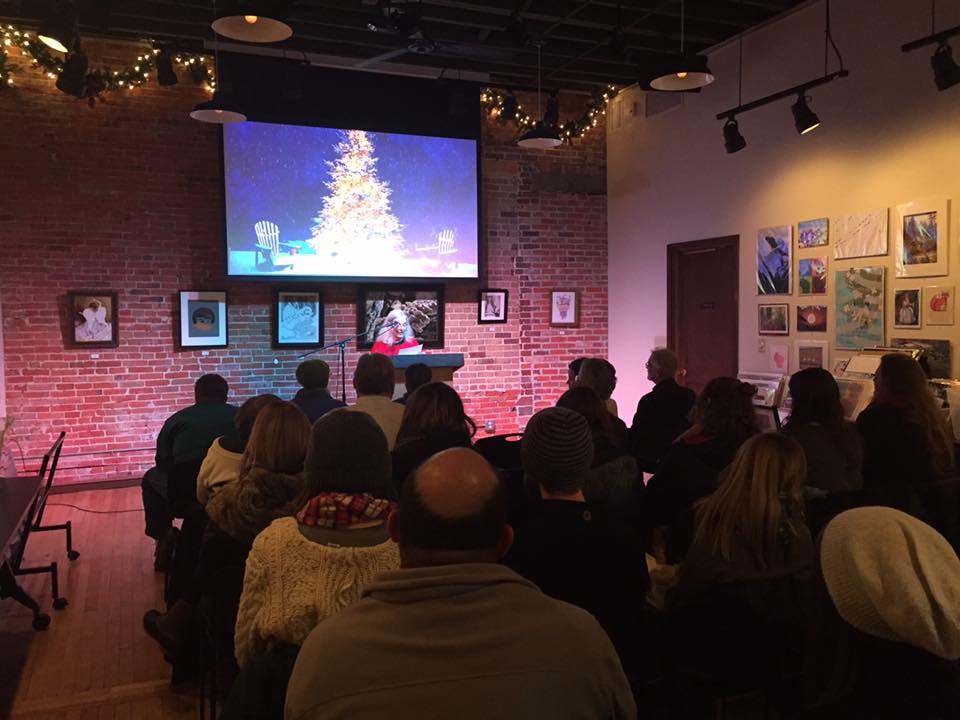
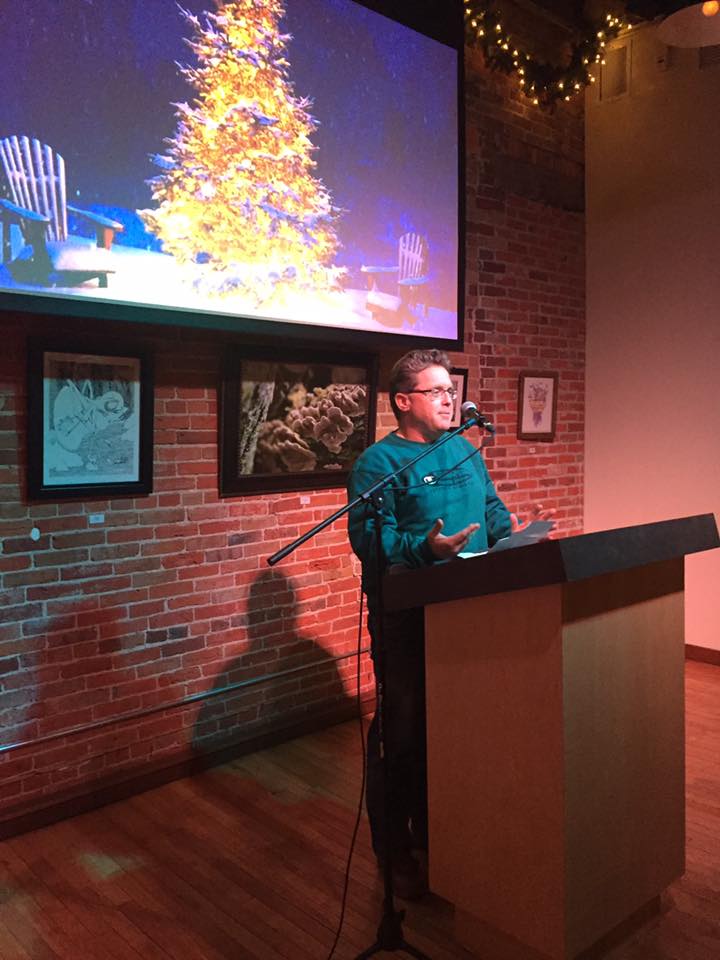
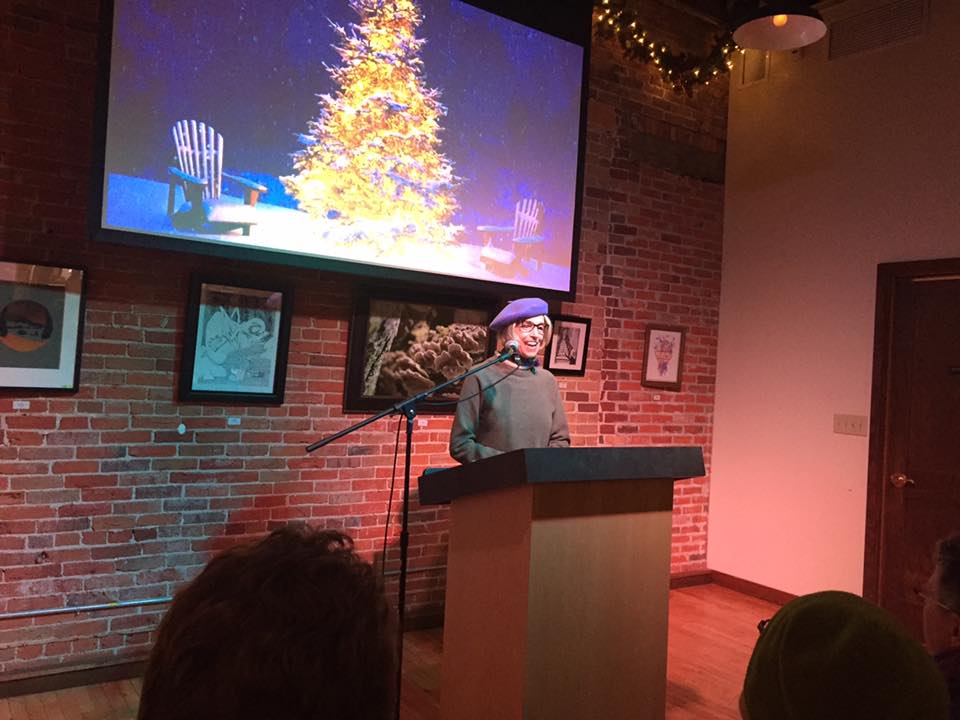
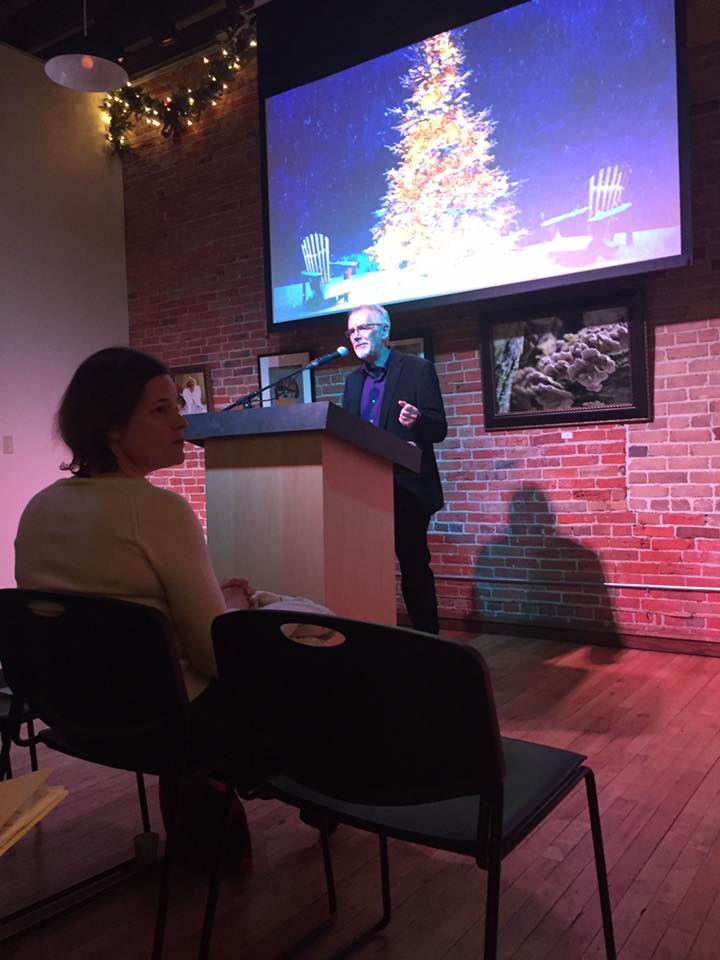
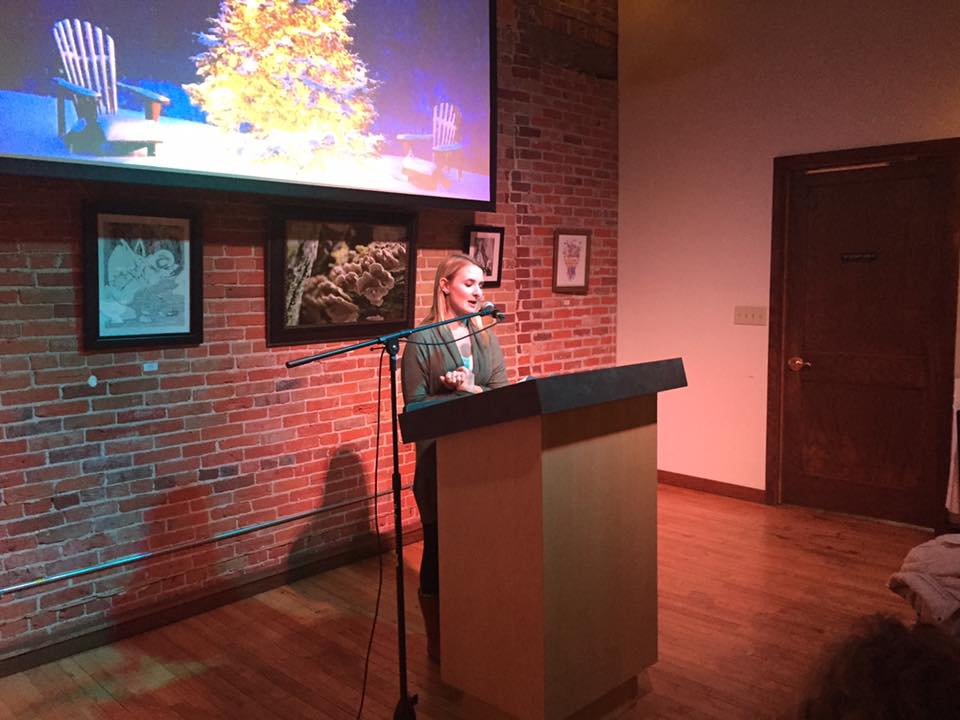
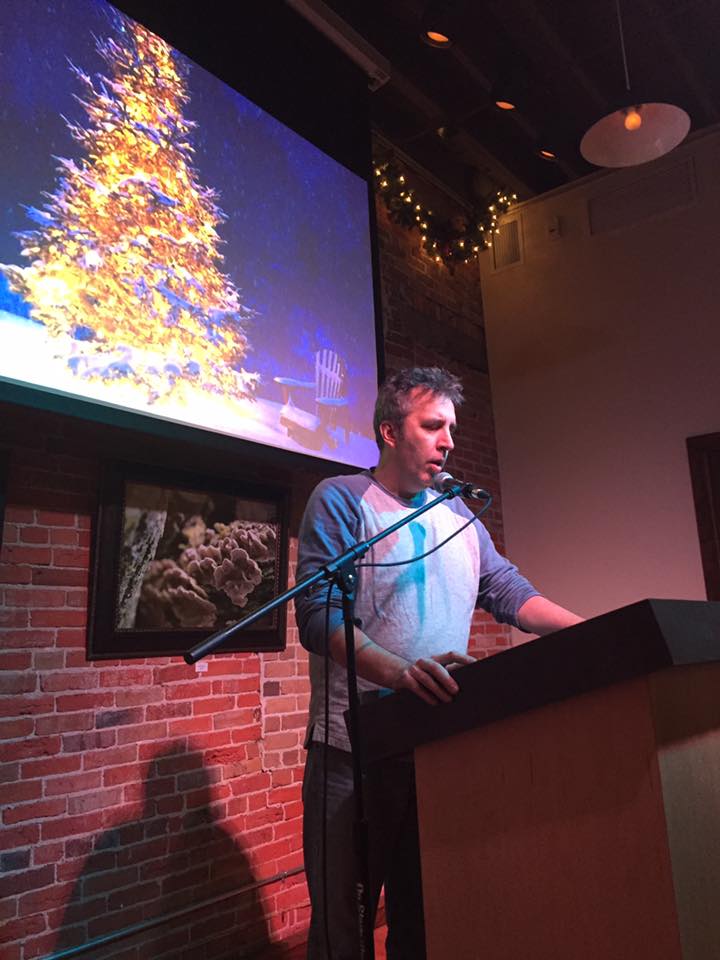
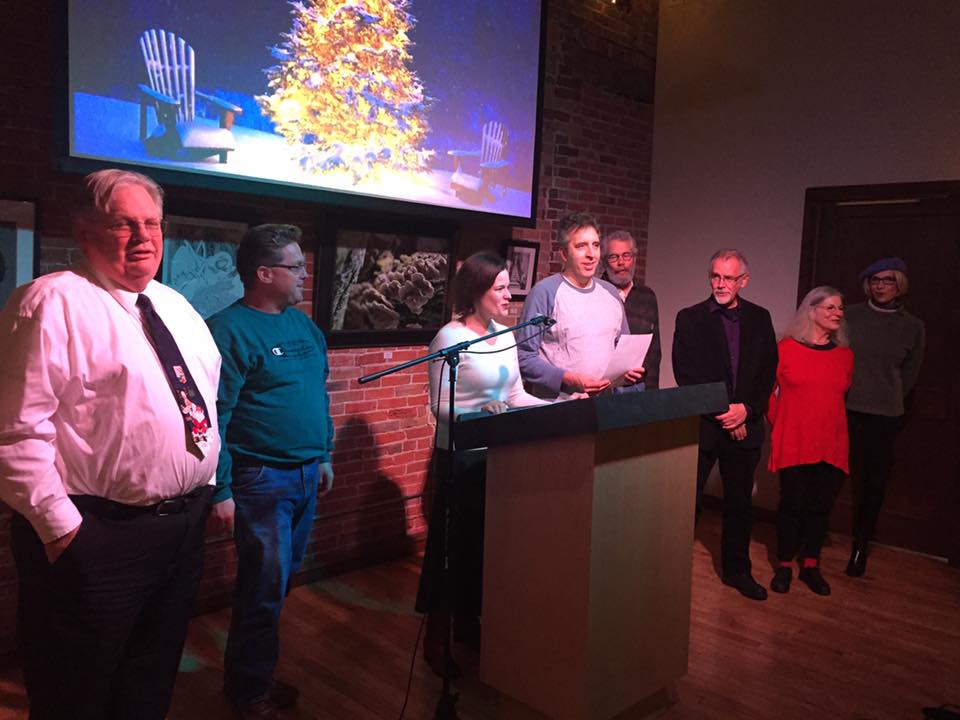
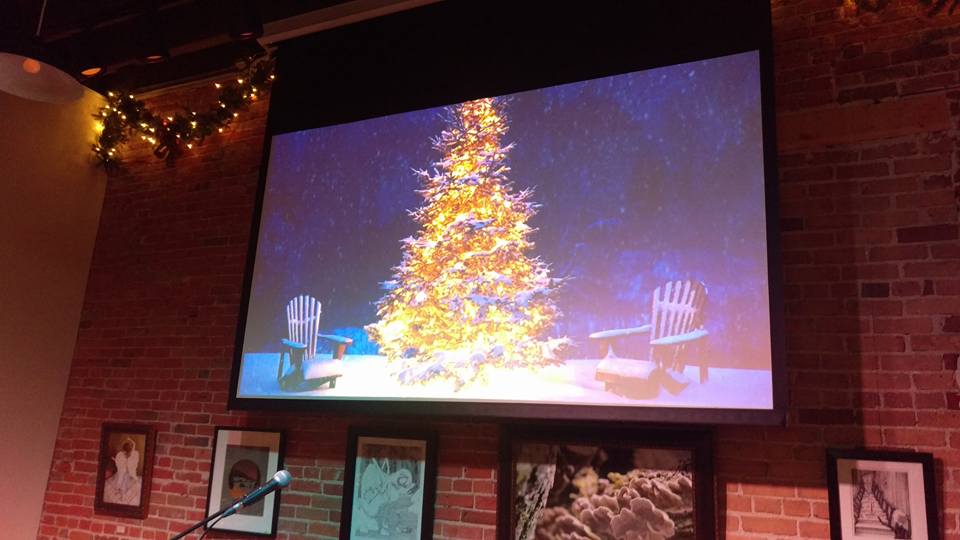
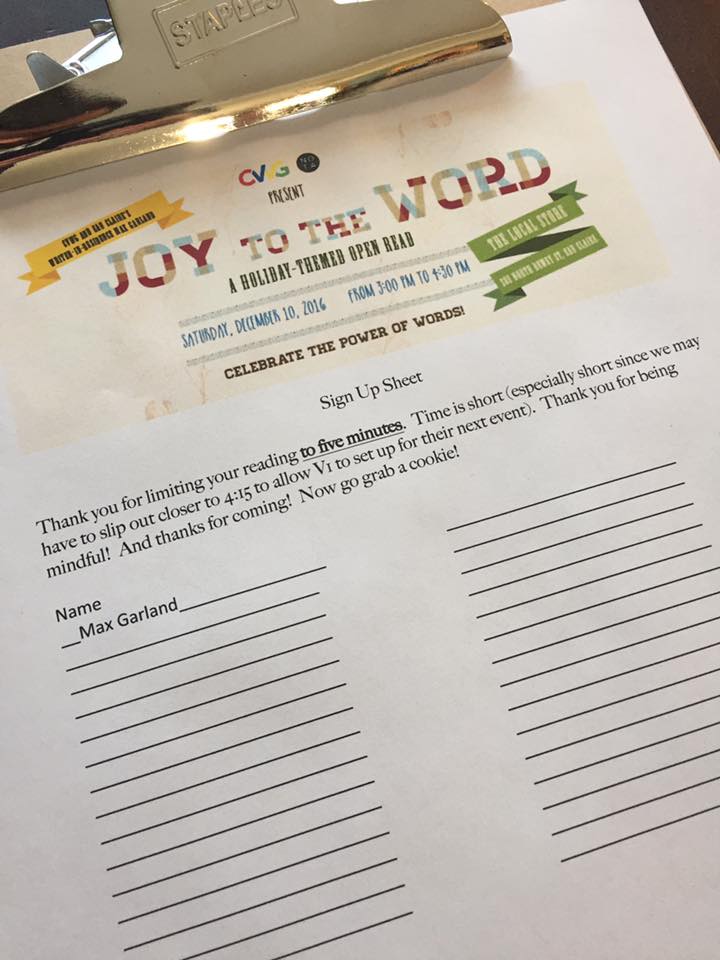
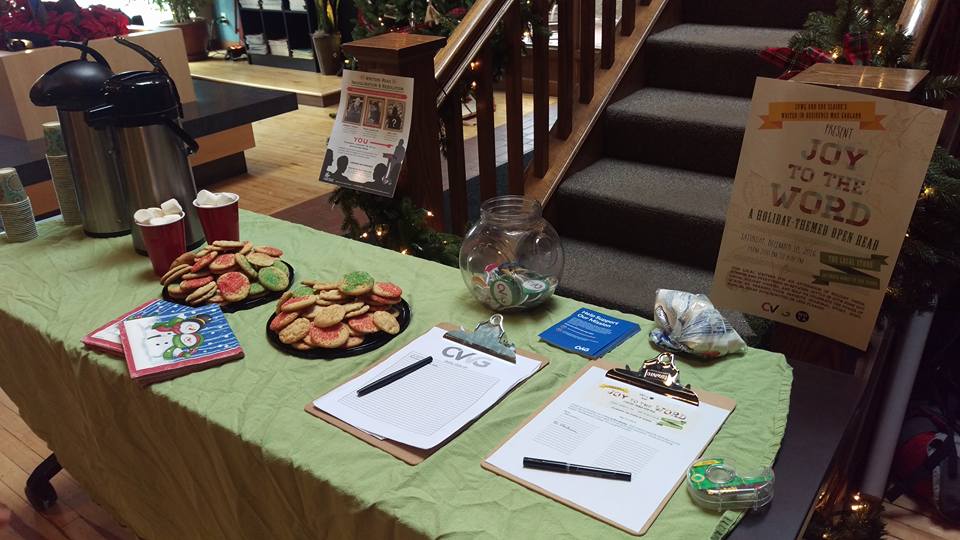
On December 10th, a snowy Saturday in Eau Claire, the Chippewa Valley Writers Guild hosted a holiday themed open read in the hopes of spreading holiday cheer. Those who braved the cold weather were greeted with a smile, hot chocolate, and an assortment of cookies. To make the gallery more festive, a video of a lit up Christmas tree, silently standing in the snow, played behind the podium. Starting off the event was Max Garland, who recited Robert Frost’s “Stopping by Woods on a Snowy Evening”—a poem, and sight, many of us are familiar with—before sharing an original poem. Fellow readers shared their own work, and their pieces ranged from past holiday articles and stories of holiday traditions to a raccoon in a freezer and the importance of Christmas trees in making memories. Allyson Loomis wrapped up the event by telling a story based on her own experiences of Christmas with her family in Los Angeles, and she ended her reading by inviting everyone to sing “White Christmas” together. Leaving the event, everyone felt closer, more inspired, and ready for the holidays! 

Happy holidays from the Chippewa Valley Writers Guild, and happy New Year!

Making Sense of the Music: Notes from our November Craft Talk

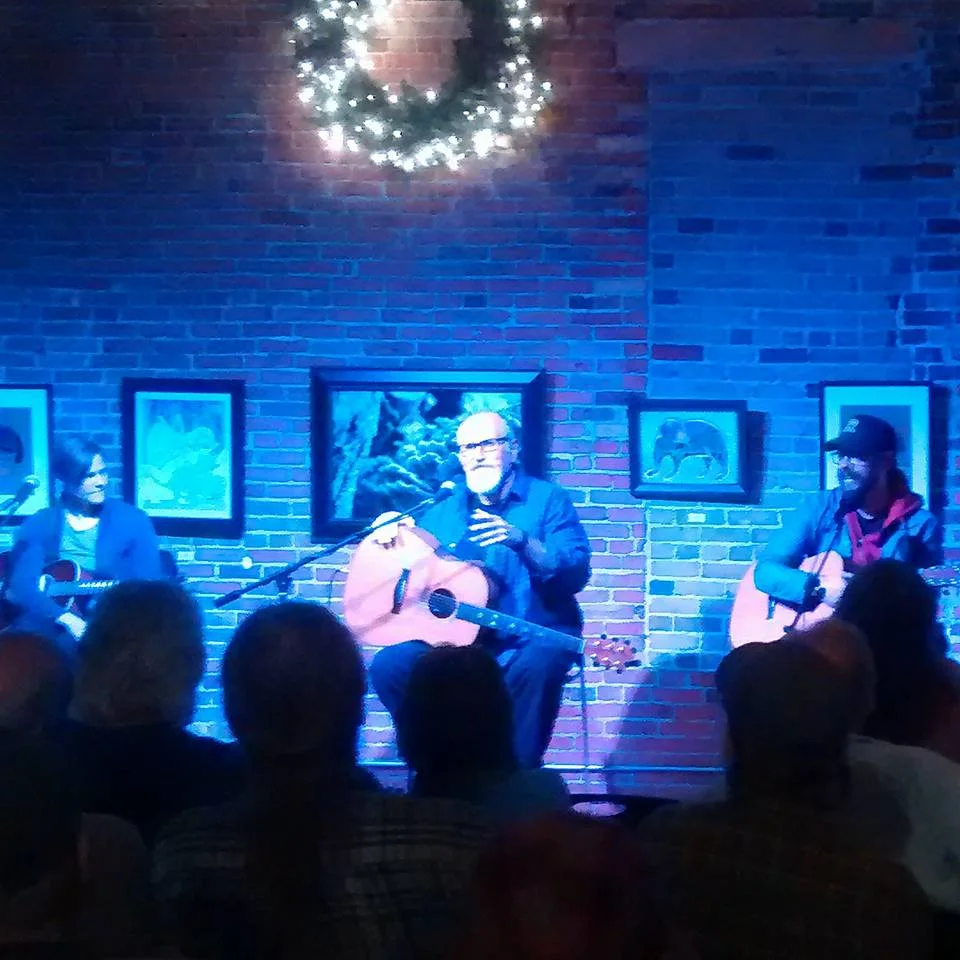
Writing comes in all different forms, but perhaps the most mysterious is song writing. How musical melodies intertwine with poetic lyrics has long captivated curious audiences. In “Where Songs Come From,” our November Craft Talk facilitated by Max Garland, the Chippewa Valley Writers Guild set out to uncover the art behind song writing by inviting three local artists to share their songs and discuss their origins. The talk featured Jerrika Mighelle, Billy Krause, and Evan Middlesworth—all accompanied by their acoustic guitars—to help the rest of us understand this fascinating art form.

Jerrika Mighelle, who plays in sister band QuinnElizabeth in addition to her solo career, was the first to take to the mic with her song, “Where Are You Now?” When writing a song, Jerrika explained, she starts with chords she knows well, and then finds a riff that captures her attention.  The lyrics, she noted, come later. After sharing her second song of the evening, “Take My Hand,” Jerrika explained that many of her songs are rooted in personal experience, many involving the search for goodness and truth in life. At the same time, she always keeps the listener in mind.  It’s crucial, she noted, to make a connection with the audience and make them feel the emotions she relays in her songs. 

Next, Billy Krause shared two songs—“Smoke and Mirror” and “A Ballad of Farewell— and discussed his song writing methods. For Billy, the process is simply to listen to the music constantly playing in his head and wait for a bit of it to stick. Serendipitously, the music just “happens”, and then he starts to feel it out with chord progressions on his guitar. Much like Jerrika, Billy’s lyrics follow the music, many of them scrawled on scraps of paper he collects and sorts through later. He tends to write about love or life lost, and like Jerrika, strives to connect with the audience through his work. 

Closing the Craft Talk was Evan Middlesworth, who played “Holy Ghost” and “LoLo Anne,” songs that touched on losing a loved one and falling in love. Evan described his writing process as a meeting of the subconscious and the conscious, what he said was “kind of like having a dream, and then when you wake up, you can’t explain it to someone else.” Typically, lyrics come to him when he’s doing mundane things like mowing the lawn, and as he continues to do these mundane things, he writes in his head. Later, when the music comes, he tends to underscore to the lyrics to create the song’s atmosphere. 

While each musician had different techniques for writing songs, after listening to the fruits of their labor and their insights on where their songs come from, we’re closer to understanding the process. So start strumming those chords and writing down the random lines that pop into your head.  Maybe we’ll see you on stage one day!

From the TC to EC: 5 Reasons Why I’m Heading to Eau Claire for a Writing Retreat

By Erin Stevens

I’m a proud resident of the Twin Cities. I’m also a proud alumna of UW-Eau Claire. Because of this, I’m often torn when I try to decide where I’m supposed to be. While I have many friends and a great job in the Twin Cities, my heart and my writing community are in Eau Claire.

So when I heard about the Chippewa Valley Writers Guild’s first ever Winter Writers' Weekend being held on February 4th and 5th, I knew that I needed to be there.

This might strike you as odd一why is someone from Minneapolis jumping at the chance to head over to Eau Claire for a writers’ retreat? There are plenty of reasons - too many reasons, actually一but here are the 5 that stand out most to me:

1. This retreat is unique to the area. Whether you’re from Eau Claire or the Twin Cities, Madison or Milwaukee, there really isn’t a program like this anywhere else in Wisconsin or the Twin Cities metro area. How many places do you find the chance to have a weekend writing getaway at a new, boutique hotel, with high quality writing instruction? Having lived in the Minneapolis area for a few years now, I can say I haven’t found any opportunities quite like the programs put on by the Chippewa Valley Writers Guild. This winter writers’ retreat is no exception, it’s truly one-of-a-kind.  

Having lived in the Minneapolis area for a few years now, I can say I haven’t found any opportunities quite like the programs put on by the Chippewa Valley Writers Guild. This winter writers’ retreat is no exception, it’s truly one-of-a-kind.

2. Quality of Instruction. As a graduate from UW-Eau Claire’s creative writing program, I’ve had plenty of opportunities to learn from BJ Hollars. While I spent some time heckling him from the back of a classroom, I can wholeheartedly say that his instruction is one of my fondest memories of my time at UWEC. My writing drastically improved through classroom lectures and one-on-one writing conferences, so when I saw that he was going to lead this winter writing retreat, signing up was an easy decision. I’ve also had the opportunity to work with both Jamie and Charlotte, and so I know that feedback and advice  from both of them will also be incredibly valuable. Whether you’re new to writing or you’re in the middle of your third novel, your work is in good hands with the folks running this show!

3. The Oxbow. I’ve been following their Instagram account for a few months now, and I’ve been dying to get inside ever since. The decor in the rooms and lobby are inspiring and inviting, and  the food looks amazing, as well. Not only is this boutique hotel a great addition to Eau Claire, but, by hosting the CVWG’s first winter writing retreat, they’re proving to be a friend to our arts community, which was enough to make me hit the “submit” button on my application. The cost of the retreat includes one night's lodging at The Oxbow, two great meals, a snack, a drink ticket, in addition to live jazz in the evening. What more could you ask for? (What's that?  You want a record player in your room and a vinyl lending library curated by Justin Vernon?  Good news!  You get that too!  Pretty cool hotel, right?).

4. Read and Have Your Work Broadcast. If you love listening to books on tape, imagine listening to your voice reading your work back to you. That’s exactly what’s going to happen when you sign-up for the winter retreat. Blugold Radio一the hippest station in town一will be at The Oxbow during our reading, and they’ll be broadcasting your work to the world.  How often do you get to start the day with an idea and end it with a public reading to be broadcast to the region?

5. Writing Community. In the big city of Minneapolis, I’ve found a lot of things. I’ve found my favorite coffee shop with a great, worn-in couch that’s perfect for tea, a good book and a rainy day. I’ve found two amazing independent bookstores that, between the two of them, I can find whatever it is I’m looking for. I’ve also found a great job. And yet, after trying a creative writing course in downtown Minneapolis and scouring the Internet for other writing organizations or groups in the Twin Cities, I haven’t found anything that comes close to the community that exists through the Chippewa Valley Writers Guild. The writers in the CVWG community are not only immensely talented, but they’re supportive and radiate positivity, which is unlike anything I’ve experienced in the Cities. This community alone is worth a trip across the state line.  

So what are you waiting for? Spots are filling fast, so click here and reserve your seat, today!

HAPPY HOLIDAYS! A special note from Guild Director BJ Hollars ...

Greetings Writers!

BJ Hollars

BJ Hollars

Inspired by the warmth of this holiday season, I wanted to take a moment to thank you for your continued support of the Chippewa Valley Writers Guild.  Thanks to you, the CVWG is now wrapping up its most active season to date.  This fall, we’ve hosted three standing-room-only Craft Talks, featuring: literary agent Erik Hane, National Novel Writing Month municipal liaison Aimee Johnson, and a lyrics writing symposium (complete with live music!) hosted by Max Garland and featuring Jerrika Mighelle, Evans Middlesworth and Billy Krause.  We’ve also produced a live, radio drama version of the 1938 classic War of the Worlds (subsequently aired on BluGold Radio!), as well as organized countless write-ins throughout the city.  In addition, we’re currently hard at work on two new major initiatives: a literary magazine for the Chippewa Valley, as well as additional radio drama opportunities for local writers.  It’s been a whirlwind, to be sure, but what a glorious whirlwind it’s been!

I wanted to cordially invite you to our final event of the fall season: “Joy to the Word: A Holiday-Themed Open Read” which will take place at The Local Store on Saturday, December 10 at 3:00p.m.  Please join us for cookies, cocoa, and the chance to share your favorite original holiday-themed work, or even work written by another.  (To ensure that all can read, please keep your piece to five minutes or less!)

In more exciting news, the Guild is currently putting the finishing touches on next year’s summer residency schedule at Cirenaica.  Trust me—it’s quite a lineup.  We’ll announce the schedule at the start of the new year, but for loyal contributors who make a donation of any size between now and December 17, you’ll receive a pre-announcement email a few days in advance.  It’s just our way of saying thanks to all of you who give so generously so that our events can remain free and open to the public. 

Our philanthropy philosophy is pretty simple here at the Guild: when it comes to giving, participation is our goal. If we all give a little, no one needs to give a lot.  And that’s all we’d ever ask for: a little.  Consider becoming a 5.00/month sustaining member and take pride in knowing that you have personally sponsored a Craft Talk to be enjoyed by all.  Or make a one-time donation and have the satisfaction of knowing that you have contributed meaningfully to our high-impact programming. Though you’re surely being inundated with many worthy causes asking for your end-of-the-year, tax-deductible gifts, please take a moment to consider the Guild.  Your Guild.  And let us grow it together.

To make your gift, please go to www.eauclairearts.com/donate.  Scroll to the bottom of the page and direct your gift either to the Chippewa Valley Writers Guild's Annual Membership or Sustaining Membership campaign.  

Be inspired.  And thank YOU for inspiring us.

Yours,
B.J. Hollars
Director, Chippewa Valley Writers Guild

Scribble (November): “Holiday Eats”

Image: hildgrim, CC 2.0

Image: hildgrim, CC 2.0

Each month we’ll offer a low-stakes, writing prompt applicable to all genres. Upon completing the prompt, send your piece (500 words or less please) to chippewavalleywritersguild@gmail.com for potential publication in next month’s newsletter!

Without further adieu, here is your November Scribble challenge:

There’s no denying that while getting together with family and friends is a huge bonus of the holiday season, we all know what the real star is here: the food. From the steaming stuffing to the just-perfectly-crisp turkey to your grandma’s secret-recipe sugar cookies that only come around once a year, holiday food always seems to take on a unique level of perfection. Maybe it’s the nostalgia. Maybe it’s the warmth of being surrounded by your loved ones. Or maybe it’s just that good. 

Your task this month is to write the most descriptive, vivid poem about a holiday meal of your choice. 

At a Glance: Upcoming Opportunities to educate, collaborate, and celebrate

The Local Store. Image: Volume One

The Local Store. Image: Volume One

Where Songs Come From: A Songwriter’s Craft Talk

Whether you have a song in your heart that you just can’t seem to get onto paper, you’re a bona fide lyrical pro, or you fall somewhere in between, this month’s Craft Talk is for you. 

At Where Songs Come From: A Songwriter’s Craft Talk, three prolific local songwriters, Billy Kraus, Jerrika Mighelle, and Evan Middlesworth will share some of their songs and discuss the perils and pleasures (but also the nuts and bolts) of songwriting, using examples from their own recent compositions. The event will be held Nov 17 from 6-7:30pm at The Local Store and will be moderated by Eau Claire Writer-in-Residence Max Garland.

Calling all poets!    

As part of its year of centennial celebrations, UW-Eau Claire is holding a poetry contest. The UW-Eau Claire Centennial Poetry Competition is accepting submissions of original poems on the theme “Reflections on Education” from now until Dec. 31. Judging the competition is Max Garland, UW-Eau Claire professor emeritus of English, former Wisconsin poet laureate, and Eau Claire’s Writer-in- Residence. The winners will be announced at the 2017 Frederick G. and Joan Christopherson Schmidt Robert Frost Celebration of American Poetry in April, where they will then read their winning poems. Cash prizes are available for first, second, and third places. The competition is sponsored by the UW-Eau Claire Foundation, English department, and McIntyre Library.

Click here for more information on the UW-Eau Claire Centennial Poetry Competition, or contact Greg Kocken at kockeng@uwec.edu

Joy to the Word

This holiday season, treat yourself to an afternoon of holiday cheer, hot cocoa, and the company of local writers. On Dec. 10, The Local Store will host Joy to the Word: A Holiday-Themed Open Read from 3-4:30pm. Come celebrate the magic of the season and the power of words by sharing a favorite seasonal story, song, poem, or essay. The event will feature Eau Claire Writer-in-Residence Max Garland. 

Foster Gallery exhibit showcases intersection of fact and fiction

Fauxtography.jpg

by Alison Wagener

Every picture tells a story. But what happens when that story strays from the truth – perhaps so far that it becomes a truth of its own?

That’s what UW-Eau Claire archivist Greg Kocken, associate professor of English B.J. Hollars, and associate professor of photography Jyl Kelley set out to discover. And at their UWEC Foster Gallery exhibition, “Fauxtography: Real Photos, Fake Stories, and the Intersection of Fact and Fiction,” you can too.

The exhibition consists of 16 photographs from Daniel Nelson and Charles Van Schaick, both turn of the 20th century western Wisconsin photographers. Displayed under each photograph is a story, written by Hollars, that features the picture’s subject. To make the experience even more immersive, the team recruited several community members to read the stories aloud. 

But while writing these stories came naturally to Hollars, pairing fictional, inaccurate information with historical photos was a departure from Kocken’s everyday work.

“That’s the difficult thing to wrap my mind around, still. Partly because my training is as a historian, and this goes absolutely against everything that a historian would do,” Kocken joked. “I think we’re really trying to challenge the viewer to question what they see.”

In 2011, Kocken assisted a historian who was working on a small family project. The historian was intrigued by a set of glass plate negatives taken by his grandfather, Daniel Nelson, an amateur Eau Claire photographer. Over 400 in total, these negatives presented a considerable opportunity for the McIntyre Library Special Collections and Archives to partner in preserving and providing access to a piece of Eau Claire history.

“All of those images focus on Eau Claire, and more importantly, place [the researcher’s] family in the context of Eau Claire at a very important time in our community’s history, a time when Eau Claire was transitioning from a lumber town into this kind of post-lumber, emerging industrial town,” Kocken said. “It’s a very fascinating collection.”

Kocken added that while Nelson’s photography is obviously amateur, he was struck by the candid nature in which he captured his subjects while simultaneously placing them within a meaningful scene. Kocken later had the idea to display the Nelson images in the Foster Gallery, and he knew he wanted to pair them with Van Schaick’s. 

Van Schaick began as a studio photographer in Black River Falls in 1885 and served as the town’s main photographer for over 50 years. His professional photographs present a contrast to Nelson’s amateur work, featuring posed subjects, painted backdrops, and often blank expressions. His collection of over 6,000 images was made available by the Wisconsin Historical Society and have been featured in Wisconsin Death Trip and Hollars’ own Dispatches from the Drownings.

Together, Kocken, Hollars, and Kelley narrowed down the thousands of images to just 16, a process Greg understated as being “not easy.” The challenge, Greg said, was to find images that not only had a fine aesthetic quality, but that also told a story.

Hollars then took inspiration from those stories to write his own.

"It was so fun to develop the stories inspired by these photographs. In some ways, it felt like I was collaborating with Van Schaick and Nelson. And it sort of felt like I was collaborating with the subjects, too—all of whom are long dead, of course, but through the power of fiction, we were able to dream a few more stories."

Kocken said that by pairing fictional stories with these very real photographs, they hope to challenge the audience’s narrative of what happens when you look at a picture. 

“The photographs are perfectly real – they capture perfectly real moments in time. But often when we see a photograph, when we don’t know the subject or the scene, our mind starts trying to piece that puzzle together,” Kocken said. “In this way, we’ve taken that concept and kind of flipped it on its head, because we’ve absolutely built those puzzle pieces for you in your mind. But they’re not accurate at all.”

When I went to chat with him, Kocken showed me a sneak peek of the exhibition, and I can say that “Fauxtography” certainly subverts its audience’s expectations. The true lives of the people in each historical picture are essentially unknowable, so the fictional stories Hollars has created become, in a way, more true for the audience than their real-life situations. It’s a very personal experience—but still completely fabricated.

So basically, it’s just your everyday art exhibition, except it makes you question everything you know about art, photography, stories, and perhaps even truth itself.

“Fauxtography: Real Photos, Fake Stories, and the Intersection of Fact and Fiction” will be displayed Nov. 4-23 in the Haas Fine Arts Center’s Foster Gallery at UW-Eau Claire. Entrance to the Foster Gallery is free. Those interested in listening to the stories are encouraged to bring their smartphones and a pair of headphones.

7 Questions with Jeannie Roberts

Jeannie Roberts

Jeannie Roberts

by Alison Wagener

If there’s one thing you need to know about Jeannie Roberts, it’s that she lives on the bright side of life. But the local poet understands that everything exists in balance and moderation.  

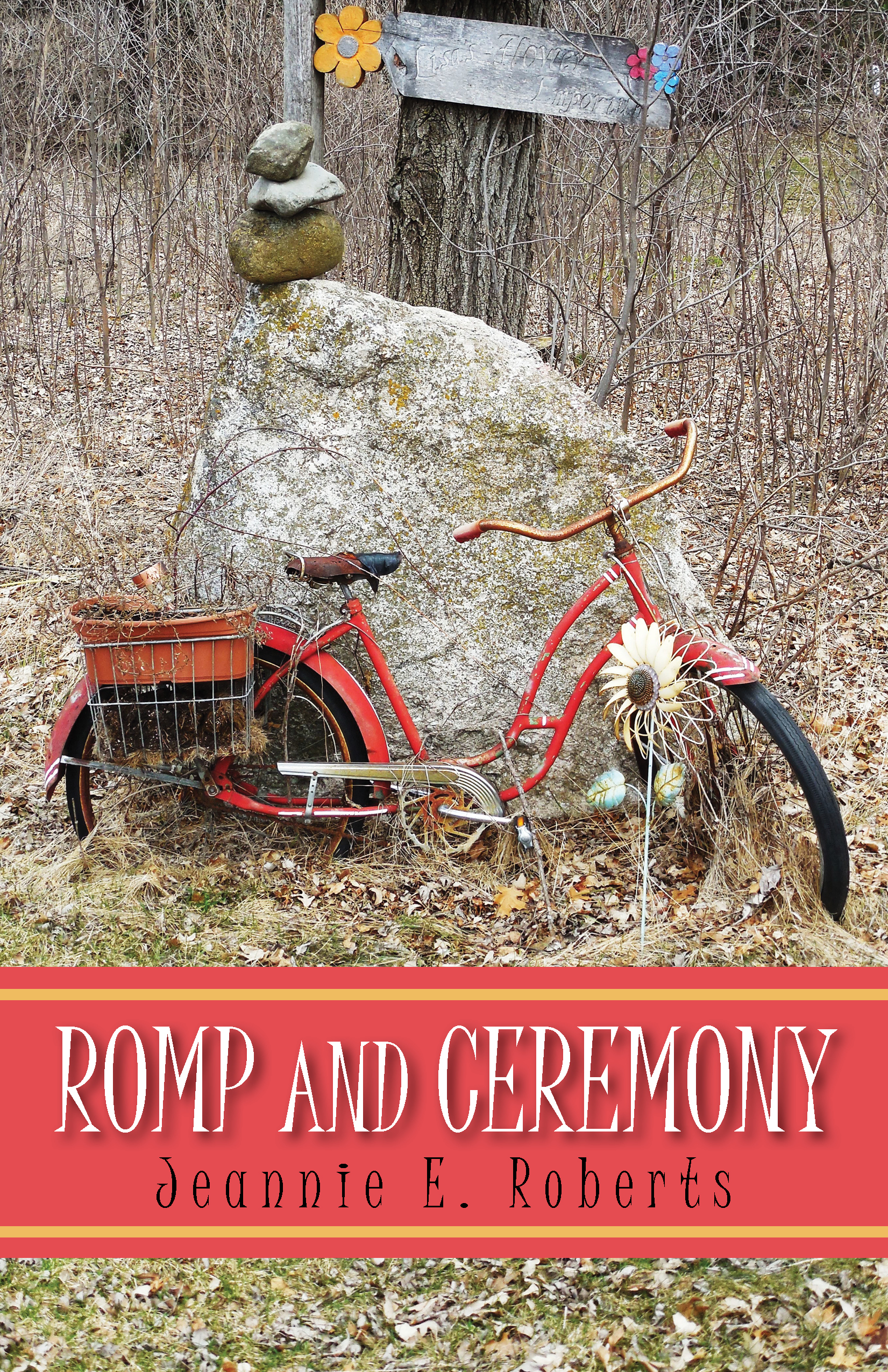
Jeannie’s soon-to-be-released collection of poetry, Romp and Ceremony, highlights this blend of realistic optimism with a voice that’s lyric, lilting, and full of soundplay. Poet Bill Yarrow said the collection presents “A book for all those who admire the sobriety of ceremony and appreciate the intoxication of a romp.” 

Romp and Ceremony was slated to be released Nov. 11, but publishing setbacks have pushed that date out several weeks. Jeannie said she hopes for it to be available by January. There is, of course, a silver lining to this delay: Jeannie has promised to donate $2 per book sold during its presale to the Confluence Project in Eau Claire. A longer presale means more money will be given back to the project. 

Jeannie was born in Minneapolis and, in her words, has since lived a hybrid Wisconsin-Minnesota life. In 2007, she served as the interim director of the Eau Claire Regional Arts Center (ECRAC). She's also worked as a house manager for ECRAC and been a member of the visual arts committee. When she’s not writing, she volunteers her time for Motionpoems in Minneapolis and also runs her own freelance creative company.  She’s recently moved to Eau Claire after living in the Chippewa Falls area. 

When we sat down to chat, she explained that the photo featured on the cover of Romp and Ceremony is of a yard neighboring her old home near Chippewa Falls. The yard is full of unorthodox lawn ornaments, trinkets that Jeannie said her clean-yard-loving father nicknamed “putterbellies.” In a poem of the same name, she offers a humorous take on the different assortment of items people use to decorate their yards. 

Are all of the poems in this collection more lighthearted, more humorous, like “Putterbellies”? 

“There are six sections within my book, and the heaviest humor section is titled ‘Romp It Up!’ It’s lighthearted, there's much whimsy interwoven within the poems. The remaining sections include: ‘Seasonal Disorders,’ ‘Brighter Days Ahead,’ ‘Signs of Life,’  ‘Food and Other Phenomena,’ ‘All Life Shines,’ with the final section being ‘Romp It Up!.’ Each section builds to the more concentrated humor at the end. It’s fairly seasonal… In most of my poetry, I intersperse the light and the dark—which is life, right? It’s a combination. We have spring where there’s life and light, and then winter where we have the darker parts.” 

So how does the poetry in this collection speak to you? Why is this something that you were drawn towards, this tone that blends the light and dark? 

I enjoy humor. When I look at things, I see numerous sides to life’s situations. I like looking at the brighter, more humorous aspects of life. In this collection, I guess what speaks to me the most is its lightheartedness.  

Is that what you want your readers to take away, to focus more on the lighter side of life? 

You know, I do… In the beginning of my book, I include a quote by Hugh Sidey, an American journalist who died in 2005.  For me, his words encapsulate my book in a sentence or two:  “Above all else, go out with a sense of humor. It is needed armor. Joy in one’s heart and some laughter on one’s lips is a sign that the person down deep has a pretty good grasp of life.” That pretty much sums it up. If we can look at the brighter side, see the positive elements of things, that’s the takeaway. 

I hear you’re donating part of the proceeds from presales of the book towards the Confluence Arts Center. Why did you choose to do that?  

The Eau Claire Regional Arts Center/State Theatre has always been dear to my heart. It feels like part of my essence. When I was the interim director in 2007, we discussed expansion of the Arts Center or the possibility of building a new one.  Way back, the seeds of renewal had been planted. I find it really exciting to see the progress of the Confluence Project, to have watched them break ground. Eau Claire is such a beautiful city, a river town.  The Confluence Project, along with the new Confluence Arts Center, will bring revitalization and will showcase the area's beauty and rich history.   

So I know this is a bit premature to ask because you’re still in the publishing stage of this book, but do you already have an idea of what you’d like to do next? 

I am shopping around a new children’s book.  Recently, a small Minnesota press rejected it. The editors were so gracious.  They said they wished they could publish it, but with full-color illustrations it wasn't cost-effective for them. They also suggested other publishers I might pursue for my manuscript. I thought that was pretty nice, because not all publishers do that.  And I do have two new chapbooks that I have out to editors for possible publication, so yeah, I’m always working on something, and it never stops. 

What does that feel like – always putting your work out there and never really knowing what’s going to stick? How do you deal with that as a writer? 

I guess it’s just a process. Rejections are part of being a writer, and I’ve just become so immune to them. You don’t always get acceptances.  When rejections arrive, ‘Oh, okay, they rejected me, on to the next.’ I always have that mindset… I’m always writing poetry, and sending my individual poems to editors, and online journals, and to anthologies. Usually, I send out ten or more poems a month to different journals and magazines. There’s always activity, you know? And sometimes I’d like to stop the activity and just take a break, but that’s just not part of my personality… I live in the moment, but I would be living more in the moment if I didn’t have so many projects on my plate! But when you’re creative, as writers and artists know, that’s just how it is. You’ve got a bouquet of ideas in your head, and you have to figure out how to piece them all together. 

Is there a big dream project that you’ve always wanted to take on, that you’re working towards? Or do you just take your projects as they come to you? 

That’s a good question… It would be nice to have a big-name publisher pick up my poetry manuscripts.  Though, the bigger publishers are usually more interested in writers with an MFA degree in creative writing, those who are creative writing professors. I have an MA and have taught, but have not instructed at the university level. Beyond the big dream project, I guess I've always wanted to go back to school to further my education, to earn an MFA and even a PhD, to teach in a university, to be able to promote my books nationally, and to do poetry readings at larger venues.  However, at my age, I don’t see that happening because I’m realistic that way… But you asked about a dream, and that’s usually pie in the sky stuff, right?  So that’s what it would be for me.  

Dispatches from the Wild: On Writing, Trail Work, and Falling in Love with the Challenge

Rebekah Morrisson

Rebekah Morrisson

by Rebekah Morrisson

I am a trail worker. When I tell people that, I’m sure they imagine me emerging at dawn from a rustic cabin with sturdy boots, a flannel shirt, and suspenders. I take a sip of strong black coffee from a mug I carved out of a nearby oak as the animals frolic over to greet me. The smell of sap and morning dew sits in the air around us… Okay, okay, maybe they don’t imagine a lumberjack Snow White, per se, but whatever they do imagine isn’t quite what I and thousands of other trail workers experience season after season. We are dedicated outdoorsmen who wake up early to repair, create, or maintain the trails we all enjoy.

Trail work is tough. Let me repeat that: trail work is tough. It’s rugged. And it’s different wherever you do it. I’ve spent four seasons and 17 months doing trail work with the Maine Conservation Corps and California Conservation Corps, and nine of those I spent as a team leader. I’ve felled trees with a crosscut saw, slept wrapped in a tarp out under the stars, and lived in the backcountry without technology for three and a half months. There are other trail crews nationwide and some help eradicate invasive plants, some live deep in the woods, and some drive to a trailhead every day. They work through rain and snow and freezing temperatures because they’re committed and, for the most part, they like the work.

I used to think, as I assume most people do, that trails were formed by mere foot traffic. After all, prior to my time with the conservation corps, I’d never run into a crew rolling rocks, creating a reroute, or hauling tree trimmings off into the woods. Now, I know better. It’s been my life for a few years and I’ve fallen in love with it. The physical challenge of straining my muscles for nine hours a day at high altitude is rewarding, if you can believe it. Sure, there are times when I’ve thought about quitting but feeling myself grow stronger, hike faster, and learn more and more about the natural world are just a few of the reasons I’ve stayed in this line of work.

In 2014, I graduated from the University of Wisconsin-Eau Claire with a focus on creative writing. Since then, I’ve been working out how to explain my experience in the woods through my words. In my first eight months doing trails, I wrote every day. Usually in my tent after everyone else had gone to bed, but occasionally on lunch breaks and after hammock naps on the weekends. Most of it was in letters to my mother about the things I’d seen and done and felt. I wanted to share my experience with people beyond my trail crews, to invite my family and friends to be transported to the moments I was experiencing. It seemed only natural.

There has long been a link between nature and writing. For proof, we need only read the works of authors like John Muir, Henry David Thoreau, Edward Abbey, Rick Bass, and Terry Tempest Williams—all of whom have long explored how woods and words go together. Sometimes a person's words can affect the preservation of nature and other times nature can move someone to words. In a way, my trail work helps hikers create an experience similar to mine and the pieces of experience they lack, I’m attempting to construct through my writing.

They’ve done it and so can I, but in describing anything foreign to someone, I know it will take a lot of effort. Writing is tough, sometimes as tough as trail work, but as I struggle to work on trails, I also struggle to write about it. I try to keep in mind that neither is rewarding without a struggle and the finished product is always better when I take my time with it. I’ve realized that if I simply explain how to hammer rocks to bits or what it’s like to eat trail mix every day for a week, my friends and family won’t understand the collective experience as I do. 

As a trail worker, not only are you sore and tired, but you scratch raw the four mosquito bites on your left leg, the two near your right elbow, and the bunch on the back of your neck. You’re annoyed at one of your teammates for crushing your last good step rock because now you’ll have to roll another one 30 feet up the trail. You rave about how great dinner was even though much of its “greatness” was a direct result of your hunger.

These are just a few short snippets of experiences I’ve had.  The others remain mostly indescribable. Though as difficult as both trail work and writing can be, I’ve found I’ve fallen in love with both.  And with a little more work and a little more time, I hope to one day have the words to give people a clear picture of what it’s like out here on the trail.

CVWG Forms New Partnership

CVWG_Logo_4c_tagline.png

The Chippewa Valley Writers Guild has partnered with the Novel-In-Progress Bookcamp & Writing Retreat to offer Guild members a discounted rate at NIP events.  

Each spring the NIP offers a six-day residential workshop for writers of book-length manuscripts and a concurrent residential writing retreat in southeast Wisconsin. The next Bookcamp and Retreat will be held May 7-13, 2017 in southeast Wisconsin.

“For those who can’t wait for Cirenaica’s summer retreats, this sounds like a great chance to get a head start,” said Guild founder B.J. Hollars.  

“The Novel-In-Progress Bookcamp’s award-winning staff and guest instructors, all published authors, editors, or literary agents, provide advice specific to your work-in-progress, hands-on writing instruction, and the latest information on today’s rapidly changing publishing industry,” said NIP founder and director Dave Rank.

The concurrent writing retreat provides six days of personal writing time with opportunities to discuss writing issues with the NIP staff and guest instructors and chat with fellow writers in a relaxed environment focused on the writing craft.

NIP also held its first one-day “So You Want to Start a Novel!” workshop for novice novelists in October, an event they plan to hold again next year. 

“We welcome the Chippewa Valley Writers Guild as another of our formal supportive Friends. Members of the CVWG now are eligible to attend our Bookcamp for a discounted price that will save them $45 when they register,” Rank said. “As an NIP Friend, the CVWG agrees to help promote our programs.”

For more information on NIP programs, visit their website

The Chippewa Valley Post: An Overview

David Gordon

David Gordon

by David Gordon, Board Chair and Associate Editor, Chippewa Valley Post

The Chippewa Valley Post is a relative newcomer to the local media landscape, but it’s one that is trying to make a difference.  

The locally-focused news and information website was launched in February of 2015 to fill some of the growing gaps in local news coverage, particularly those that leave out the nonprofit community. Those gaps, stemming from cutbacks in the size and experience of mainstream media news staffs, and in the space and airtime available for news, have created a possibility that the Chippewa Valley could become a “news desert.”

This would mean that citizens—no matter how interested they might be—would lack access to various kinds of information they need to engage knowledgeably in the life of their communities.  

To help prevent this, the CVPost intends to “connect the dots” for our audience (and, in some cases, to discover where those dots actually are). The ultimate goal is to help build a stronger community by strengthening its information infrastructure.   

This goal stems from our mission statement, which says that the CVPost aims “to help develop informed and engaged citizens who will strengthen the fabric of an effective democracy.” This commits us to providing as complete a picture as possible of life in the Chippewa Valley—both what works and what isn’t working – and to explaining how complex that picture really is.

Nonprofit Focus

To pursue these goals, the CVPost is focusing heavily on the nonprofit sector, where many organizations and activities that are important to the community go unreported. We intend to inform the community about the roles nonprofit organizations play, why these groups are needed, and the challenges faced by the people they serve.

This approach presents us with the considerable challenge of gathering and reporting this news. The CVPost, incorporated as a nonprofit organization, depends heavily on volunteers, with a particular need for community journalists who will take responsibility for covering some aspect of Chippewa Valley life.

Although we will not duplicate coverage provided by the existing media, we will report on community-wide topics and issues which those media either don’t cover or ignore after doing a one-time story.  

The CVPost has followed in part a successful community journalism model in Grand Rapids, MI that began after the local daily paper reduced its publication schedule. Unlike Grand Rapids, however, the CVPost board insists that whatever appears on our website will be reported and edited to at least minimum professional standards.  

To accomplish this, we will mentor our community journalists and help them become better reporters and writers as they continue to provide content for the CVPost website. We have lined up several veteran journalists, now working here in other fields, to serve as mentors.

Environmental and Other Stories

Coverage of Chippewa Valley groups engaged with the environment is high on our priority list. We are currently seeking at least one community journalist who will provide regular coverage of these organizations along with reports on general environmental issues that impact the local community. As part of this effort, we will regularly cover a community-wide group headed by the Grace Lutheran Church pastor, whose goal is to promote awareness of climate change and other environmental issues through the lens of religious faith and spirituality.                              

We already have a list of overlooked community-wide stories that deserve coverage. Among other topics, these include an article on where/whether the businesses displaced by the Confluence Project have relocated and how well they’re surviving the move; a series on how the Affordable Care Act and changes in Wisconsin regulations have affected both local health care providers (including the Chippewa Valley Free Clinic) and patients; and stories that look at the impact of United Way’s new funding formula on nonprofit organizations that have benefitted from the change and on those whose funding was reduced or eliminated.

Civility and Partnerships

We hope to provide a forum where reasonable people with differing viewpoints can hold civil discussions of those viewpoints. We will strongly encourage people to use that forum to offer new or competing thoughts from across the ideological spectrum, and will try to facilitate their debate and discussion in the so-called “marketplace of ideas.” (See, for example.) 

We also would like to make available an opportunity for audience members to comment on the stories we run. However, the CVPost board has decided not to provide this option until we are able to monitor those comments closely, and remove any that lack civility.

The CVPost has formed partnerships with Wisconsin Public Radio and with Northern Spirit Radio, an Eau Claire-based nonprofit that syndicates educational and inspirational radio programming focused on peace and social justice to more than 20 stations. We have informal working arrangements with the student paper at UW-Eau Claire and with the university’s journalism program, to display some student-produced news stories during the academic year. We have also held preliminary discussions about cooperative arrangements with Chippewa Valley Community TV and with one of the commercial TV stations in town.

Revenue Model

Our revenue model, which is slowly being implemented, includes securing public memberships ranging from $50 to $500. We are developing plans to recruit 200 nonprofit organizations that would become members of the CVPost at a minimum annual level of $50. We also need to secure underwriting and sponsorship for the CVPost website from the for-profit sector. These efforts have been hindered by the lack of a development coordinator to oversee them.      

If learning journalistic style, or improving what you already know, appeals to you, we’d love to hear from you. If helping to provide information that’s now missing from the “marketplace of ideas” appeals to you, please get in touch. I can be reached at adgordon@charter.net or via the CVPost’s Gmail address, at cvpostwi@gmail.com.  

Craft Talk Rewind: Aimee Johnson's "Your Novel Starts Now"

by Karissa Zastrow

The Chippewa Valley Writers Guild’s second craft talk of the season featured Aimee Johnson, the National Novel Writing Month (NaNoWriMo) Municipal Liaison for Eau Claire.  Aimee spoke to Guild members to help motivate them for one of the most challenging, but rewarding experiences writers put themselves through: National Novel Writing Month.

During the month of November, writers across the world challenge themselves to write 50,000 words in 30 days. To reach this goal, they have to write approximately 1,667 words a day, which is about three-to-four pages. Some people might wonder why writers do this to themselves. To some, it may not sound like fun, but to others, it is thrilling. It’s that feeling of the urgent deadline getting closer and closer that make your fingers fly across the keyboard in a mad rush to get everything from your brain out on paper before it’s lost. It’s turning off that voice in your head that makes you doubt every word you write. It’s about pushing yourself to finally set aside time to write instead of putting it off until later. It’s about living your dream of being able to say, “I am a writer.”

Getting started is the easy part. Sign up at nanowrimo.org and create a profile. Then choose Eau Claire as your home region to get updates and information from Aimee Johnson. Next, add your friends who are also participating in NaNoWriMo. Through this website, you can keep track of your word count using the graph, see where your friends are at, win badges and other prizes, and be a part of the NaNoWriMo community.

During her craft talk, Aimee Johnson offered a list of helpful hints, tips and tools for those wanting to join in on the fun:

  • Do not try to take on anything else during November—just writing.
  • Let everyone know, especially those you live with, because you’re going to be missing in action. Don’t be afraid to ask for help from family, roommates, and friends.
  • Avoid time wasters like social media, your phone, and Netflix. Aimee suggests getting a social media blocker if it is hard for you to be away from your social media accounts.
  • Attend write-ins. On average, writers who attend the write-ins write more words than those who do not. Write-ins tend to help writers stay focused on their work instead of getting distracted, but they also get their social fix at the same time.
  • Write everywhere. You’ll be surprised where you can write!
  • Keep a notebook and something to write with on you at all times—you never know when creativity will strike.
  • Write now, edit later and don’t delete anything.
  • Take care of yourself.
  • Find things that motivate you: Create a playlist or read your favorite short story or whatever makes you want to write.
  • Don’t let people read your work.
  • Reach out to others. People can help motivate you more than you think.
  • Most importantly: Don’t give up. No matter how far behind you get or how bad you think your writing is, keep going.

Now that you have all these fantastic tips, find your nearest computer and sign-up to participate in NaNoWriMo! We’ll be there, cheering you on through every cup of coffee, every late night, and every word. So ready, set, write!