Craft Talk Rewind: “Patience and Perspective” as told by Nickolas Butler

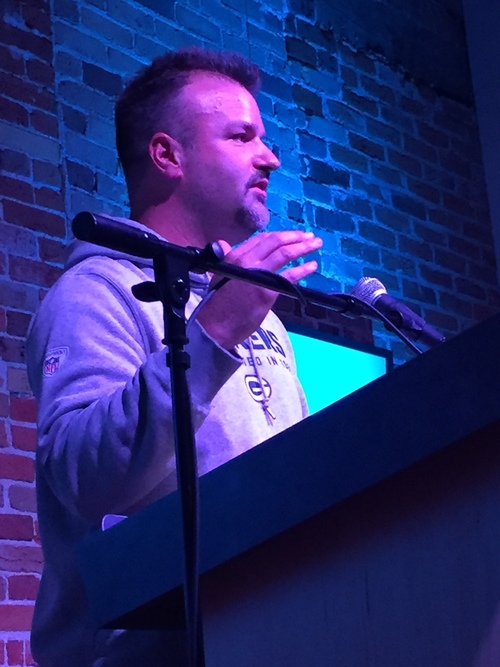
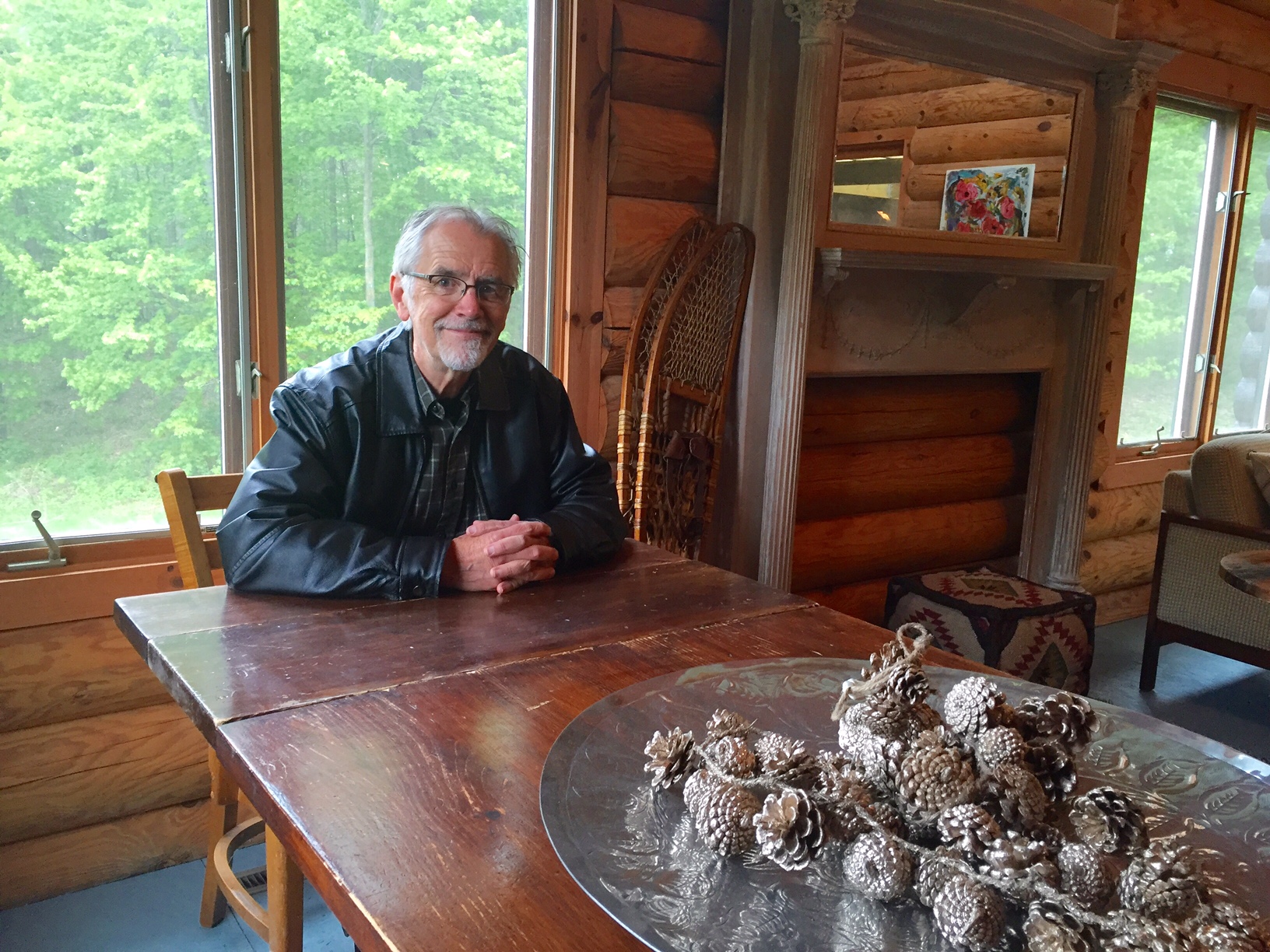
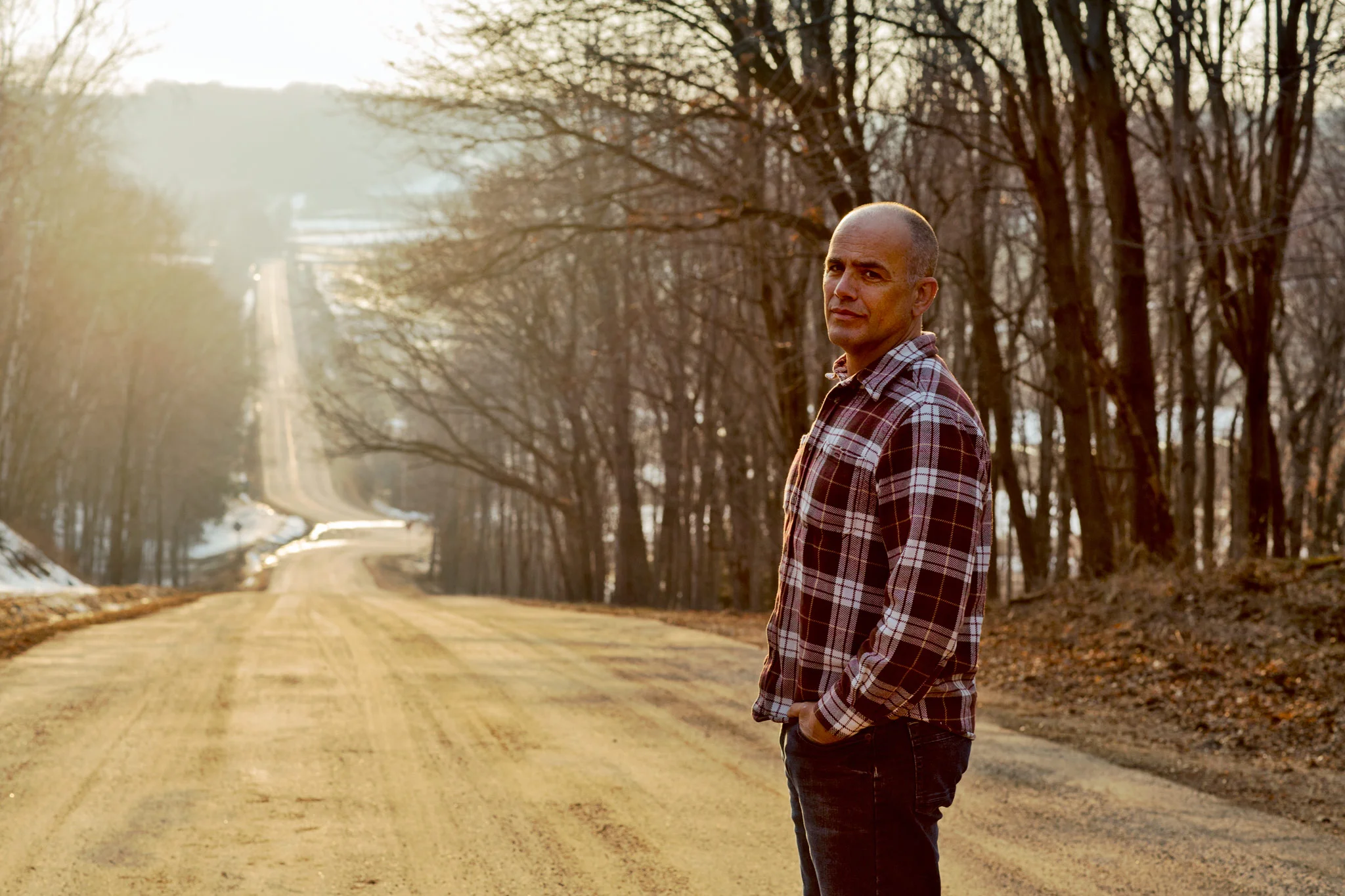
In April, Nickolas Butler gave a standing-room-only Craft Talk at the Local Store. His message: the impact of patience and perspective on our writing. In addition, Butler, the award-winning author of Shotgun Lovesongs and Beneath the Bonfire: stories, discussed his latest project一 a novel that draws on a heart wrenching situation he experienced 17 years ago when he was a teenager. 

Butler said that while he could have written about the subject as a teenager, it would have been raw and relatively narrow-minded. Now, 17 years after the fact, he’s had enough experiences to gain multiple perspectives on the situation. He told us that as writers it’s up to us to see situations from different angles and perspectives in order to write a great piece. This could mean spending time researching or talking to other people about a topic. 

More often than not, perspective comes with time, and time requires patience. 

In an era when instant gratification is king (see: Facebook likes or a YouTube video that’s gone “viral”), there’s also a desire to have work published instantly. This makes patience a virtue we want to ignore. The payoff for having patience (and perspective!) with your work, however, will be even more rewarding than a quick submission. 

What should you do in the meantime while you’re being patient and gaining perspective?

Read. Butler told us that you can’t be a good, solid writer without reading a lot. Not only will you have a better sense of writing and storytelling, but reading different genres like fiction, poetry, essays, and more will help give you the perspective you’re trying to gain. Butler also stressed the importance of reading in order to increase creativity, as well as looking for the creativity in everyday things and conversations. 

We’re grateful that Butler gave us such an honest and inspiring talk, and we’re already looking forward to our next season of Craft Talks starting up in fall of 2016. Make sure to check back to our website so you don’t miss any upcoming Chippewa Valley Writers Guild events! Have an inspired and inspiring summer!

Michael Perry on Saying Yes, Climbing Mountains, and Literary Solitaire

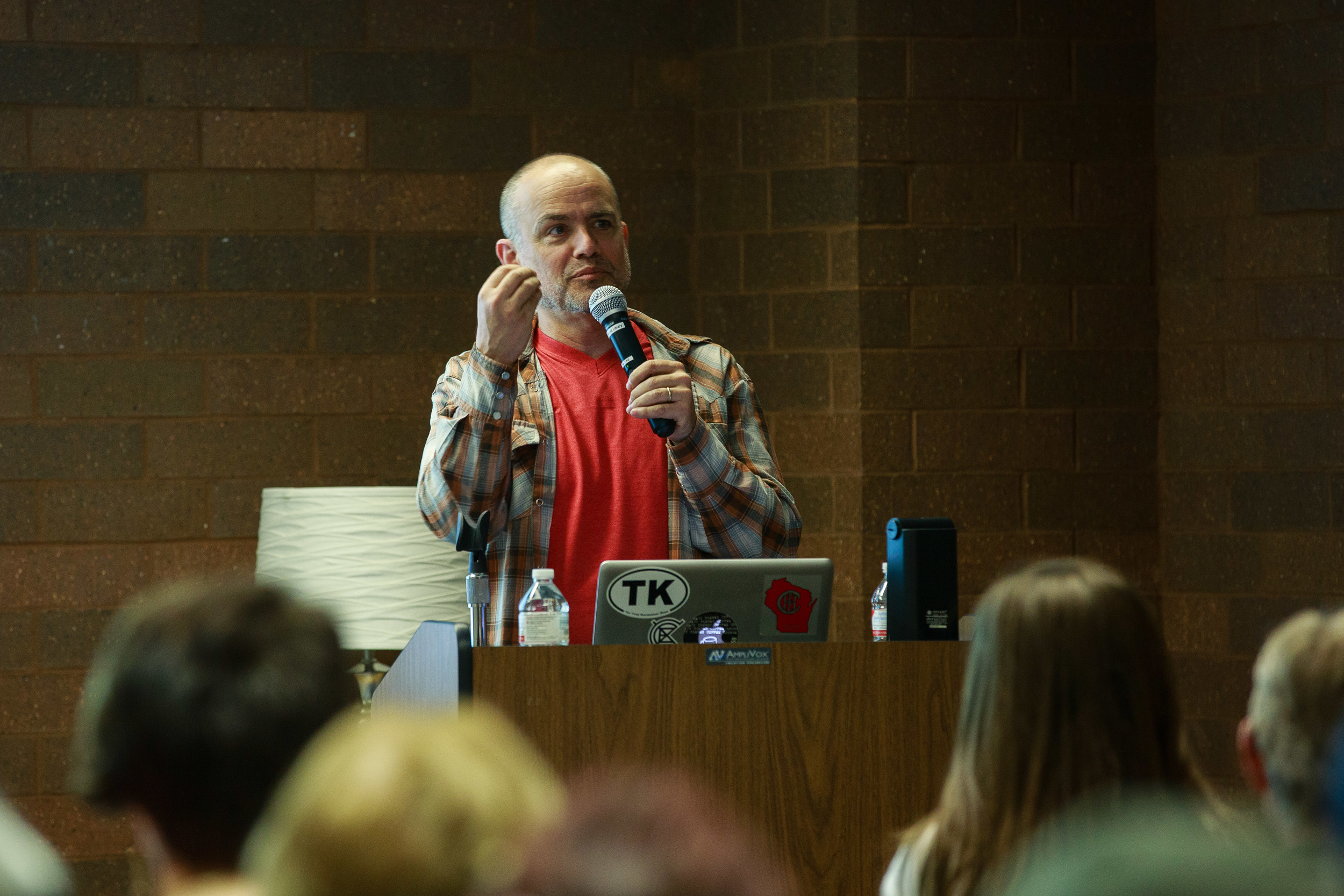
Michael Perry at the L.E. Phillips Memorial Public Library (May 7, 2016)

Michael Perry at the L.E. Phillips Memorial Public Library (May 7, 2016)

By Ken Szymanski

Mike Perry’s level of success can’t be reached by listening to a speech. Still, the L.E. Phillips Memorial Public Library basement was packed with aspiring writers for his May 7 keynote address for the Chippewa Valley Writer's Guild, all us hoping to catch some tips that might provide the elusive secret. 

Anyone who’s reading this knows the Mike Perry story. His success has been a blend of natural born talent and farm boy work ethic, combined with the ability to work a crowd on a book tour stops. Plus, his books often cover the right topics at the right times. Simple, right? Hardly. But he did reveal a simple word important to aspiring writers.

Perry said that being a successful freelance writer starts with saying yes. When agent called and asked if he’d be willing to climb up Mount Rainier for a story, he faked a confident “Yes.” And saying yes over and over has led to opportunities that provide a more exciting angle to writing than simply sitting at the keyboard. “Writing is a means to adventure,” he said, showing slides of mountain top views.

Once on assignments, he stressed the importance of observation (“You have to be the five senses for the reader”) and veracity (it wouldn’t be a Perry if he didn’t send some of us to the dictionary at least once). Nonfiction writers depend on the reader’s trust. It cannot be broken. 

One audience member asked how to deal with having so many job-related writing obligations, that she had little time left to do the writing she really wants to do. 

While writers dream of having months to devote to a project, Perry said that can be actually be counter-productive. Put in that situation, writers can auger down rather than gain traction. Conversely, the brain can spark a lot of ideas while doing other things. Tasks such as chores, mundane writing assignments, firefighting calls, etc. can give the brain a needed break or stimulus for the creative project. Sounds like part of the trick, for busy people, is to learn how to work on your writing when you’re not working on your writing. 

But for those who like to talk about how writing is such tough work, Perry offered some relief. His brother is a logger up north. If writing is so hard, Perry said, try logging with him. “I’m sure we could arrange a sabbatical for ya,” he said, drawing a good laugh from the crowd.  

That’s classic Perry. He loves talking about the craft of writing, but he never gets mystical. He mentioned that his muse is the guy at the bank who holds his mortgage. He writes to put food on the table for his family. It’s simply about observing, writing down observations, typing them up, printing them, cutting up those observations and laying scraps all over giant tables, and finding connections. Simple, right?

Sometimes it’s what Perry called “word jazz” and other times, he said, “It’s like a desperate game of literary solitaire.” 

Literary solitaire: that sums it up the writing process as well as anything. It can be frustrating, success can be elusive, but if you stay up late enough and play long enough, eventually you’ll win one. 


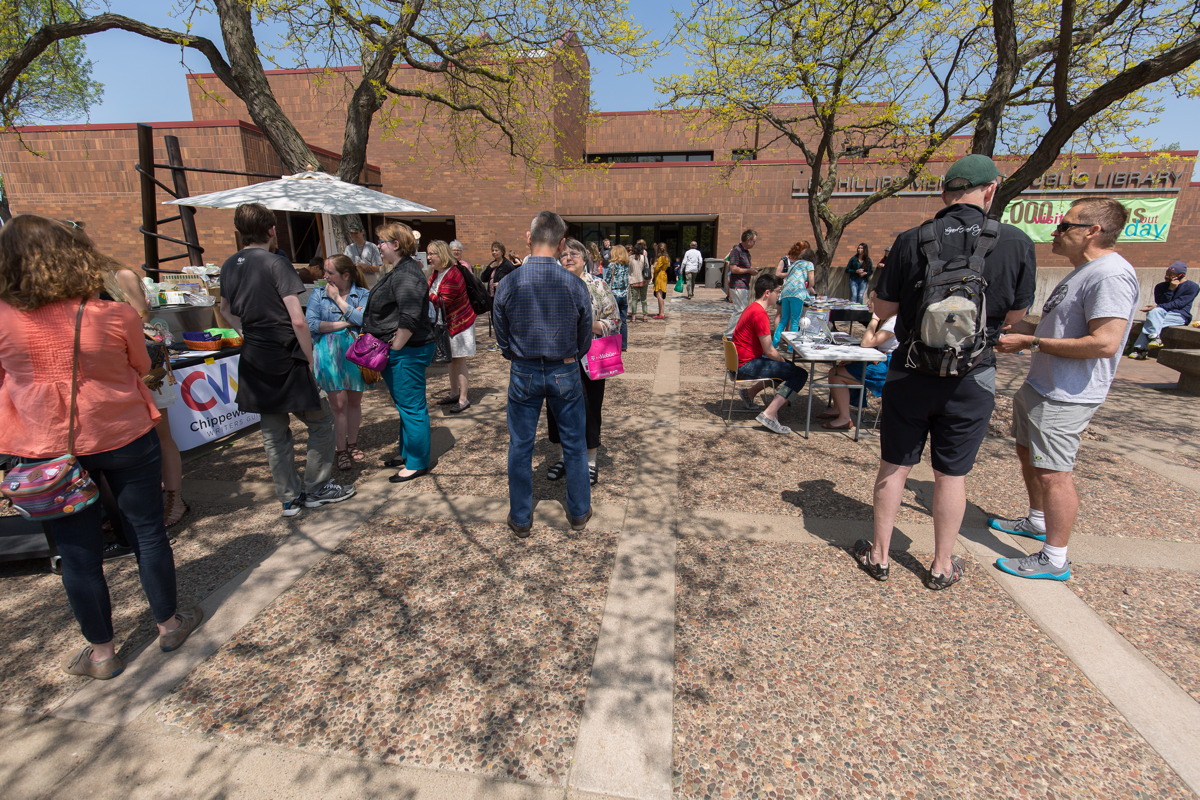
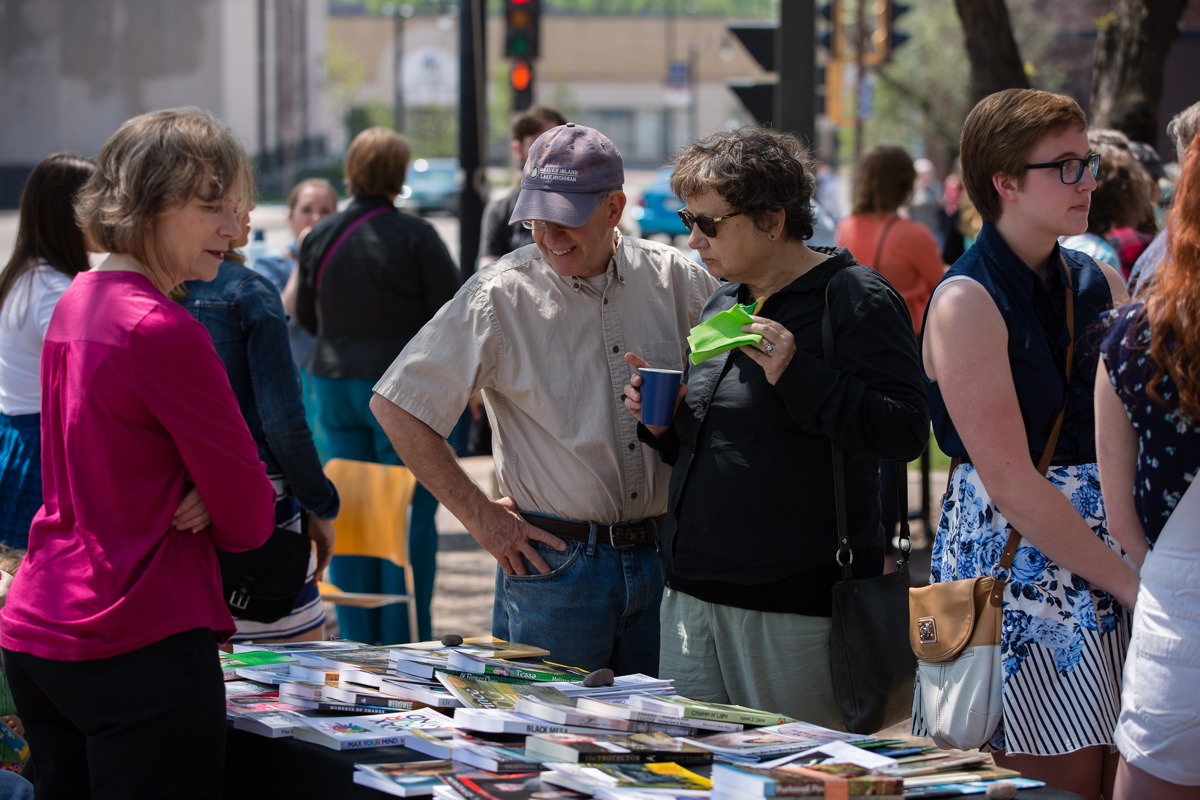
Check out some photos from Perry's keynotE

A Collaborative Poem (Courtesy of the Chippewa ValleyWriters Guild)

As folks waited for our Michael Perry Keynote Address (Saturday, May 7) to begin, we asked them to type a few lines on an old Smith-Corona typewriter, contributing to a collaborative poem. Please—enjoy the fruits of our labor!

On the Occasion of a Michael Perry Reading at the Library

Sunny Eau Claire Saturday, first signs of summer
Behold the child, by nature’s kindly law
The hosts offered cookies and ice cream; a bummer
But love for words is not a character flaw
But merely method of breath

The red sports car drives over by the library—LOVE!
The air is fresh, the books plentiful…perfect
Hugs between friends and new acquaintances made
Loving memories of the past to be resurrect
Lighting the literary flame
Hazy smoke from far away
Mingles in the breeze
Hope sparkling in the trees; we are one
The photo booth makes everyone smile

LAST CALL: Cirenaica Residencies

UW-Eau Claire emeritus professor and former Wisconsin poet laureate Max Garland

UW-Eau Claire emeritus professor and former Wisconsin poet laureate Max Garland

Throughout the  summer of 2016, Cirenaica will host six, 3-day writing residencies.  Though our June residencies have filled, we still have a few spots left for Wisconsin poet laureate Kimberly Blaeser’s poetry residency and John Hildebrand’s nonfiction residency and Erika Janik's 'writing for radio' residency.

The Nuts and Bolts

Each residency will host a maximum of 10 writers.  Writers will be joined by a writer-in-residence, who will oversee workshops and conferences, as well as the occasional special guests, who will take part in evening activities and readings.

When you sign-up for a residency at Cirenaica, you know you’re going to learn from the best. Our residencies seek to balance creation with instruction, providing the flexibility and structure to ensure that all writers of all backgrounds can thrive.  

It's like your favorite class and your summer camp all rolled into one!

Spend your mornings writing in one of our many pristine, shared work spaces, then dedicate your afternoons to workshops, lectures and conferences with our writer-in-residence.  In the evenings, unwind with fellowship and networking around the campfire.  In addition, enjoy guest visits from local writers and prepare for your residency’s public reading, scheduled for the final night of each session.  

But Is It for Me?

Whether you’ve been writing for decades or days, Cirenaica has a place for you! The Chippewa Valley Writers Guild invites you to submit an application and a writing sample for consideration. It’s our mission to support and inspire writers of all levels, so don’t hesitate to put yourself in the running to spend a few days writing with us!

Widening the World (and Learning New Words Along the Way)

By Katie Allan

Growing up in a snow globe town makes you appreciate quaint neighborhoods, countryside, the hundred-or-so people who make up your world, and…well, snow.

And plenty of other things. It takes roughly one radio song to drive the length of my Wisconsin hometown. If you were passing through town during the 90s, and happened to glance up through a smudgy school bus window, you might’ve glimpsed a day-dreamy kid with grass-hopper legs, a kitten shirt, and bangs long enough to tickle her eyelids. She’d have been reading a library book. 

There was something special about that 45-minute commute to school twice a day, where my imagination sucked up stories like superfood. Because cute as snow globe towns are, sooner or later you start flicking pine cones at the glass out of curiosity. You learn about earth on the other side of rural Dairyland. I blame books, mostly. A few teachers. And definitely my parents. 

But just knowing about faraway places isn’t enough. You have to see something out there that’s worth leaving home for. Some folks see mountains calling, others see cities, careers, Beyoncé, the ocean, education, real Chinese food, kinder climates…I don’t know what I first saw. 

But a different window comes to mind, marginally less-smudgy, and 35,000 above the ground. I was nineteen and watching the rivers and village-speckled mountains shrink out of sight as I left Guatemala behind. I had a pile of hand-drawn pictures and cards in my lap; parting tokens from the girls of a Mayan village school.  I was wondering how a foreign country could feel so much like home after fourteen days, and if that was normal. 

Since that initial glimpse, I’ve returned four times to Guatemala. I’ve lived with a Guatemalan family and worked with a nonprofit called Mission Impact for nearly two years. I worked from the communication office, the Mayan girl’s school in a mountain town, and translated in the field for teams. I also spent five months in a training program called GoInternational.tv in Ecuador. There are a lot of stories I now carry around, wedged in my mind. 

But since returning to the U.S. a few months ago, I still haven’t figured out how to translate them all into writing; I’m lacking words. But a miraculous thing about learning a new language is you acquire new words. So I’ve come across a couple in Spanish (*Spain-Spanish, not Guatemalan-Spanish), and one in Greek that echo things I encountered while living in Central and South America.

*Querencia – (n.) a place from which one’s strength is drawn, where one feels at home, the place where you are your most authentic self (Spanish). [kɛˈrɛnsɪə].

*Sobremesa – (n.) The time spent around the table after lunch or dinner, talking to the people you shared the meal with; time to digest and savor both food and friendship (Spanish) [sO-bRe-‘mA-sa].

*Convivencia – (n.) lit. “living together”, in the sense of living or working closely with other people with whom you share feelings, desires, or common purpose (Spanish) [con-vi-‘ven-sE-a].

*Meraki (μεράκι) – (n.) The soul, creativity, or love put into something; the essence of yourself that is put into your work (Greek) [mA-‘rak-E].

****All words and definitions come from the blog Other Wordly compiled by an awesome gal named Yee-Lum. Check it out at http://other-wordly.tumblr.com/ 

These aren’t words I’d use in a sentence. But just knowing they exist and that someone else has felt them before is somehow amazing. 

I’m no longer in my small Wisconsin town, but in Seattle. It’s funny how in a way each city seems like a snow globe (size and snow variable); they’re unique, condensed collections of people, landscape, history and evolving culture. Sometimes the real challenge is to seek out adventure right where we are – to find wonder and humor and purpose in the places we live and work. 

But if you’ve never left the place you were born, and you’re still captivated by what could be on the other side of the glass, it could be time to seek new worlds elsewhere. To stand from a different vantage point and look back at the glass sphere of home. Like the first men on the moon looking back at the blue globe of earth, maybe you’ll find it all the more beautiful from afar. Or maybe you’ll choose to make your home somewhere new. 

Certain goldfish grow in accordance to how big their bowl is. I imagine it would be uncomfortable otherwise; they wouldn’t fit. We have to grow, learn and adapt in order to dive into a new environment where we don’t know the culture, language, systems, and rules of the kingdom.

But there are also new flavors and scents and sights and wonders. Blurry, nameless faces sharpen into friends, and there’s a lot of joking around, but also moments when you see someone, really see them, and realize they see you too. And one day, all that background noise and gibberish around you begins to sound like words. 

Wisconsin Poet’s Calendar Discount

There are many benefits of being a member of a writers group—support, feedback, camaraderie, etc.  Now, thanks to the Wisconsin Fellowship of Poets, we’ve got one more!

Contact Sandra Lindow to receive $5.00 off the 2016 and 2017 Wisconsin Poets’ Calendar.  The discounted rate for the 2016 calendar is 5.00; the discounted rate for 2017 is a mere $10.00.

To receive this discount, please contact Sandra at 715-309-2084 or at lindowleaf@gmail.com.

Save the Date: Join us for Michael Perry’s Keynote Address!

By Erin Stevens

The Chippewa Valley Writers Guild is off to a rousing start! We’re thrilled by the support we’ve received from our community, as evidenced by our standing-room-only Craft Talks, our dozens of applications for Cirenaica, and most exciting of all, the many brave writers who took to the mic at our very first Open Read. We’re inspired by you, and we hope our programs might return the favor.

Though it seems we just got started, our first season of Craft Talks is coming to a close. (Don’t worry, next season will begin lickety split in September.)  But if September is too far away, never fear, we still have some exciting events coming up. Mark your calendars for Saturday, May 7th, 2016 at 2 p.m. because the Chippewa Valley’s very own Michael Perry will be giving a keynote address at the L.E. Phillips Memorial Public Library’s Eau Claire room. 

Yes, you read that right. A New York Times best-selling author, humorist and radio show host, Perry will discuss the keyboard-level realities of balancing writing for a living with writing for meaning. Perry is the author of The Jesus Cow, Population 485, Truck: A Love Story, Coop and many more. This event is free and open to all writers, readers and lovers of literature in the Chippewa Valley and beyond. Bring yourself, your friends, your family members, and/or your roommates. 

Just when you thought it couldn’t get any better than this… brace yourself! At 1 p.m. (prior to Perry’s keynote address), come hang out with the Chippewa Valley Writers Guild on the library’s front lawn! This is a perfect way to meet and engage with fellow writers and literature lovers, and to learn more about the Guild. We’ll also have swag, music, refreshments, ice cream from 9 Degrees, giveaways, collaborative art opportunities, and more! Stop on by and get to know the writers in your neighborhood!

For more information, visit the Chippewa Valley Writers Guild website, or email us at chippewavalleywritersguild@gmail.com

DEADLINE EXTENDED: Summer 2016 Residencies

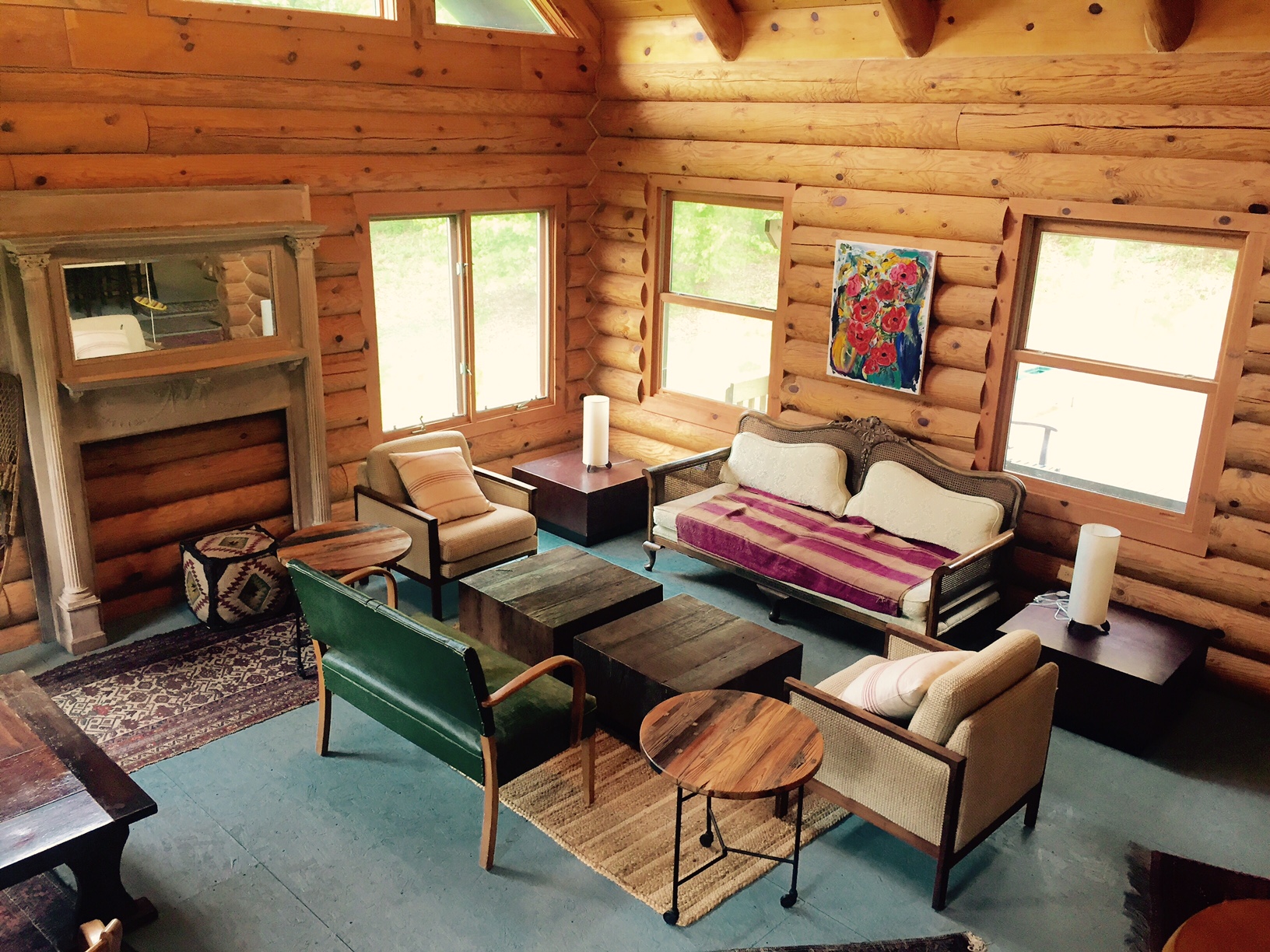
Cirenaica is an artist residency nestled on 43 acres of hills, farmland, and forest in the quaint village of Fall Creek, Wisconsin.

Cirenaica is an artist residency nestled on 43 acres of hills, farmland, and forest in the quaint village of Fall Creek, Wisconsin.

We've EXTENDED THE DEADLINE for summer writing residencies at Cirenaica to May 1! So put the finishing touches on your application and come out for an incredible creative experience in the wilds of Wisconsin! Can't wait to see you there!

Important Info

➜ Residency at Cirenaica
➜ 2016 Summer Residencies


Spotlight: Drs. Audrey Fessler and Jeff Vahlbusch

Jeff Vahlbusch and Audrey Fessler

Jeff Vahlbusch and Audrey Fessler

By B.J. Hollars

No entry-level creative writing classroom is complete without a reading of Billy Collins’ “Introduction to Poetry”, a poem that pleads with students to simply let poems be.  

Admittedly, it’s a task easier said than done, especially when so much of students’ educational lives now involves synthesis, analysis and deconstructing a thing into its simplest parts.  By poem’s end, the resigned narrator laments that despite his pleas, readers will likely still tend to beat poems “with a hose / to find out what it really means.” 

Yet what happens when we allow meaning to take a back seat to musicality?

For a decade now, Drs. Audrey Fessler and Jeff Vahlbusch have been doing just that, organizing the International Poetry Reading—a one evening event each spring dedicated to encouraging community members to recite poems in languages from across the world.  And that’s the beauty of the event: a chance to appreciate the sound of diverse languages, as well as to honor the cultures of the people who speak them.  

The impetus for the International Poetry Reading began long ago, during Jeff and Audrey’s time as junior faculty members at Washington College in Chestertown, Maryland.  

“It was a small college, it was a small event, and it lasted for an hour, maybe an hour and a half, “Jeff remembers.  “Perhaps 20 people read in five or six or seven languages.  We loved it, we thought it was magical.”

“And then we arrived here at UW-Eau Claire,” Audrey continues, “and thought, ‘This would be a wonderful kind of gift and tradition perhaps we could institute here.”   

In 2006, Jeff and Audrey organized the very first International Poetry Reading here in Eau Claire.  They kept expectations low, hoping for five or six languages to be represented.  They were shocked to find the reality far exceeded their expectation: no fewer than 30 languages were represented. 

“We were blown away,” Audrey says.  “We just barely made it into our little two hour allocation of time."

They not only exceeded their expectation in terms of participants, but in terms of audience members as well, so much so that folding doors were soon spread wide to make room for overflow rooms. 

“Our startlement and joy at the initial community response has kept us motivated for a long time to continue,” Audrey notes.

“Have there been any moments that really stand out in your mind?” I ask.  “After all the poems you’ve heard and all the languages, what really resonates with you two?”

“The ones that have hit home for me, often, are when you expect someone to read and they sing,” Jeff says.  “Where you expect someone to read and they chant.”

He goes on to describe an instance in which a woman from Cambodia leaned into the microphone, informing the audience that in her country they don’t read poems, they sing them.

“And she stepped back from the microphone and in a crystal clear, little but incredibly impressive voice she sang for four minutes,” Jeff says, his eyes glossing over in memory, “and it was evocative, amazing, and wonderful.  And it brought down the house.”  

Audrey adds that for her, the most memorable moment involved being “plunged into silence.”  

“At this event people listen with all their might because they’re hearing languages they’ve never had the opportunity to hear before,” she explains.  “They’re hearing sounds that they might not have known the human voice was capable of making.”

After 45 minutes or so of intense listening, all sounds were momentarily silenced as a reader shared a poem in American Sign Language.

 “Suddenly there was nothing there for most audience members’ ears,” Audrey explains, “but there was this beautiful body in motion of poetry that had so much eloquence and grace and perfect intelligibility to audience members…” 

Of course, moments such as these don’t just happen; they require lots of work.  And for the past decade, Jeff and Audrey have dedicated hundreds of hours each year to their effort.  There are a range of duties to be fulfilled, though perhaps most complicated of all is creating a booklet which allows audience members to read each poem both in its original language as well as translated into English. 

“There’s an awful lot of work to do in just putting together the book,” Vahlbusch says, “…formatting all of these different scripts and languages—some of which our computers can’t handle—is a very, very exciting kind of work.”  

“So how has the International Poetry Reading contributed to the Chippewa Valley?” I ask.

“One thing we have thought for years,” Jeff explains, “is that this is an event in which we in the Chippewa Valley get to see what an amazingly diverse place we actually are, and how many different people’s languages and traditions, ethnicities and races, come together in this small spot in Wisconsin to live together.”

He’s right, and were it not for events such as this, perhaps we’d never stop to notice the depth and range of our community.  

Art often finds a way to bring people together, I think, and in this instance, the collision of poetry and culture seems to do just that, as well as instilling a deeper affection and appreciation for the place that we call home.       

I’d hate to lose such an event, and when I ask Audrey and Jeff if it’s really over, Audrey says, “We would like it not to be the end. It has certainly been a great labor of love for us both.”  

She goes on to say she’s hopeful that someone else might be willing to carry it on for a while.

“Free training,” Jeff says with a smile.

“And a ton of gratitude,” Audrey adds.  

This year, the tenth International Poetry Festival will be from 7:00-9:00p.m. on Wednesday, May 4 in the Ojibwe Grand Ballroom in the Davies Center on the UW-Eau Claire campus.

If it is, indeed, the last chance we have to come together in this way, be sure to clean out your ears, listen carefully, and savor as much as you can.

***

Music courtesy of Lulzacruza

Scribble (4-25-16): “Summer Strikes”

Each month we’ll offer a low-stakes, writing prompt applicable to all genres.   This month, enjoy “Summer Strikes”—a prompt meant to help us celebrate this wondrous season. Upon completing the prompt, send your piece (500 words or less please) to chippewavalleywritersguild@gmail.com for potential publication in next month’s newsletter!

Without further adieu, “Summer Strikes” ...

What are your most tangible memories of the first night of summer?  How did you spend that first night as a child, a teenager, a young adult, an adult (we could go on…).  Spend five minutes recording all your sensory details of that night, then another five minutes recounting an encounter that occurred.  Revive, revise, revise, and once you’ve crafted something you’re proud of, send it our way!   

Craft Talk Rewind: Patti See’s “Writing Where You Live: Making the Most of What You Have”

Patti See

Patti See

By B.J. Hollars

Couldn’t make it out to Patti See’s fantastic craft talk?  Not too worry!  We’re here to offer you a few of the highlights.

Patti’s craft talk covered the idea of writing about place, which for her, means writing about Lake Hallie, Wisconsin. Though as a Chippewa Falls native, Patti’s personal story starts there.  She began her talk by describing her childhood spent in the family tavern. “Kids drank orange crush and played games,” she recalled, adding also that the tavern was the site where more than a few stories were swapped and spun.  This upbringing, coupled with her mother’s letter writing and her father’s storytelling prowess, created the conditions for her own future as a writer. 

Patti began her writing career by composing thinly veiled fictional stories, though in the midst of her mother’s prolonged battle with Alzheimer’s, she found herself blogging about her caregiving experience—an experience that resonated with readers throughout the world.

While all genres and subjects can prove difficult for a writer, writing about where one lives is particularly challenging, Patti explained, “because it means those who live near you may read what you write.”  And so, Patti knows to negotiate these relationships carefully, often making people aware of their potential appearance in a story.  

In a small town like Lake Hallie, she explained, word often travels as fast as the “bark patrol” from 101 Dalmatians; as such, it’s best if folks know who the writer is.  And as Patti has proved, she always has her pen at the ready.

Click here to listen to Patti read her work on Wisconsin Public Radio’s “Wisconsin Life.”

Fast Forward: Nickolas Butler’s “Brass Tacks & Before Cirenaica”

Nickolas Butler

Nickolas Butler

Next up on our craft talk series is the great Nickolas Butler!  Mark those calendars for April 28 at 7:00p.m. in The Local Store Gallery, where you’ll hear Nick provide an insightful and candid discussion on the everyday work of being a writer.  (As I’m sure we’ll all learn, it ain’t as easy as Nick makes it look.)  In addition, Nick will also get folks fired up for his summer writing residency this summer at Cirenaica.  A few spots still remain!  Check out the details on Nick’s residency here, and more on all our residencies here.    

And while we have you, might we just take a moment to brag a bit about one of Eau Claire’s favorite sons?  You know him best for Shotgun Lovesongs and Beneath the Bonfires, but do you know just how much hardware the guy’s won for his efforts?  From France's prestigious PAGE Prix America award, to the 2015 Wisconsin Library Association Literary Award, Nick’s accolades have come from the world over.  And to whet your pallet for what’s coming next, stay tuned for a forthcoming featured spotlight with Nick Butler coming your way this summer! 

On the Achievement of My 100th Literary Journal Rejection

By Eric Rasmussen

In 1955, a struggling actor in Los Angeles got a job driving a cab.

This allowed him to work at night, and still go out on auditions during the day. Cab drivers in Hollywood must meet all sorts of famous and influential people, and one afternoon this particular cabbie picked up a fare who topped all others – John F. Kennedy. Kennedy maintained his masterful political charm even from the backseat of the car. The then-Senator peppered the driver with questions about his family and his acting prospects, about their shared hometown of Boston and Adlai Stevenson's prospects for winning the Democratic presidential nomination.

"Unfortunately," as if publishing is decided by a coin flip

"Unfortunately," as if publishing is decided by a coin flip

I can guess what that driver felt, because I've felt it, too. He strove for something difficult, something that many of his friends and relatives probably dismissed as an impossibility. Acting? What a cliché. What a ridiculous endeavor. Do you know how many people are trying to become actors? There's no money in acting. When one struggles to achieve something like becoming an actor, or, in my case, a writer, every experience comes to be viewed through that lens. It morphs into a sort of obsession. Every person is someone new to discuss my writing with, every new memory transforms into potential subject matter for a story or essay. I imagine that driver couldn't help but question if his encounter with JFK meant something, if, finally and at long last, his moment had arrived. Maybe that connection would finally lead to something. Who knows how, but maybe that was the turning point.

At some point during the ride, Kennedy offered this thought to the driver. "Lots of competition in your business, just like in mine. Just remember there's always room for one more good one."

Thanks, editors, for looking at my stories

Thanks, editors, for looking at my stories

As it turns out, the driver was a "good one," and his business made room for him. Leonard Nimoy acted in small parts and B-movies for another nine years after that cab ride until the pilot episode of Star Trek in 1964.

Today, I had an experience that feels important. I didn't receive sage advice from a beloved politician or anything quite so dramatic. In my email, I found another rejection from a literary journal, which happens several times a week. But this one is my 100th. If all successful writers face mountains of rejection, then I am inching closer to being a successful writer. Stephen King had his infamous nail full of rejection letters. All the stories I've read about winning query letters and offer of representation phone calls feature tons of "Dear author, Unfortunately..." emails. All those people felt everything I keep feeling. Every rejection is another tiny devastation that forces the question, "What the hell am I doing?"

He probably felt inadequate, too, not just because of that haircut

He probably felt inadequate, too, not just because of that haircut

But this one, I will celebrate. Number 99 stung terribly, and so will number 101. But number 100 is a milestone. I may not be good enough yet, but I am working, desperately, hopefully, tirelessly. Soon they will have no choice but to make me some room.

This piece originally appeared on theotherericrasmussen.blogspot.com, where Eric discusses life in Wisconsin and his pursuit of publishing fiction, and compiles various creative pieces. The collection is mostly humorous, often on purpose. 

Poetry and Popcorn?

Like poems? Like popcorn? Join the CVWG and NOTA for an evening filled with both!   In celebration of National Poetry Month, we ask that you please bring a beloved poem—one you've penned or one you hold close to your heart—to share with all the other popcorn/poetry lovers out there. Be sure to swing by The Local Store & Volume One Gallery (205 N Dewey St., downtown Eau Claire) at 7:00p.m. on Friday, April 29.  Open to all ages. BYOP (The “p” stands for “poem”).

JOIN: Children’s and Young Adult Writing Group

Interested in joining a children’s and young adult writing group?

Join Rob Reid for an organizational meeting on Wednesday, May 18 in the Chippewa Room at the L.E. Phillips Memorial Public Library from 7:00-8:30pm.

The meeting is open to anyone who would like to form a group designed to provide feedback and support for adults writing for children (approximately birth to age 12) and/or young adults (approximately ages 12-18) on a monthly basis.

For more information, contact Rob Reid at reidra@uwec.edu

The Straight Line Lie

Debbie Campbell

Debbie Campbell

By Debbie Campbell

Last week, I’m having coffee with an old friend. We’re splitting a blueberry muffin and she’s telling me what it’s like to be a mom. We’re mid-laugh in conversation when she stops abruptly and says, “I just thought I’d have it figured out by now.” For her, figured out means the marriage thing. But whether it’s the marriage thing or the career thing or any other thing, somehow the people I care about most all seem to think they should be someplace else by now. Writing can feel this way, too. Maybe it’s the novel you said you would write by fifteen—I had lofty childhood goals—or the poem that, no matter how many times you go to write it, refuses to assemble into something meaningful.

When I was a little girl, I kept quotes in sloppy handwriting in notebooks with moons on the front. I caught caterpillars in my parents’ little garden while they planted tomatoes and green beans. I would stand on the wooden garden gate and silently recite my favorite quotes, eyes closed, soft caterpillar feet almost indistinguishable from the small hairs on my arms. My absolute favorite was from Helen Keller: “Life is either a daring adventure or nothing at all.”

In 2010, I graduated from a midsized Midwestern university, our very own UWEC. If you had asked me then, I would have told you adventure was Japan—the green grassy hill flooded with unfamiliarly large dragonflies, the young students I taught English phrases to through silly songs and program-approved drills. I would have said adventure was teaching yoga at local churches, or applying to MFA programs. If you had asked me then, I wouldn’t have, in the faintest, imagined adventure could soon mean teaching at my alma mater.

There’s an image I keep seeing recycled on social media. It says “Success” across the top. On the left of the picture, an arrow, a straight line. Below that straight-lined arrow, it reads, “what people think it looks like.” On the right, another arrow, this one a twisty turny mess. This one reads, “what it really looks like.”

Maybe this image keeps grabbing my attention because it speaks to my experiences both with writing and with teaching. Like I said, as short a time ago as 2010, the idea of teaching at UWEC would have been like a fever dream, something unattainable or unthinkable. I’m not sure anything has ever felt as strange or as exhilarating as having teachers I admired as a student become my colleagues. And it wasn’t a straight line from childhood to here, or even student to teacher at UWEC. It was a messy road I grew to love that led me here.

Writing is like that, too. That poem I’ve been struggling to assemble…well, it might not have come to fruition, but each time I sit down to write it, something messy and wonderful happens. I start with what I think will help me figure it out, take me on a straight line to my destination. Each time, every time, by the end of a mad hours-long writing session, I’ll have begun several other poems or maybe a novel. It won’t be the elusive poem I set out to write, but it might just be better, all of this surprising idea material that arises from the mess. And any writer knows, half the fun is being surprised.

There’s another favorite quote from my little girl days. It’s from an Emily Dickinson poem: “Not knowing when the Dawn will come, I open every Door…” To me, it reminds me to embrace the mess, the adventure. It reminds me that, while some days I feel like I should be someplace else by now, life, like most good writing, does not happen in a straight line.

Spotlight: Nick Meyer on The Formation and Future of Volume One

By B.J. Hollars

                                                                      &nbs…

                                                                                          Volume One publisher and co-founder Nick Meyer in the archive

“Watch your head!” Nick Meyer calls back to me.

            I do, ducking to avoid the low vent in the bowels of the basement of Eau Claire’s Local Store

            “Thanks for your concern,” I say, following after Nick’s 6’5” frame, “but I’m a little more worried about your head.”

            In truth, I hardly have to duck at all, though when I do, I rise up to spot a wall lined with boxes directly ahead of me.

            “So this is the archive,” Nick says.  “It’s where we keep all the back issues.”

            All 300 of them. 

            Certainly Nick Meyer needs no introduction.  At 22, he—along with Dale Karls and several of their friends—decided to create an arts and culture magazine in the city, though at the outset, were wholly uncertain about the magazine’s future.

            “This publication may very well be a one-time exercise in futility for us,” the inaugural issue’s opening statements reads.   “Depending on what kind of response we receive, it might continue.”

            It did continue.  It continues to continue.  And our valley is better for it.

            Nick and I meet to talk on his 37th birthday, which, as it turns out, happens to coincide with Volume One’s 14th birthday.

            “Well happy birthday to you both,” I say.

            “Thank you and thank you,” Nick smiles.

            Though I’ve long heard rumor of Volume One’s origin story, I’ve never heard it directly from Nick.  However, given the abundance of birthdays in that basement, it only seems natural to harken back to the old days.

            “What was [Volume One] initially supposed to be like for you?” I ask.

            “The whole reason it started—my personal story for it—was there was a band called the Buddyrevelles, who I thought was the greatest band in the world.”

            Nick discovered the local band while attending a show on the UWEC campus in the fall of 1998.  Four years later, long after the band had made good in Chicago, they planned a homecoming show in Eau Claire.  Nick was anxious to spread word of their return; the problem, though, was that he found it impossible to spread the word in print.  After the traditional media outlets passed on the story, Nick began to wonder how he might create a publication specifically aimed at local arts and culture.

                                                      Issue one of Volume One

                                                      Issue one of Volume One

            Volume One was born soon after, arriving into the world on March 1, 2002—exactly 23 years after Nick.

            Years later, Nick began to realize that it wasn’t just the Buddyrevelles’ music that inspired him so deeply, but what that music came to represent: proof, as he put it, that “amazing art can be made anywhere—including a place like this.”

            For many, Volume One has become synonymous with community building—a tangible, bi-weekly reminder of the power we possess when communities come together for a cause.  Though in the case of the Chippewa Valley, it’s hard to put a finger on just what our “cause” may be.   Perhaps it’s simply to continue to grow the place that we call home.

            “So many people pulling in the same direction on a place is a powerful thing,” Nick tells me.  “And we’re lucky in that way because a lot of communities don’t have that vibe going at all.  There are places bigger and smaller than this that just sort of exist—and there’s a few people here and there—but this community’s been able to find this wave of energy and keep it building and growing, and it hasn’t even crested yet.”

            When I ask Nick to reflect on his years with the magazine—on what it means to him—he admits that he probably doesn’t reflect nearly enough; mainly, because he’s always looking forward. 

            Though for a moment I do catch him reflecting, watching as he flips through the humble, 24 black-and-white pages that became Volume One’s first volume.

            Over the years the magazine had grown tremendously both in terms of page count and readership.  But it’s grown in other ways as well, including its ability to provide jobs for over 20 of the most talented writers, designers, editors and advertising teams in the region.  More recently, Nick has also found ways to pay contributing writers for specific content as well—a step he believes will not only ensure Volume One’s high quality content for years to come, but will also better reflect his own values related to compensating writers and artists for their work.

            Nick and I wrap up our conversation, ascend the stairs—and after one last happy birthday wish courtesy of me—part ways and get back to our jobs.

            But before leaving the parking lot, my eye catches on the many bumper stickers lining Nick’s car.  Each sticker reveals his support for one facet or another of our local scene, though one sticker, in particular, stands out. 

            There it is, innocuously positioned near his right taillight: 

            I ❤︎ EC

            It’s a message so simple it can fit on a sticker, yet so complex that—300 issues later—we’ve hardly begun to explain all the reasons why.

Interview music courtesy of Lee Rosevere

Meet Our Writers-in-Residence

Top: Erika Janik, John Hildebrand, Max Garland. Bottom: BJ Hollars, Nickolas Butler, Kimberly Blaeser.

Top: Erika Janik, John Hildebrand, Max Garland. Bottom: BJ Hollars, Nickolas Butler, Kimberly Blaeser.

This summer’s residencies at Cirenaica will host a number of acclaimed writers. Take a moment to meet them and learn more of their work!

Max Garland

Perhaps no poet captures the twang of Kentucky with the heart of Wisconsin better than Wisconsin’s former poet laureate, Max Garland.  For those who’ve had the pleasure of hearing him read (and trust us, you’ll never forget it!), chances are he didn’t read at all, but simply recited the poems from memory.  Max’s poetry has lifted our spirits time and again, helping us through the hard parts of life, and the happy times, too, and occasionally, even the bittersweet.  Such was the case when Eau Claire said farewell to our beloved Mega-Foods now memorialized in this poem. | ➜ See residency info

Nickolas Butler

Nickolas Butler: the man, the myth, the legend.  A writer whose reputation transcends oceans (did you know he won France’s PAGE Prix America Award?), yet when you meet him, he’s as humble and down-to-earth as any other hardworking Midwesterner.  Which is to say: Nick is the ideal writer-in-residence for budding and veteran fiction writers alike.  Click here for a great interview with Nick and Wisconsin People & Ideas editor Jason Smith. | ➜ See residency info

B.J. Hollars

Since B.J. may or may not be writing this content, he’ll keep it brief.  He loves teaching, he loves writing, and he’d love to teach and write with you.  Click here for a featured excerpt from his debut essay collection This Is Only A Test over at the Huffington Post. | ➜ See residency info

Erika Janik

The author of several books (A Short History of Wisconsin, Odd Wisconsin, etc.), whose essays have appeared in Smithsonian, The Atlantic, and Salon, chances are you still know her best from her work as executive director for Wisconsin Public Radio’s “Wisconsin Life.”  Perhaps no one in the region has done more for capturing our stories and voices than she.  Click here to listen to “Poetry and Beer, Together at Last at Poetry and Pints”  produced by Erika and featuring Max Garland, too! | ➜ See residency info

Kimberly Blaeser

It’s not every day you get to work closely with Wisconsin’s poet laureate, but from July 14-17 you can!  Kimberly has penned three collections of poetry (Apprenticed to Justice, Absentee Indians and Other Poems, and Trailing You) and when she’s not busy crisscrossing the state in support of poetry, she can be found teaching at the University of Wisconsin—Milwaukee.  This year she’s started a new project aimed at making Wisconsin the “Poetry Recitation Capital” of the country.  Learn more (much more!) with her this summer!  Until then, enjoy a few of Kimberly poems at The Poetry Foundation. | ➜ See residency info

 John Hildebrand

Whether you’re canoeing across the state, building a cabin in Alaska, or simply observing the brief moments of beauty that flicker past us each and every day, there’s no better tour guide than John Hildebrand.  You can read John’s books (The Heart of ThingsA Northern FrontReading the River, Mapping the Farm) or simply flip through a magazine to find him.  His work has been featured in Harper's, Audubon, Outside, Sports Illustrated, and more.  This summer, let him help you grace the glossy pages, too!  Listen to him read “Skating Backwards” in a segment of “Wisconsin Life.” | ➜ See residency info

5 Tips for Starting a Writers Group

In theory, starting a writing group should be pretty straightforward: find some writers, put them in a room, brew some coffee, and let the magic begin.  But even within this simplified model, there are complications, such as: What people?  What room?  Decaf or caffeinated?  

Below are five tips to make your fledgling writers group a great success.

1. Finding Your People. 

It’s not easy to find writers.  Sure, we’re everywhere, but it can feel a little awkward to walk up to a stranger in a bookstore and ask if they want to form a group.  The CVWG’s “Directory” is an attempt to avoid that awkwardness, and it’s one place to begin your search.   Keep in mind that the Guild does not have the resources to personally vet each individual group, but the assumption is that each “open” group is willing to meet prospective members with a potential to welcome them into the group.  Admittedly, this, too, can feel a little awkward.  Which is why sometimes rallying a group of friends (3-5 is a fine starting place!) and starting a new group that fits your needs is another way to get things going.   

2. Settling On Goals.

The success of a writers group hinges on finding people who share your goals.  Begin your early meetings by discussing just what your goals might be.  Do you want your group to serve as a place to workshop new work?  If so, what’s an appropriate number of pages to share, and how do you play to distribute the work?  More than anything, the sharing of work should always be equitable.  Group members loose steam when one person turns in a poem to be workshopped while another person turns in a book.  By settling on a few basic goals (What do we want to achieve?  How will our meetings run?  How many pages do we plan to share?  How will we distribute the work) can go a long way to ensure that the expectations are clear for all involved.

3. Maintaining A Schedule. 

We all live busy lives, and it can be tough to squeeze in even an hour or two a month for a writers group to meet.  Perhaps the best way to find a schedule that works is to set upon a specific time each month (the second Tuesday, for instance) and then stick to that schedule as best as you can.  Things always come up, of course, but if you can make your writers group adhere to a routine, then your group will benefit as a result of the stability.  Schedule early, block out the time on your calendar, and reserve a brief moment in your life for your art and the art of others.  

4. Providing Useful Feedback. 

Not all writers group will follow the “workshop” model of sharing work and offering feedback.  Some groups, for instance, might simply benefit by the social engagement or support provided by the group setting.  However, for those who do want to provide substantive feedback on work, take some time to decide the group’s comfort level.  You can develop your group’s “tone” or “vibe” by having a candid conversation about the depth of feedback you’re comfortable giving and receiving.  Being mindful of the tenor of the room is crucial, and striking a balance between providing feedback that is simultaneously supportive, substantive, and specific, and can often go a long way.

5. Making It Your Own. 

The most successful writers groups don’t subscribe to the same rules as any other.  Rather, each group should feel comfortable forming its own culture for the benefit of the group.  Do what you want!  Have fun!  And if it starts to feel like a slog, it’s time to take stock of your current structure and adjust as necessary.  Keep in mind, however, that building a community takes time, and building a writing group, in particular, takes time and trust.  Be generous, be kind, be present, be helpful, and most of all, be inspired and be inspiring.

Scribble (3-21-16): “A Brush With Spring”

Each month we’ll offer a low-stakes, writing prompt applicable to all genres. This month, enjoy “A Brush With Spring”—a prompt meant to help us celebrate this wondrous season. Upon completing the prompt, send your piece (500 words or less please) to chippewavalleywritersguild@gmail.com for potential publication here on the website and in an upcoming newsletter!

Without further adieu, “A Brush With Spring”

Take a walk in your backyard. What has revealed itself after the thaw? Dead grass? Pine needles? The remnants of a toy from the previous summer? Use your close observations to begin a poem, story, or essay related to the shift of the seasons. Let your reader see the beauty in renewal.


And congrats to last month’s winner, Delaney Green, whose piece can be found below:

Colfax, Wisconsin, 1972

If I knew then what I know now…

I would have peeled a bit of speckled white bark from one of the birch trees to press into a book. A woodpecker would have chittered from the top of the tree, allowing the theft but insisting that I move along. 

I would have saved a tiny phial of sand to remember the sand pies I and my cousins made when we were little, and our parents made before us when their hands were young and plump, each pie decorated with twigs or white pebbles or red honeysuckle berries, every single pie too pretty to eat. 

I would have stoppered autumn air scented with leaves and swamp and manure in a bottle and allowed myself a quick nip when my nose was full of car exhaust and cement dust but Grandma’s house was thousands of miles away. I would have run out of air before the first snowfall. 

If I knew then what I know now…

I would have taken up pen and ink to draw Grandma’s sandy driveway, to etch the shadows of trees and swamp grass and the barbed wire fence. I would have lingered on an outline of my sister, gone now these eight years, but walking then with the setting sun shimmering in her long hair.  

I would have bought fabric just that shade of blue and just that shade of gold—striped, maybe, with barn red—and I would have cut and sewed a pair of curtains to hang in my bedroom on Fourteenth Street. One night, I would have pushed them aside when the drunks in the alley five flights down argued over cardboard boxes and, two blocks away, ambulances poured into the night, screaming city, city, city.