Craft Talk Rewind: Aimee Johnson's "Your Novel Starts Now"

by Karissa Zastrow

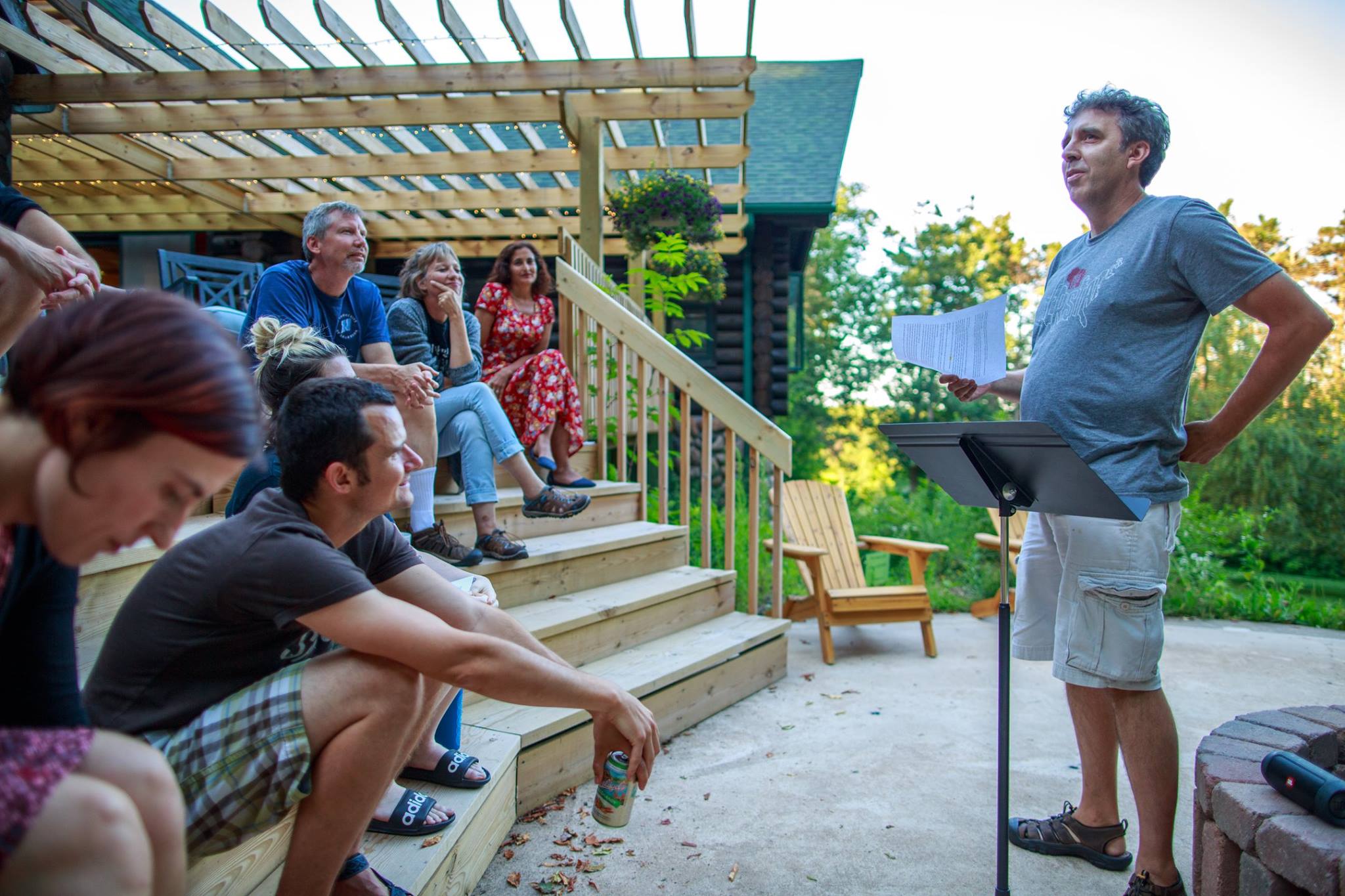
The Chippewa Valley Writers Guild’s second craft talk of the season featured Aimee Johnson, the National Novel Writing Month (NaNoWriMo) Municipal Liaison for Eau Claire.  Aimee spoke to Guild members to help motivate them for one of the most challenging, but rewarding experiences writers put themselves through: National Novel Writing Month.

During the month of November, writers across the world challenge themselves to write 50,000 words in 30 days. To reach this goal, they have to write approximately 1,667 words a day, which is about three-to-four pages. Some people might wonder why writers do this to themselves. To some, it may not sound like fun, but to others, it is thrilling. It’s that feeling of the urgent deadline getting closer and closer that make your fingers fly across the keyboard in a mad rush to get everything from your brain out on paper before it’s lost. It’s turning off that voice in your head that makes you doubt every word you write. It’s about pushing yourself to finally set aside time to write instead of putting it off until later. It’s about living your dream of being able to say, “I am a writer.”

Getting started is the easy part. Sign up at nanowrimo.org and create a profile. Then choose Eau Claire as your home region to get updates and information from Aimee Johnson. Next, add your friends who are also participating in NaNoWriMo. Through this website, you can keep track of your word count using the graph, see where your friends are at, win badges and other prizes, and be a part of the NaNoWriMo community.

During her craft talk, Aimee Johnson offered a list of helpful hints, tips and tools for those wanting to join in on the fun:

  • Do not try to take on anything else during November—just writing.
  • Let everyone know, especially those you live with, because you’re going to be missing in action. Don’t be afraid to ask for help from family, roommates, and friends.
  • Avoid time wasters like social media, your phone, and Netflix. Aimee suggests getting a social media blocker if it is hard for you to be away from your social media accounts.
  • Attend write-ins. On average, writers who attend the write-ins write more words than those who do not. Write-ins tend to help writers stay focused on their work instead of getting distracted, but they also get their social fix at the same time.
  • Write everywhere. You’ll be surprised where you can write!
  • Keep a notebook and something to write with on you at all times—you never know when creativity will strike.
  • Write now, edit later and don’t delete anything.
  • Take care of yourself.
  • Find things that motivate you: Create a playlist or read your favorite short story or whatever makes you want to write.
  • Don’t let people read your work.
  • Reach out to others. People can help motivate you more than you think.
  • Most importantly: Don’t give up. No matter how far behind you get or how bad you think your writing is, keep going.

Now that you have all these fantastic tips, find your nearest computer and sign-up to participate in NaNoWriMo! We’ll be there, cheering you on through every cup of coffee, every late night, and every word. So ready, set, write!

Falling, Falling, Falling: September Scribble’s winning entry

By Olivia Sitter 

We met when branches were barren and the air nipped our skin. Despite the layers of snow and ice that came, our friendship grew in the cold. In our insulated forms, we shared our interests, testing to see if the ground was too slick for us to tread.

When buds and baby new leaves unfurled, our hands entwined. Every breath of fresh blossom-kissed air fluttered my heart. Your gaze trained on mine warmed me in the still cold nights. I felt I was waking up after a long slumber; everything was brighter, more vibrant, and filled with life.

Something was blooming inside us. It flourished over the months, as the trees spread wide their arms. We basked in their cool shade as bees hummed nearby, cicadas sang to the sky, and birds sighed. We stole kisses with the breeze and drifted through sleepy days. We were curtained by maples, oaks, cottonwoods, safe from showers and thunder.

The verdant smells of foliage dried to a crisp; the air crackled. Yellows stained through green, our hearts beating the same. Oranges flamed, igniting our certainty. Reds and browns calmed our pace but softly. While the world prepared to sleep, we were wide awake, watching it all.

Hand in hand, we strode through crunching piles of discarded shade. We said nothing, but we knew, we knew. At a fallen tree spanning a dip in the ravine, we climbed. Together, triumphant we made it to the other side, the sharp breath of autumn coloring our cheeks. 

Grinning, exhilarated by the height we had achieved, we looked back across the trunk to where the path meandered through the forest. Down to where fallen leaves promised to catch us if we chose to jump or happened to tumble. And back to each other’s face, our eyes alive, alive, alive.

We knew, we knew. Balanced above the ground, on this precipice of wood and hope, you knelt, as I knew you would. And me, lighter than a milkweed seed, clung to the branches and said yes, as you knew I would. As one, we traversed the span, our feet crunching on the stable path again, new with the possibilities of the future.

We knew winter was harsh, but we walked on, knowing we would weather it together. 

Image: Albert Bridge

Finding the Strange Around You: Writing sci-fi and fantasy in the world outside your window

By Charles Payseur (above)

If there's one bit of writing advice that I've heard a lot, it's "write what you know." As a writer of science fiction and fantasy, people might think I just throw that tidbit out the airlock. But in some ways because I write science fiction and fantasy, my relationship with writing what I know is somewhat complicated, but no less real. The strange and luminous are not limited to far away planets or settings with dragons and wizards. There is magic all around us, and for those willing to look and imagine, there are stories there as well.

Now, this all is not to say that I don't like writing space operas and second world fantasies where the setting…doesn't really resemble Eau Claire, Wisconsin, or really any place I've lived. However, just because the stage is different doesn't mean that the experiences are galaxies apart. Feelings of isolation and longing that one experiences here, of being caught in between larger places as Eau Claire is caught between larger cities, are feelings that can easily be taken into almost any setting imaginable. Similarly, knowledge of rivers and farms and wineries and orchards is something that can inform almost any story, speculative or not. Some of my favorite stories take something achingly familiar and complicate it by setting it against a fantastical backdrop. Speculative fiction isn't so much an excuse to write the things that you don't know so much as an invitation to take what you know and take it out of its familiar context. Micro-breweries on Mars will feel more real if the writer knows a bit about micro-breweries first, and the Chippewa Valley offers a great many amazing places to gain some first-hand knowledge.

And that's not the only option. Bringing the strange and magical to Eau Claire or any other Wisconsin town can be fun and fascinating. Post-apocalyptic stories, for example, set here and written by people who know the area will feel more authentic than if a writer living in Wisconsin tried to imagine what the same post-apocalypse would look like in New York or California. Similarly, just because every superhero story seems to take place in a large city doesn't mean that a young person getting superpowers on a farm or in a smaller town in Wisconsin isn't interesting. Indeed, telling a more local story can be more personal and meaningful for writers surrounded by the world they're writing about because it gives them the chance to explore the issues and flavors that make their home unique, but in a way that is new and different, bold and speculative. Writers are tasked with combing through the possibilities of human experience and finding stories that will connect with and move their readers. This is no less true of speculative fiction writers--it's just that what is considered "possible" is greatly expanded. And with that added freedom, with all the nearly infinite options for setting and populating a story, sometimes it helps to start close to home.

And let's face it, the Chippewa Valley is a compelling setting, one with a diversity of peoples and perspectives and experiences and histories, all of which can lend to great sci-fi and fantasy. Want to tell a monster story about hodags rampaging through the downtown? Or about a troupe of local ghost hunters finding a bit more than they bargained for while checking out a haunted site in Chippewa Falls? Maybe Paul Bunyan is alive and well and actually a very good chainsaw artist? Or perhaps in an alternate history steamships fill the skies of the Wisconsin Territory in preparation for a very different War of 1812? 

The advice to "write what you know" is something I find very helpful, but only so far as it's not used as a chain, as a leash. Write what you know, yes, but also write what you don't know. Because in between the two is the gulf where art is made. Especially with science fiction and fantasy, there are countless worlds to explore, but that doesn't mean you should ignore the one just outside your window.

Bring on the Mass Hysteria: War of the Worlds reenactment set for Oct. 28

By Alison Wagener

We interrupt this blog post to bring you a special announcement: 

A team of writers, educators, and lovers of widespread panic have come together to recreate one of the most well-known radio broadcasts in American history. The group, spearheaded by BJ Hollars and UW-Eau Claire physics and astronomy professor Paul Thomas, will perform a live-action version of Orson Welles’ “War of the Worlds.”

The performance began as BJ’s idea to invite people to simply listen to a recording of the original 1938 broadcast. But Paul had other plans. 

"What I pitched back at him was that we'd actually do the radio show, not just listen to it,” Paul said. “And he typically enough said, 'Alright! Let's do it!'"

Orson Welles’ radio broadcast was intended as a modern day recreation of H.G. Wells’ 1898 science fiction novel War of the Worlds. The seasoned 23-year-old didn’t plan the show as a large-scale hoax, but simply as a Halloween episode of the American radio drama anthology series The Mercury Theatre on Air. The episode was broadcasted on CBS on October 30, 1938.

The October 28 reenactment will technically celebrate the 78th anniversary of Welles’ broadcast, almost to the day. But most people don’t know it was originally a Halloween show. 

“Orson Welles makes a joke at the end, as sort of a low-key joke,” Paul said. “He tries to diffuse the tension set up and he says, 'Well, this is the Mercury Theatre's equivalent of dressing up in a sheet and shouting boo.' So it was intentionally a Halloween show from the beginning.”

Welles presented the story as a live first-person account of what he thought was a large meteor striking the tiny town of Grovers Mill, New Jersey. But then, extraterrestrial beings emerged from metal canisters at the crash site. The increasingly panicked newscaster documented the night’s terror as the Martians attacked all surrounding humans with heat-ray guns and even killed a troop of 7,000 National Guardsmen.

The History Channel reports that the fictitious program caused widespread real-life consequences, causing listeners to flee from their homes, pray for their families, and in some extreme urban legends, take their own lives.

Perhaps as many as a million radio listeners believed that a real Martian invasion was underway. Panic broke out across the country. In New Jersey, terrified civilians jammed highways seeking to escape the alien marauders. People begged police for gas masks to save them from the toxic gas and asked electric companies to turn off the power so that the Martians wouldn’t see their lights. One woman ran into an Indianapolis church where evening services were being held and yelled, “New York has been destroyed! It’s the end of the world! Go home and prepare to die!”

But it’s likely that accounts such as this have been incredibly exaggerated. Slate reported in 2013 that major newspapers fabricated the hysteria, hoping to discredit radio as a credible news source. Either way, the broadcast had a lasting impact on American radio and skyrocketed Welles to critical success.

"I'm an astronomer who studies the planets, and for me, the Orson Welles radio show and the H.G. Wells novel that preceded it are landmark works,” Paul said, later adding, “Wells essentially mapped the history of imperialism onto what he thought was the most advanced technological civilization of the time, but was utterly powerless against the Martians. Orson Welles revamped that into a pre-Second World War version, where the power of the U.S. Army, Airforce, and all of our guns are totally insignificant.”

BJ has taken on the role of director, and rehearsals are well underway. Paul’s first step was to cast himself as Orson Welles, a role he has always dreamt of fulfilling.

"Playing a genius like Orson Welles is a real treat. I sort of hoped that sometime in my life I'd get a chance to do that,” Paul said. “I just didn't see how it would happen… I'm humbled and incredibly proud to be a tiny part of all this. It's just great. It's a hoot, it works dramatically, and doing it with BJ, that's just an even bigger thrill.”

The rest of the cast includes Rob Reid, a professor of education studies at UW-Eau Claire, Ken Szymanski and Jason Splichal, English teachers at South Middle School, and Debbie Brown, volunteer and event coordinator at WPR’s Eau Claire studio.

The performance will be held on Friday, October 28 at 7 p.m. at Volume One and will last for around 50 minutes. Before the show, resident Orson Welles expert Jim Rybicki will give a background on the filmmaker’s life and how the broadcast sent him to stardom.

Paul warned that public excitement for the event has been pretty high, but the Volume One gallery only holds around 30 people. Securing a seat might require showing up relatively early. Their plan is to allow guests to flow into the rest of the Volume One space and play the show over the speakers, giving the rest of the audience a true radio recreation. 

For those looking for a Halloween costume opportunity a few days early, attendees are eagerly invited to join the actors in dressing in 1930s garb. The cast will be dress in not only the get-up you would associate with those working at a radio station in 1938, but also the everyday outfits of the horrified characters their roles portray. Paul said he hopes acting out the drama so realistically will get to the heart of the iconic story: an account of destruction, fear, and helplessness at the precipice of colonization.

“We're gonna try to make it fresh. One of the reasons I wanted to do it—I mean you can't beat Orson Welles, you can't beat the Mercury Theatre—but I wanted to make it fresh and raw,” Paul said. “And every time we rehearse, that's what we're trying to aim for... It won't, I hope, seem familiar and easy to you. It'll seem a bit edgy. That's where we want to be, that's our goal.

We’re Starting a Journal!

Eric Rasmussen

Chippewa Valley Literary Journal Kick-Off Meeting; Thursday, October 27th; L.E. Phillips Memorial Public Library; 6:00 PM Pizza, 6:30 Meeting; Everyone is welcome! 

By Eric Rasmussen (above)

Supporting writers is not hard. Anyone can do it. Make sure your writer has enough food and water. Writers can get lonely during the day, so creating a community of writers will help them all thrive. You’ll need to brush your writer to avoid knots and excessive shedding. Occasional praise will also help your writer grow and succeed.

And, after meeting their basic needs, if at all possible, give them a place to publish their writing. They work very hard at it, many with the hope that they can share their words and ideas with the world.

The Chippewa Valley Writers’ Guild exists to support writers, which means it’s time to take that next step. We are going to publish some of your writing. With your help, we are starting a literary journal with a local focus. Its pages will be filled with fiction, nonfiction, and poetry from people with some connection to the Chippewa Valley, and we plan to work like the dickens to promote your work and provide something worthwhile to everyone – our submitters, the authors we publish, and the larger community.

We would be honored if you would help. We need everything. We need ideas, for the title (we like Barstow & Grand, but what about The Falsetto Woodsman?), for the submission guidelines, for the marketing and production and distribution, for all of it. We need people to read submissions and help edit the final product. We need your help spreading the word when submissions open, and most importantly, we need you to send in your work so we can fill issue #1 with the incredible quality we’ve seen over the past year.

Please join us on October 27th at 6:00 p.m. in the Eau Claire room at the L.E. Phillips Memorial Public Library for our Kick-Off Meeting and Planning Session. We’ll provide the pizza and soda if you provide your thoughts and opinions. Whether you’d like to be a part of the team that puts the journal together, or you have ideas you’d like to share, or you just want to hang with a bunch of folks about to embark on something cool, we’d love to have you.

There is nothing quite like the feeling of fostering a writer all the way through to maturity. By helping build an outlet for local creatives to publish their work, you can experience that feeling too.

Write your way through November with NaNoWriMo

By Aimee Johnson

NaNoWriMo, or National Novel Writing Month, is an annual literary marathon that involves writing 50,000 words during the month of November. The idea behind this insane sounding challenge is to pack away the biggest foils many writers and would-be writers struggle with—procrastination and self-criticism. Chris Baty, author of No Plot? No Problem! and the mad genius behind NaNoWriMo, kicked off the event in 1999 when he discovered the power of a break neck deadline for sticking to a writing habit.

Since then, NaNoWriMo has swept the writing nation during the month of November. Municipal liaisons for the event, such as myself, act as regional chapter heads and organize local events. One such event is my upcoming Craft Talk “Our Novel Starts Here: How to Tackle National Novel Writing Month” held on Thursday, October 20 from 7pm - 9pm at the L.E. Philips Public Library. At the Craft Talk, I’ll explain how NaNoWriMo works, what to do prepare for it, and some sweet tips and tricks for staying on track.

In addition to the Craft Talk, the WriMos of Eau Claire will be hosting a bunch of events for participating writers throughout the month:

The Kick-Off Party is a great opportunity for interested local writers to get together before NaNoWriMo actually starts. It's a chance to have questions answered, get to know your NaNoWriMo municipal liaison, get important dates for your region, play games, plot your novel, and pick up your official NaNoWriMo swag. This year it will be held at the L.E. Phillips Library in the Eau Claire Room on Saturday, October 29 from 1pm - 4pm.  

Write-ins are staple events held throughout November. Participants gather to work on their novels as a group. It’s a perfect way to boost your word count by writing alongside your fellow WriMos. The combined energy of a room full of writers is a powerful thing—come harness some of that for your own novel writing success! Dates and times for Eau Claire’s write-ins can be found here.

Night of Writing Dangerously is a mega write-in and fundraiser! This is the only NaNoWriMo event that you have to pay to attend, but it's for a good cause. The money goes to NaNoWriMo and in turn funds literacy programs. We’ll have word-sprints, contests, and a candy potluck. You don't want to miss out on the fun. It will be held at the Unitarian Universalist Congregation Social Hall Saturday, November 19 from 10pm - 2am. If you’re interested, register by emailing me at aimeedbj@gmail.com.

The Wrap-Up Party is held after the event ends and allows participants to celebrate the end of our writing marathon, congratulate, commiserate, play games, and get chance to talk about our future novel plans. We will meet at The Pub Bar and Grill in Action City on Sunday, December 4 from 12:30 - 3:30pm.  

To stay on top of the word count goal, participants have to write 1,667 words, or about 3 pages, every single day. The benefits include a permission slip to put writing at the top of your to-do list, living out the fantasy of being a "real" writer, if only for 30 days, and discovering that a few stolen minutes to work on your novel quickly add up into pages and chapters that might not normally have been written without such a motivator. 

Turn off your inner editor, sign up at NaNoWriMo.org, and come join us this November!

Craft Talk Rewind: Erik Hane’s “Ushering Your Book into the World”

By Karissa Zastrow

The Chippewa Valley Writer’s Guild kicked off their second season with guest speaker Erik Hane from Red Sofa Literary to discuss submitting to literary agents and how to find the right agent for you and your work.    

One of the first things Hane discussed during his craft talk was that writers should not be intimidated by literary agents. Typically, the person on the other end of that dreaded e-mail is a writer just like you, who will one day need to find an agent to represent their work. The important thing to remember when submitting to agents is to not be discouraged by rejections. While it is taxing to get rejection after rejection, Hane emphasized that the rejections are not reflections of your work, but rather that what you have written may not be the best fit for that agent.

Hane described the relationship between agents and writers as an equal partnership. The agent has to feel like he or she can have an interpersonal relationship with the writer since they will be working closely together for quite some time. The agent’s job is to keep everything on track from creating a social media presence for the author, editing the author’s work, advocating for the author, and explaining the whole process. Many agents work on commission and unless the book is sold, no one gets paid, so it is in everyone’s best interest that the agent feels confident in the relationship with the author and the author’s work.

One of the main topics at the craft talk was the query letter, which is most often an e-mail sent to an agent advocating your writing. This is not an opportunity to send your manuscript, but instead pitch who you are and what your book is like. Query letters should be brief (3-4 paragraphs) with a short author bio near the end, and information on your novel. According to Hane, agents love when it feels like the author has thought about where their book would fit in the current market. Don’t be afraid to name comparable titles that are similar to the novel you are pitching. The key here is to point to a book that is like yours, but explain what sets it apart and what makes it attractive to your audience. 

Hane offered some crucial information on the dos and don’ts of query letters:

• He stressed that these letters should be personalized. In the e-mail you should use the agent’s name and explain why you would want to send it to them. 

• Many agents include a paragraph on what they are looking for and what piques their interest on the website, so do your research before submitting your work. 

• Do not send a query letter to more than one agent at an agency at a time. This could lead to conflicts within their company and it puts everyone involved in an uncomfortable position. 

• Before you sent the query letter, your work should be completed and edited. It should be as polished as it can be before even thinking about submitting a query letter. 

• Never describe your novel as “recently completed” because it sounds like it has not been edited or like it has not even been completed yet. 

Using his professional knowledge as an agent along with his personal understanding as a writer, Hane encourages writers to look at the industry from a different perspective. Remember, the agent-writer relationship is a partnership, not one where the agent or the writer has the upper hand. Instead of getting discouraged when your work is rejected, refocus and tell yourself, “I guess that agent is not the right fit,” and start looking for another agent who might be perfect for you and your work. After all, you have worked hard to get your work to where you want it to be, why would you want someone not as invested in your work as you are?

7 Questions with Joe Niese

By Alison Wagener

As the World Series quickly approaches, what is a literary organization to do? Interview the Chippewa Valley’s only baseball and writing double-hitter, that’s what! 

Joe Niese is a local librarian and member of the Society for American Baseball Research. His articles on baseball have appeared in The National Pastime and Nine: A Journal of Baseball History and Culture. His first book, Burleigh Grimes: Baseball’s Last Legal Spitballer, was published in 2013 by McFarland Press. He raised the funds to publish his most recent release, Handy Andy: The Andy Pafko Story, through a more nontraditional route.

I sat down with Joe via email to chat about his work, recent literary award, and predictions for the biggest baseball game of the year.

So why baseball? How does one find themselves in a career of writing nonfiction baseball novels?

First, I’d love to make writing my career, but, alas, I don’t think I’ll be quitting my day job anytime soon. As far as baseball goes—it has been a part of my life and identity for as long as I can remember. I played it, watched it and read about it. About a decade ago I started writing articles about local baseball history. Several years ago, one of my articles snowballed into a book.

How do you think your stories resonate with your readers?

No other sport is as tied to its history as baseball is. In turn, fans enjoy reading about players from the past—whether it be a Hall of Famer, or a favorite player from their childhood. For my two books, I think it is fun to read about a person from western Wisconsin that reached the pinnacle of their professional. 

I hear that your latest release, Handy Andy: The Andy Pafko Story, recently won an award – could you tell us more about that?

Yes, the book won a bronze in Foreword Reviews’ 2015 INDIEFAB Book of the Year Award-Sports (Adult Non-Fiction). I had done things a little backwards. My first title (Burleigh Grimes: Baseball’s Last Legal Spitball), was published by a traditional publisher. For Handy Andy, I self-published through a successful Kickstarter campaign. It was a rewarding experience and nice to be recognized for my efforts.

You’ve now written books about two pretty extraordinary baseball players from Wisconsin. How did you choose who to write about?

Frankly, it was proximity that attracted me to Grimes and Pafko. Both grew up within an hour of my hometown, Eau Claire and both of them got their start in professional ball in Eau Claire, too. Of course, you start researching their lives and you ask “How has someone not done this already?” Both were a pleasure to write about. 

What should your readers expect from you next?

Oh, I have endless book ideas, but right now my efforts are focused on chronicling the life of Charles “Gus” Dorais from Chippewa Falls. He was one of the most influential football minds of the first half of the 20th century. His claim to fame is popularizing the forward pass at the University of Notre Dame with his good friend, roommate and receiver, Knute Rockne, but there is so much more than that. I hope that it will be available around this time in 2018. 

What’s your favorite local baseball story?

I don’t have one story that I can pinpoint, but, personally, I like to look back on the great times I had playing sandlot ball with my two brothers and the eight-ten guys from the neighborhood we grew up in. Every generation feels like theirs was the end of the innocence, but, those memories are wonderful. 

As the Chippewa Valley’s baseball expert, I have to ask—who’s going to win the World Series? 

Well, I don’t think I can take the crown of the area’s baseball expert. There are plenty who have forgotten more than I’ll ever know. But, as far as the World Series goes, I’d like to see the Cubs and Red Sox, with the Cubs winning in six. 

Well there you have it, folks! Be sure to check out Joe’s books, which can be found through his website and at the Local Store. 

Scribble (9-14-16): “Falling, Falling, Falling”

Each month we’ll offer a low-stakes, writing prompt applicable to all genres. Upon completing the prompt, send your piece (500 words or less please) to chippewavalleywritersguild@gmail.com for potential publication in next month’s newsletter!

Without further adieu, “Falling, Falling, Falling” ...

September is here, and with it comes one of the top four most beautiful seasons in the Chippewa Valley: Fall. The days are getting shorter, the temperatures are starting to drop (just a little), and the leaves won’t be green for much longer. Often, the transition between summer and fall happens so gradually that it’s hard to tell when one season starts and the other begins.

Write a story about the moment you know summer has turned into fall. Is it the first sight of a golden tree? A trip to the apple orchard? Or has it already passed with the first day of school?

Something for Everyone at the 2016 Chippewa Valley Book Festival

Lucie Amundsen will share stories of learning to raise chickens at the 2016 book festival.

Lucie Amundsen will share stories of learning to raise chickens at the 2016 book festival.

By Chris Kondrasuk, CVBF marketing co-chair

Mysteries? Historical fiction? Nonfiction? I like them all, which is why I belong to three book clubs —and why the Chippewa Valley Book Festival is right up my alley. I can hear authors of all kinds of books right here in Eau Claire and the surrounding area. 

From this year's selection of authors, I’ve already read a mystery book (The Guise of Another by Allen Eskens), one whose main character is an early Chinese empress (The Moon in the Palace by Weina Dai Randel), one that takes place in the South (Mudbound by Hillary Jordan), and one about the influence of being born to a mother in prison (Prison Baby by Deborah Jiang-Stein).

And that’s just a few of the more than a dozen that will be presenting.

I love the chance to hear the authors talk about their works and what inspires them, and that's what the Chippewa Valley Book Festival is all about. Barbara Massaad will talk about refugees and Syria at a Lebanese-inspired dinner at the Altoona Country Club; Lucie Amundsen will share stories of learning to raise chickens and sell eggs at L.E. Phillips Memorial Public Library; poets Rita Mae Reese and Ron Wallace will share readings with us. I loved Sandy Tolan’s book The Lemon Tree: An Arab, a Jew, and the Heart of the Middle East, and now he will be here to talk about refugees and his latest book Children of the Stone: The Power of Music in a Hard Land. What a wealth of diversity! I try to attend as many sessions as possible.

In addition to author presentations, there are writing workshops and a panel on publishing. Programs are held around the Chippewa Valley, and everything other than meals and workshops are free to attend. I know that I want to attend the cooking demonstration of recipes from Barbara Massaad’s Soup for Syria which will be held at Forage. I could meet Jack Mitchell, one of the earliest employees of Wisconsin Public Radio, at a lunch at the Chippewa Valley Museum. And I definitely want to try chicken with freekeh, a Lebanese inspired dish, at the Eau Claire Country Club. Lebanese food in Eau Claire? This is a real opportunity! 

At the end of the festival, I’ll still have a pile of books to read, but I know I will already be looking forward to the next year’s authors.

And not to forget the children. There are writing workshops, authors in the schools, and even an opportunity for aspiring authors to read their own stories. I’ve been the host for visiting school authors in past book festivals, and it was a thoroughly enjoyable experience. The kids are so excited to meet the author of a favorite book.

If I’ve piqued your interest at all, details are available on our website, cvbookfest.org. The Book Festival will be held from October 10-20, and whether you live in Eau Claire, Bloomer, Chippewa Falls, Menomonie, Altoona, or any place in between, there should be a program that appeals to you.

Start your own pile of must-read books now!

10 Things I Learned at Cirenaica Last Summer

Local educator Ken Szymanski reads his work at the Cirenaica Writing for Radio residency

Local educator Ken Szymanski reads his work at the Cirenaica Writing for Radio residency

By Amy Renshaw

This summer, I had the pleasure of hanging out in a log cabin with a group of skillful nonfiction writers in a residency program organized by the Chippewa Valley Writers Guild. Over the course of a fun weekend, I learned a few things. 

1. It’s pronounced SEAR-IN-NAY-KUH. 

It means “siren of the sea,” according to fishermen from Uruguay. I’m not sure why the fishermen have a language that differs from people with other occupations, but I did feel pulled away from my mundane responsibilities to focus on writing. However you pronounce it, it’s an alluring concept.  

2. Everybody struggles with first drafts. 

Author and former UW-Eau Claire professor John Hildebrand shared early drafts from essayists E.B. White and George Orwell, and we compared them to the finished versions. Studying only perfected, final drafts is like trying to learn construction by only looking at finished houses, John said. The key is to keep working until you’ve built the best piece that you possibly can.  

3. Put more of yourself into your work. 

Nonfiction is telling the truth, but there are lots of ways to tell it. Bring in your own opinions, describe things in your own words, study photographs to get visual impressions, and make your work uniquely original. Even a biography that’s been told and retold dozens of times can take on new life with a fresh perspective.  

4. Provide interesting context. 

It’s the privilege of the storyteller or historian to be able to see the big picture. If your subject lived through wars, persecution, or social upheaval, spell it out. Talk about the location, culture, and setting of the story.  

5. Help readers to envision the characters. 

A few words describing each person who’s named in the piece can enable the reader to form a clear mental picture. If the person isn’t key to the story, don’t give a name. In a memoir or personal essay, remember that you’re a character, too. 

6. Recognize the value of feedback from others. 

Hearing what works and what doesn’t work from supportive people who care deeply about writing is immensely valuable. In addition to the group at the weekend residency, the Chippewa Valley Writers Guild website offers connections to writing groups in a variety of genres and styles. 

7. Read your stuff out loud. 

At Cirenaica, one evening featured a reading that was open to family and friends. Beforehand, UW-Eau Claire professor Allyson Loomis shared helpful tips. She suggested reading at a slower pace than usual, practicing ahead of time, and timing your performance (5-7 minutes was the target length that evening). Allyson also encouraged including a “potato chip”—one tasty idea that makes the audience think or laugh. 

8. Less is more. 

Most writers were urged to consider cutting out early pages or paragraphs, or even chopping off the ending, to focus on the compelling action in our stories. Preparing for the reading on Saturday night was a useful exercise in trimming the excess.   

9. It’s never too late to start. 

Some members of our group were from the retired set, and their stories were fresh and appealing (one person wrote about riding a bike around his Oahu neighborhood during the Pearl Harbor attack in 1941). We all have memorable experiences that others will enjoy hearing about.  

10. Cold oatmeal tastes a lot better than it sounds. 

Seriously. Mix uncooked oatmeal with milk, yogurt, fruit, and nuts, and put it in the fridge overnight. It could fuel your genius.

7 Questions with Jon Loomis

By Alison Wagener

Jon Loomis wants you to know that happiness is fleeting. But not to worry – in a few short days, you can simultaneously bask in the moment, look nostalgically upon your past, and celebrate your own impending and unavoidable death while reading his latest book of poems, The Mansion of Happiness. To preview his upcoming release, I sat down with Jon (albeit 300 miles apart and via email) to talk about writing, happiness, and the man behind the mansion.

Q: From the poems I've seen from your collection, you've spanned quite a lot of topics and themes, from sandhill cranes to suicide, from Reagan masks to Thanksgiving. For you, what - if anything - ties these poems together?

A: The human condition.  Which is to say, this book is a love song for the present, in which we are reasonably happy—or at least not suicidal—and not terribly unwell, and the children are doing okay and we’re maybe even, at this point in our lives, almost prosperous, but what’s looming on the horizon is not good, at all.  It’s global warming and ocean acidification and Zika virus and Donald Trump and heart disease, and all the horrors of our age bearing down on us.  So enjoy the moment, because it won’t last, and what’s trailing along behind it is going to suck, and if you’re lucky you’ll die before it gets here.  So it’s a cheerful book, is what I’m saying, about the nature of happiness, and what a fragile construction that can be.  

Q: Who would you say you write for?

A: About 20 years ago I was running a reading series on Cape Cod, and the first or second week of the series we had two very famous and engaging readers—a poet and a memoirist.  And just as I’m about to shut the doors and go do the introductions, a big silver Cadillac pulls into the parking lot and a guy jumps out.  He’s kind of stocky and he’s dressed for the golf course, circa 1978—plaid pants, white belt, white shoes—the full Cleveland, pretty much, and he’s smoking a big cigar.  And he asks me who’s reading that night, so I tell him.  And he says, “Are you sure?  I thought I read in the paper that this guy Jon Loomis was reading.  I’ve been following his work and it really gets to me."  And I said, sorry, no—it’s a famous and dynamic poet and memoirist—should be a great reading.  And he thinks for a second and says, “Nah,” and gets back in his car and drives away.  And I realized that he was my audience—the man in the white belt.  And he was not a guy who would put up with any bullshit.  So that’s who I write for, pretty much—smart people who may not be academics or other poets.  Not that there’s anything wrong with poets and academics—I just don’t care as much about whether they like my work.    

Q: How would you describe The Mansion of Happiness in one sentence?

A: It’s a cheerful book about the nature of happiness.  And death.  Two sentences—sorry. 

Q: Why did you feel compelled to write this collection?

A: After my first two books of poems came out, I spent about eight years writing novels, which is a very different kind of work.  But all during that time I knew I wanted to go back to poetry at some point.  Long form fiction is hard—it requires lengthy stretches of one’s full attention—you have to keep the whole thing in your head, and there are a lot of moving parts—and I found that after three novels I was kind of exhausted by the process.  Poems are hard, too—they’re fussier in their obsessions—but you can work on them in shorter bursts.  Perfect for someone like me, who has terrible adult ADD.

Q: Mortality is at the forefront of many of your poems, but your tone towards the subject shifts a lot throughout the collection: the feeling of desperation in "Sandhill Cranes in Migration," the blind optimism of "Thanksgiving," and the solemn peacefulness of "If I Come Back." What was your reasoning in presenting these different approaches? 

A: Well, I’m not sure I’d call “Thanksgiving” an optimistic poem—those white sails are headed our way.  But yeah—I think as a whole the collection is pretty dark, though that gets mixed up with a certain amount of manic hilarity at times.  It’s about doing the police in different voices.  Bonus points if you get the reference.

Q: Out of the collection, would you say you have a favorite poem? Which one, and why?

A: I’m not sure I have a favorite.  My wife likes “When the Rapture Came,” which works for me.

Q: What do you want your readers to take away from The Mansion of Happiness?

A: Attention to the moment.  A brief period of putting down your phone, maybe, and seeing what’s around you.  Being happy with what you’ve got, because it’s probably not going to get any better than this.  A blend of appreciation and moderate pessimism, I guess.

Mark your calendars! Author Jon Loomis will be hosting a reading and book release for The Mansion of Happiness at the Volume One Gallery on Sept. 16 at 7 p.m. More details about the event can be found here. If you miss the release, be sure to pick up a copy at The Local Store or the UW-Eau Claire bookstore. 

For more information about Jon Loomis and The Mansion of Happiness, please see these two wonderful articles published by Volume One and the Leader-Telegram.

100 Years of Stories

Photo used with permission from UW-Eau Claire

Who doesn’t love a good story?

In celebration of UW-Eau Claire’s centennial, the College of Education and Human Sciences will host Storytelling Festival Friday on September 16 at 7 p.m. in the Davies Center Dakota Ballroom. The event is free and open to the entire community.

The festival will feature twelve storytellers made up of current and former UWEC students, faculty, and staff. There will be a mix of personal narratives and folklore, all presented in traditional storytelling format. 

The storytellers include local fan favorites Chancellor James Schmidt; UWEC alumni Catherine Emmanuel of the Eau Claire City Council, Mike Paulus of Volume One, Psia Mou of the Eau Claire School District, Khoua Vang of the Eau Claire School District; faculty members Eric Torres of Education Studies, Kristin Rossi of Special Education; faculty emeritus August Rubrecht from English; and current students Mai Lee Kha, Kayla Patterson, and Sergei Raspel. 

Rob Reid of education studies will emcee and share a story, and Carmen Manning, dean of the College of Education and Human Sciences, will welcome the crowd.

The band Pit Wagon, which includes three UW-Eau Claire alumni, will play before the festival and during intermission. Doors open at 6:30pm. 

For more information, contact Rob Reid by email or at 715-836-5015.

Photo used with permission from UW-Eau Claire

Why You Should Attend
a Writers Residency at Cirenaica

When I first heard that the Chippewa Valley Writers Guild would be partnering with Cirenaica to host a series of writers residencies this summer, I was intrigued. As a recent college grad, I’d fallen into the trap of trying to figure out how the real world works (bills, work, buying kitchenware, getting oil changes). Because I was so busy doing that, I reasoned that I didn’t have any time to focus on my writing. Not even an hour a day or an hour a month. The excuses kept flowing, and as a result, I haven’t devoted much time to writing in two years, the activity I claimed to love so much.

Then the opportunity to attend the fiction residency at Cirenaica presented itself, and I decided to stop making excuses and sign-up. 

For a multitude of reasons, it’s the best decision I’ve made in a long time. While there are 100 reasons to sign-up, I’ll limit this list to four reasons why you should attend a writers residency at Cirenaica this summer.

  1. Writing. If you’re going to a writer’s residency/retreat, this is might seem obvious. However, getting three weekend mornings of uninterrupted writing (or reading) time is an incredibly precious thing. In the real world, we always have work to do, kids to care for, and projects around the house to get to. Many times, we let these important things get in the way of our writing, which is also important to us. Cirenaica allows you to take a short reprieve from all of these things and focus on you and your writing. For me, that made the entire experience worth it.

  2. Location. Beautiful. Tranquil. Breathtaking. Any and all of these words can be used to describe Cirenaica. Located in Fall Creek, Wisconsin on “43 acres of hills, farmland, and forest,” it is the perfect spot to be with your thoughts and write. There isn’t a view that I don’t miss. The early morning lighting and view that you see coming up the driveway; sitting on the deck at night, watching the sunset behind the woods; seeing a deer through the window while workshopping. Come see the sights for yourself!

  3. Food. Cirenaica: come for the writing, stay for the food. One of the many perks of attending Cirenaica is that you get three meals a day for the entire three days you’re there. Let me tell you, the food is amazing. So good that you’ll want to go up for thirds, even if some people haven’t eaten yet (no, I did not do this…). From delicious, homemade hummus and quinoa salad for lunch, to fresh grilled veggies and tenderloin for dinner, I’m already nostalgic for the food that has come and gone. Rest assured, you will write well and eat well at Cirenaica.

  4. Community. This is the main reason why I’ll be coming back to Cirenaica next year. It seems unlikely that 10 strangers can come to a writers retreat and leave as friends three days later, and yet Cirenaica made it happen. As writers, we’re only as successful as the community that supports and pushes us to test the limits of our work. Now, thanks to Cirenaica, I have that community. I now have the email addresses and phone numbers of 10 writers 一 10 friends 一 who I can ask for advice on a story or essay I’m working on. They’ll hold me accountable, and tell me to stop making excuses and get writing. They’ll give me honest, yet kind feedback. I can’t even put a price on how valuable this is. Let Cirenaica introduce you to your writing community.

I went into Cirenaica not knowing what to expect. I left three days later with an abundance of ideas for my YA novel, a network of writers who I trust with my work, and a rediscovered motivation to get and keep writing. No more excuses for me!

There are still a few spots available in the July residencies! Join Kimberly Blaeser, Wisconsin’s Poet Laureate, for her poetry residency, or hang out with John Hildebrand and work on your nonfiction piece during his nonfiction residency.

If you’ve found that you’re making excuses for not writing, maybe a weekend at Cirenaica is all you need to break the pattern! Sign-up for one of these remaining spots today!

Please Take a Short (Yet Very Important) Survey!

As we come to the close of the Chippewa Valley Writers Guild’s inaugural season, it’s time to hear from you!  How can we make this Guild YOUR Guild? How can we better provide you the resources needed to support your own writing?

Please take two minutes to fill out the survey below.  Be on the ground floor of helping us make the Guild great!

Heck Yes! I'll Take the Survey!

Our Once-a-Year Ask: The Beginning and End of our 2016 Fundraising Drive

Whether you love the craft talks, the open reads, or the friendship and fellowship that follows, the Chippewa Valley Writers Guild has something for everyone! Thank you for helping us make our first season a great one!  We’ve touched thousands of lives in short order, and we couldn’t do it without you. 

Donate Now

While the Guild is here to support you, please take a moment to support the Guild as well. Consider becoming a $5/month sustaining member, or making a one time gift that fits your budget.  When we all give a little, no one needs to give a lot. 

Besides, it’s easy! Just click here and, in the pull down menu on the right of the “Make a Donation” box, direct your gift to the “Chippewa Valley Writers Guild.”

Our gratitude runs deep. Thank you for helping us sustain our organization.

Spotlight: Sarah Lou Richards On Songwriting

Sarah Lou Richards

Sarah Lou Richards

By BJ Hollars

I first meet Sarah Lou Richards on a rainy night in August.  She’s scheduled to play the Sounds like Summer Concert series, though given the uncooperative weather, is forced to cut the show short.  

Concertgoers pack up all around me, squeezing the water from their drenched blankets as they head back toward their cars.  But since my family and I are already soaked beyond saving, we take our time, and in our casualness, eventually make our way toward Sarah Lou.  

I introduce myself, tell her how much I enjoyed her music, and mention how great it would be to have her drop by one of my creative writing classes some time if it ever fit her schedule.

“Of course!” she says.

“Really?” I say.  

And then, a few months later, she makes good on it. 

The following April I meet Sarah Lou for the second time.  She’s riding out more miserable weather, this time in the visitor’s parking lot hut on the UW-Eau Claire campus.

She is unmistakable in her red-rimmed glasses, her leather boots, her guitar case slung over her shoulder. 

“Hey there,” I say, nodding to the hut.  “I see you’ve found our green room.”

“I’ll take it,” she laughs.

We thread through the swarms of students until making our way to my office.

“So you’re on tour?” I ask.

“I am,” she agrees.  “But I’m also helping my dad.  He just bought a new house in Menomonie, so today I’ve spent most of the day sanding boards and painting bathrooms, that sort of thing.”

“The glamorous rock star life,” I joke.

Sarah Lou offers a warm, Midwestern smile, one that reminds me that when she’s not busy being a rock star she’s busy being a daughter, a sister, an aunt, a fiancé, a friend, and today, my visiting lecturer. 

“So you graduated from here a few years ago?” I ask as we settle into my office.

“Yup, exactly.  I can’t really remember the year,” she says wryly.  “We won’t talk about that.”

What we do know—minus her exact graduation year—is that she studied to become a music teacher.  Though after a fortuitous visit to Nashville, she decided to try a new path: packing her bags and moving to Music City in August of 2007.

“I was totally taken by it,” she says of Nashville.  “I didn’t play guitar and I hadn’t written any songs yet, [but] I learned very quickly that Nashville is definitely a songwriting city, so I just kind of scrambled and started to make it happen.”

“So you were kind of just ‘driven by the dream’ so to speak?”

“Yup.”

“And never looked back?”

“Nope, definitely not.”

Admittedly, I’m more than a little inspired.  So many dream big, and yet putting oneself in a position to achieve those dreams is often easier said than done.  But not for Sarah Lou.  Rather than put her dream on hold she made it her priority, and after eight years of doing odd jobs in addition to her music, at last, music’s her job.

“Most months I can pay my electric bill,” she jokes.

Though it hasn’t been easy, the journey has been a joy.  And her music (which she describes as “folk Americana, with some country roots”) has benefited from that journey.

“It’s a lot of storytelling,” she says of her lyrics, “pretty relatable stuff.  And I definitely take a lot from my own life and the lives of those around me.”

Which means many of her songs are deeply personal, which can be complicated, she explains, when collaborating with others.

“It took me a really long time to find a collaborating partner,” she tells me.  “Nashville is really big on co-writing, which is awesome, but a lot of times its totally a cold call.  You just walk into a room with somebody you’ve never met and sit down and write a song.  And in that aspect, that’s how songwriting is just like any other job: you go and you do your job.  But for me,” she continues, “that’s been kind of tricky because it’s so personal.  Sometimes its scary because things come out that are really honest, and you know that listeners, even if you’re writing about something that’s not about your own life, that’s how it’s heard.  That can be intimidating—to be that brave, that honest.”

But it’s that honesty, I reason, that allows for relatability as well.   

Later that afternoon, she’ll encourage my students to interpret a few of her songs.

What do the lyrics mean to you? she’ll ask.

The students will offer their interpretations, Sarah Lou will nod, and then, she’ll provide insight into her true intentions.  Not that she necessarily has a preferred interpretation of her music.

“If [a song’s] received exactly as you intended, there’s something rewarding about being that clear,” she tells me.  “But it’s also really special if something totally different is taken from it.”

Connecting with listeners, Sarah Lou explains, is what matters most.

As we wrap up our conversation, I ask her to tell me about the highs and lows of being a musician in Nashville.  “Do you get a little of both?”

“Well I don’t think we have time for all the low moments,” she grins and then proceeds to tell me her high moment.

It occurred on her second day in Nashville.  After a full afternoon of unpacking in the sweltering August heat, Sarah Lou, her father, and her friend, took a break to visit some of the better-known music hot spots the city has to offer. 

“Let’s just pop into the Ryman,” Sarah Lou suggested—the home to the Grand Ole Opry from 1943 to 1974.  Hailed as the “Mother Church of Country Music”, one look at the expansive auditorium explains why: it indeed resembles a church, complete with stained glass windows filtering colored beams upon the 2600 seats below. 

“They had a recording booth in there where you could do, for 15.00, basically a glorified karaoke track,” Sarah Lou explains.  “So I did two Patsy Cline songs, and as we were leaving some guy came up to me, and he was holding a guitar, and he said, ‘I just heard you recording. Why don’t you get on stage?’  And so I sang ‘Walking After Midnight’ on the Grand Ole Opry stage on the second day I lived in Nashville.”

I shake my head.

“Sometimes life just conspires on your behalf.”

“Right.  And to have my dad there, you know?  It was a really good sign,” she smiles, “that I had made the right move.”

Building a Writing Community One Group at a Time

Katie Venit

By Katie Venit

In middle school I joined my first writing group when Liz T. found a blank composition book.

We passed it around, each adding to the rambling story filled with grudges and crushes. What a joy! To create a reality using nothing but a piece of paper and the fancy pen I “borrowed” from my mother. We left each other notes for improvement in the margins, and it felt so gratifying to know that someone else felt invested in my writing. 

The wonderment lingered when I worked on my high school and college newspapers and interned one summer at a magazine where I wrote my first piece for pay. After graduating with an English major, journalism minor, I worked for a business magazine in Madison and later freelanced. As my clip pile grew, however, the feedback diminished, until finally it was limited to a check in the mail, a call back to write another piece. 

I craved improvement, I wanted the camaraderie of Liz’s writing group, but to seek feedback opened myself up to all kinds of vulnerability with which I was intensely uncomfortable. I did not fear writing or having people read my words; I feared their opinions. 

Then there is that other hurdle: the debilitation of exhaustion. Honestly, I haven’t written much at all lately, thanks to the original endurance sport: early motherhood. Writing after lights out has been exactly as enticing as writing after running a marathon. Passing out at 8:30 with a cup of tea and uneaten Halloween candy on my chest? Definitely doable. Forming coherent sentences? I’d just as soon climb Mt. Vesuvius. However, motherhood also affords long periods of drudgery, which my mind has always filled with scattered outlines or description. With tentative opening sentences. With words, always with words.

Just recently, my children have grown older, as they do, and my neglected urge to write has begun poking its nose under my hand, much like my dog (also neglected). I can no longer ignore it in favor of the couch. I can no longer hold those words only in my head; they have to spill onto the page for my own sanity. If I have to write, I reasoned, I want it to be good. But I had no one to tell me when it sucks. I decided I need critique and feedback. But how?

Here’s a peek at my thought process: Liz started my first writing group. I needed Liz. Liz lives in Virginia. I would have to start my own group. I would have to be Liz. Gulp.

As luck would have it, I had a few female friends who might be interested. Still, fear made me pause. Could I keep the experience convivial, as Liz had? Could I make myself vulnerable to their opinions, and did I have the time and energy to organize a group? Not likely. Still, I thought about it. And matched socks. And thought about it. And rescued lost toys.

And one day I took a breath and messaged those friends, some of which wrote for publication often, others have not been published yet  Some were into memoir; others nonfiction; others novels. They were all game, and we met within a week.

We set the group’s structure. Bucking all advice to the contrary, we decided would meet occasionally--nay, irregularly--and hold each other to zero accountability. For all of us, writing had to wait until other priorities were met. Sharing a piece at a meeting would be entirely optional. Alcohol would also be an optional, but welcome, augmentation. The only mandatory element was supporting each other to meet our goals. One of us wanted to just finish her novel already. Another wanted to apply to a Chippewa Valley Writer’s Guild residency this summer (and talked two others into applying as well). These goals, for all their ambition, seemed possible now that we weren’t on our own.

As I wrote this very article to workshop at our next meeting, I chose my wording more carefully than I would have otherwise, knowing the ladies would give me feedback. I looked suspiciously at every long sentence and passive verb. I tinkered with my opening and delved into the thesaurus to unearth more interesting verbs. And when I finally, nervously, asked for critique, the experience was nothing like I feared. My friends had insightful opinions, but even critical comments were delivered with such amity that nothing stung. I think my article is better for having been workshopped, but what do you think? Read the original here

We found the following set of questions to be helpful: 1) what were some words and phrases that stuck with you (for whatever reason)? 2) how did this piece make you feel? 3) what interfered with your enjoyment of the piece (Where did you need more information, where is the pace off, what's confusing, etc)? and 4) where are you curious to know more?

We decided to post our group, Women Who Write, on the Chippewa Valley Writer’s Guide directory. Even though our group is closed, listing it helps the guild help us by illustrating the diversity of writers in the area. Perhaps, by example, we could help other writers open themselves up to be vulnerable and share their writing with a critique group. That listing may be the one piece of accountability we allow ourselves, the one external force of pressure that keeps us at our drafts at the edges of the day when we would otherwise be sacked out on the couch, spilling cold chamomile on our slumbering chests. We are official; now we have to live up to it. 

Free time and spare energy with which to write remain elusive, but I no longer fear opinions on my work. I cleared that particular hurdle, and I’m a better writer for it. 

Scribble (5-24-16): “Audio Inspiration”

Each month we’ll offer a low-stakes, writing prompt applicable to all genres.  This month, enjoy “Audio Inspiration ”—a prompt to help us celebrate this wondrous season. Upon completing the prompt, send your piece (500 words or less please) to chippewavalleywritersguild@gmail.com for potential publication in next month’s newsletter!

Without further adieu, “Audio Inspiration” ...

Take a moment to close your eyes and listen: at the coffee shop, at the library, at the grocery store, in your home, your backyard, anywhere.  What do you hear?  Bits of conversation?  Bird song?  Elevator music?  Crickets?  Allow yourself to be inspired by the sounds that surround you.  Take what you hear and turn the sounds into the basis for a scene, or an image in a poem. 

Write hard, then send your work our way!


Congratulations to our April Scribble winner, Alex Tronson!  Check out his piece:

Cold Snap in Nevada

By Alex Tronson

I got off the plane around 11:00 P.M. and it was quiet as I crossed through the terminal toward baggage claim. The couple I’d been sitting next to, patchy skin and yellow teeth, had told me they’d come to Vegas to get married. I told them I didn’t realize people actually did that and then they refused to say anything more. I knew they were nuts from the way they asked the flight attendant for ice cubes to put in their coffee. When I got outside, waiting in line for a shuttle, the air was hot and thick. Spring had come, but these people, in this ridiculous neon desert, they hadn’t even noticed.

The shift of seasons is undeniably a Midwestern obsession. Weather patterns and temperatures transition radically in the guts of America. And once it gets just above freezing, students break out into salmon-colored cargo shorts. The polo tees and bright, ugly, tank-tops. People assume cheery personas, nice weather we’re having! They smile and wave to complete strangers. Kindness drips from every tanning pore and drivers curse quietly, passing cyclists, instead of shouting in their faces.

Last year, I missed the transition into Spring, because a few days after my twenty-first birthday I jumped onto a plane out of Minneapolis for Las Vegas, an overnight stop on my way up through the armpit of California. Winter in the Chippewa Valley had lasted too long, sporadically coughing up snow in March, even April.

Later, after checking into the Best Western on Paradise Road, I carried myself down the street and stumbled toward a Cantina built into a strip mall. There were plastic palm trees covering the entrance and a few great, blue surfboards hanging on the walls. I sat down at a table in the far corner, away from the regulars. A sign above me said: Happy Hour, Daily—3am to 5am.

The waitress was decked out in beach garb, one of those dressy, long overshirts you might layer on top of a swimsuit. She was asking, “What can I get you?”

I looked at the clock. It was almost 1:30A.M. so I ordered a beer. The waitress nodded and disappeared behind the heads at the bar.

A few minutes later she returned and set the drinks down at the table, she was saying “Your not from around here, are you?”

“Not even close,” I said. “I’m from the Midwest. Where they’ve got seasons.”

“We’ve got seasons, too,” she said. “We just don’t notice it as much.”

“Wouldn’t you like to?” I asked.

“Everyone gets so depressed and angry in the Winter.”

“But they’re nice again in the Spring.”

“I’d rather be here,” she said. “We fly our true colors year-round.”

I said, “So you’re bitter and miserable all the time?”

“At least we’re consistent,” she said, and slipped away.

I got up,  left a few bills on the table and wandered out into the dry air, listening to the whispers of desert brush and the dirt, wondering if maybe we’d spent so much time clearing the front walk, the driveway, that we’ve forgotten what we’d left, buried in the mound on the side of the road.