From the Mouths of Writers 7: Any advice for upcoming writers?

pencil-education-pencil-sharpener-art-159731.jpeg

by Jeana Conder

Several months ago I set out on the task of asking local writers to answer a series of eight questions I compiled.  The responses I received are now creating our series, “From the Mouth of Writers.”  We hope that this series allows upcoming writers to gain knowledge from others with the same passion. 

This month’s question:  Any advice for upcoming writers?

Allyson Loomis

(1) LIVE (2) READ (3) WRITE (4) THINK ABOUT WRITING (5) REPEAT UNTIL DEAD—the most important one is #5.  Writing is a practice.  Keep at it, and be patient with yourself.

Sandra Lindow

Unless you have been trained in technical writing, don’t quit your day job in order to write. Best sellers are hard to come by and you need to eat and pay your bills.  Developing as a writer is a very long process that requires discipline and cognitive development..  Poets rarely make much money unless they are already celebrities.  Spend time every day writing.  Try new forms. Go to workshops. Share work with other writers and take their critiques seriously.  Read, read, read, especially work that challenges such as nonfiction.

Bruce Taylor

I taught writing for 40 years so I have nothing but advice for upcoming writers. What it’s worth, if anything, is up to each individual writer. 

Learn to use Microsoft outline. Start there.

Early in the process stay away from sentences, paragraphs, any extended rhetorical construction for as long as you can.

Write or try to write what only you can, nobody else.

Pay attention. This is everything.  Pay attention.

Jon Loomis

Don’t wait for inspiration.  Inspiration is bullshit.  If you’re serious, put aside the things that distract you and start writing.   

Molly Patterson

Form the habit of writing. Don't wait for inspiration to hit; sit down and do the work with regularity. This might mean every day or it might mean three times a week, or it might mean every Saturday morning for one solid hour. But stick to it, and make sure it's a regular thing. If you write regularly, and with tenacity, you're a writer. Don't feel like you have to write from page one to page three hundred. Write bits and pieces, write specific moments, write half-scenes if need be, but keep getting words on the page. And don't be afraid to throw things out. Once a story starts taking shape, you'll probably find that a lot of what you wrote at first no longer fits. That's good: that means you're developing a discerning eye. Keep all those scraps somewhere in another document or another notebook, and know you can always use them if you want. Write, write, write: that's the best advice I can give.

Martha Qualey

Read out of your usual topic/genre/form zone and find or build a writing community. Watch out for those exclamation marks.

Brett Beach

Read. Read widely. Read curiously. Read books across genres. Look at what you’ve read and ask about authors who aren’t represented—writers of color, women, LGBTQ authors, foreign authors in translation. Read. Read. Read.

It’s old advice, but true. Some people say that if you read while you’re writing, you might be infected by the author’s voice, and write in an imitation. Well, good, I say: their books were published because they are good writers, most likely. There are worse things than mimicking someone you admire. I copied author’s voices when I started. I still do, probably. And then I revised, as I revise now, and other authors’ voices transformed into mine.

When Kao Kalia Yang visited UW-Eau Claire, she said, “Art inspires art.” I sometimes picture us, as writers, standing in a long line. We can look behind us at all the authors we love, who influence us, who mean the world to us, and their books are a record of what came before and how we used to live. We can look ahead at the uncertain future and try to guess what we might have to say. The two aren’t unconnected. Guiding us along, all the while, are the voices of our influences and our idols, singing in a chorus, melding together, coaxing us to put pen to paper, asking, Now what? Now what? Now what?

Jay Gilbertson

Try and shut me up! First off, finish. And you know exactly what I mean. Get it done. And read. Read your ass off. Go to workshops and take classes and meet other writers and join a few things, but not too many, and keep writing. And more than anything, don’t forget to have a life. How else can you write about it if you’re not in it kicking it around and falling once in a while? It’s the falls that make your story/poem/song/painting/life full of the passion we all need to know about. Now go and make you some art!

Nickolas Butler

Read, read, read, read, read.  That's it.  Telling me you want to be a writer, but that you don't read very much, or that you only read Harry Potter (I love the Harry Potter series and JK Rowling's exquisite universe) is sort of like telling me you want to be a carpenter but all you have in your toolbox is a few nails and maybe a pliers.  Good luck.  Take your time, read widely, live a full and interesting life, work strange jobs, take your education seriously, but mostly—read.

Cathy Sultan

Write about something you are passionate about. You will be spending long, lonely hours at your computer so love what you’re writing about. Patience and perseverance are also very important. You will write and re-write any number of times to “get it perfect” and then write it again and again so never let yourself get “down” and never say “I can’t do this.” Of course, you can, but you may need an extra dose of determination to get the job done. And I pass along what an author friend once told me: your book is never finished until it goes to press, so stick to it.

Sandra McKinney

Read good writing; pay attention; love the power of language and story

Avoiding the Sucky Sequel: Tips On Making Your Book Just As Good The Second Time Around

by Walter Rhein

Perseid Press has just released my novel, The Literate Thief, which is a sequel to my 2014 release, The Reader of Acheron. Although I’ve been writing for more than ten years, this is the first time I’ve had an opportunity to do a sequel, and it has been a truly gratifying experience. Assuming you’re writing out of a sense of literary integrity and not just making a blatant cash grab (like many sequels), there are several unique challenges you face when writing a sequel. The sequel has to be an extension of the first work, but not a retread. The sequel has to reference the preceding volume, but also stand on its own merits. Your aspirations as an author are always to create a manuscript that exceeds its predecessor, but your chance of success is dependent on having an initial thematic vision larger than what can be contained in a single book.

Part of the reason that many of the sequels we’re subjected to are seen as failures is that the initial project was never conceived as anything more than a single narrative. When a book or film achieves a certain level of success, there is pressure to create a sequel even in instances where the narrative is artistically complete. Many “bad” sequels come as a result of forcing further narratives when the story doesn’t call for them. The series of “Hangover” movies fits into this category. They’re all entertaining, but, let’s face it, you’d be better off watching the first one three times than engaging parts two or three.

Some examples of “good” sequels are simply the case of a publisher breaking a large manuscript into smaller volumes to increase sales. For example, Tolkein did not conceive of The Lord of the Rings as three volumes. The manuscript he submitted was complete and the publisher added the volume breaks. Other authors such as J.K. Rowling or George R.R. Martin have vast outlines for further volumes in readiness upon submission of their initial manuscripts. They knew in advance where the story would go, and they probably would have written them whether or not the first volume had achieved critical or financial success.

Years ago, when I was initially planning this project, I had an interesting conversation with Janet Morris of Perseid Press. Morris is famous for having written the Thieves’ World novels, and she now dedicates herself to publishing thought-provoking manuscripts. Perseid doesn’t have the advertising budget of some publishers, but the encouragement to create intellectually stimulating narratives is, for me, of foremost importance. It’s a relief to know a discerning reader like Janet Morris will be the first to evaluate my manuscript, because I know if I become intellectually lazy the work is going right in the trash where it belongs.

In 2014, Janet gave a speech at the Library of Congress, and I had the opportunity to present her to her audience. The Reader of Acheron was in print at that point, and after her talk we chatted about where the series would go. I remember saying, “This world I’ve conceived of has more problems than I can resolve in a single volume.” Even as I said it, the phrase struck me as something of a mission statement. I remember the look of knowing satisfaction Janet flashed me in response. That moment, for me, cemented the justification for subsequent books.

In fact, in the early days of writing The Reader of Acheron, I realized the narrative was growing too large. Initially I’d planned concurrent plots involving many characters in separate locations, but a month or two in I realized I was working on two books. I cut out four chapters and set them in a folder, and those chapters became the beginning of “The Literate Thief.” Actually, the very first chapter that I wrote for “Reader” was cut only to show up in the subsequent book.

What you hope for in a sequel is to convey further detail of your concept so that you retroactively enhance the first volume. The best example I can think of that illustrates this idea is The Empire Strikes Back. It’s interesting how much of the Star Wars mythos was only introduced in the sequel. The progression of the narrative from Star Wars to Empire is also honest, truthful and reasonable to the development of the characters, but much, much bigger. There is a huge advantage to bringing your readers into a sequel. You’ve established a certain kind of narrative and trained your audience to be familiar with that narrative. Now, you can accelerate your thematic ambition. You can build upon concepts and use shorthand representation of items you had to explain in great detail in volume one. When done right, a sequel is a tremendous chance at advanced storytelling. Most of the sequels that fail, do so because they try to repeat the success of the original without making an effort to introduce anything new or expand on the existing themes.

I had a tremendous time writing The Literate Thief, and I’m happy to have conveyed some themes that were necessarily cut from The Reader of Acheron. However, the underling thematic narrative of this series still gnaws at me, and there is still a lot to say. There will certainly be a third book, but at this point I’m not entirely sure if it will continue after that. I have almost 40 pages of notes ready as I work on the last volume, and it remains to be seen if all of those ideas will make their way into the last volume, or will turn up in another series. I can guarantee this though, I care too much about my characters and my readers to subject them to a work without purpose.

Having Trouble Writing? Write Faster

pexels-photo-417018.jpeg

by Katie Venit

Ah, writing. That’s what we’re all here for, right? Connecting with readers through telepathic magic, transmitting our thoughts to someone else...it’s a powerful experience. But first you have to fill that blank page, and sometimes that really sucks. You have an idea, a word, a character in mind… but then what happens? What if it’s just slop? What if the ideas vanish before they can be fixed on the page? These doubts can really get in the way of productivity. 

One of my favorite writing adages is that rough drafts are perfect just for having been finished. You should have doubts about your rough draft--but not until after it’s done. Somehow you have to ignore the doubts to complete the perfectly imperfect first draft. 

Enter fast writing. 

With your writing group, take a minute to reflect on your intentions. Set a timer for 30-40 minutes. Everyone writes as fast as they can, with absolutely no edits, no pausing, no doubts. Don’t correct your grammar or spelling. The backspace key does not exist. Your goal is to get as a high a word count as possible. 

After the timer dings, each person reads aloud. Listeners take turns sharing something that they liked about the draft. Constructive criticism is verboten; after all, it hasn’t been revised yet. 

If I have a good idea of what I want to write (or if I’ve had half a beer), I can write almost 900 words in 30 minutes. One of my groupmates consistently tops 1,000. I may only get about 400 words if I don’t really know where I’m going (or if I’ve had the entire beer). Either way, that’s several hundred more words than I had only a half hour earlier, and I can push forward from there in revisions.  

Variations

  • In person, this works best with groups of 2-4 people. If you have a larger group, split into pairs or triads.
  • In addition to giving positive feedback, talk about directions the piece could go in, bring up questions about the piece, or answer any concerns the writer herself brings up. Still, no negative constructive criticism. Just positive energy.
  • Everyone can respond to the same prompt, choose one of several prompts, or continue whatever they’re already working on. My favorite sessions are when I finally pin down an idea that’s been knocking about loose in my head for several weeks. What a relief!
  • Writing longhand on paper is the ultimate way to avoid editing. You probably can’t write as many words per minute, but there’s no backspace key. I also find that I can think more creatively when I write longhand. 

Distance variations

  • Call up a friend and say, “go!” Both of you write for 30 minutes. When time is up, call her back and read your pieces to each other. This works best with two people, unless you’re better at conference calling than I am. 
  • For an online community, set a prearranged time for everyone to start writing into wikis, a private blog, or google docs. When time is up, share the documents electronically and leave feedback for each one. Remember, no one has edited their documents; positive feedback only. 


When the Pen Won’t Work, Try the Axe: On Chopping Writers Block Out of Your Life

pexels-photo-544296.jpeg

by Ron Davis

A coffee cup holding pens, pencils, a Daisy Duck Pez dispenser and, for some reason, a size 9 blue Rapala sits on my desk. Boldly lettered in dollar bill green on the cup’s side is the phrase, “Will Write For Food.” As a motorcycle magazine columnist, feature writer and reviewer, I do that. But as any writer trying to turn words into bank deposits knows, writing for food often means butting up against the most creativity-crushing, soul-sucking, motivation-murdering impediment to writing anything you’ll ever be happy with: deadlines. Deadlines force compromises; you may never find that certain word, that certain slant you know is out there. Worse, deadlines may also lead to dead ends. A stalled vehicle on the side of the road, at night, in the rain, with no cell phone bars—not just writer’s block—writer’s paralysis. In the words of Old Lodge Skins in Little Big Man, “Sometimes the magic works. Sometimes, it doesn’t.”

What do I do then? I stop writing. But just walking away to scarf a sleeve of Caramel deLites  Girl Scout cookies or watch one more season of Homeland doesn’t work. I head out to the wood pile.

Splitting and stacking wood works, sometimes. Barring no wood pile, I try mowing the lawn. As long I don’t have to worry about garden hoses, rocks and the neighbor children, it’s a meditative state, the sound of my aged mower even sounding like a mantra…Ommmmmm, cough cough, ommmmmm... Walking the dog can be good, too, though there is a certain level of distracting focus and dexterity involved in daintily bagging dog poop. Driving? I don’t think so—too much imminent danger uses too much brain. Riding a bike? Maybe, but motorcycling, definitely not. Huddled over a luke warm cup of coffee while gazing vacantly out the Acoustic Café window has never beckoned the muse for me. And drinking Scotch just makes me want to, well, drink more Scotch. 

Shoveling snow, now there’s something to try when nature cooperates, but snow blowers, no. Painting has its merits, but isn’t a half-done wall just another deadline? Cleaning the garage, washing the car, all pretty good, as long as I don’t get too fussy. Reading, I would not recommend—too demoralizing to know some smug writer has actually hit his or her deadline.

For me, to break a stalemate with the keyboard, an activity has to walk that wobbling tightrope between having just enough self-absorption to counter the heebie-jeebies of the approaching deadline, while leaving enough room for my “inner writer” to work. As Michael Perry aptly wrote in Coop, “While the bones and meat wrassle, the mind is free to sort and ponder.” 

So, my coffee cup taunts me. Another looming deadline with not so much as a first paragraph, and it’s once more into the backyard where the wood pile awaits. It’s a frosty morning, and breaking the silence, a lone cardinal chimes from the highest branches of a barren ash. It’s working, the oak splits cleanly, and with it the Gordian Knot of another writer’s block. If you’d like to try it, I have about five cords. Bring your own maul.

Craft Talk Preview: Courtney Kersten Talks Memoirs and Reality

Kersten.jpg

By Emilia Hurst

I recently had the chance to speak with Courtney Kersten, the author of Daughter in Retrograde, a memoir forthcoming in the spring of 2018.  Find out what she has to say about writing and her upcoming craft talk!

Emilia Hurst: What are some tips you wish you had known when you first started writing?

Courtney Kersten:  If I could’ve spoken to myself then, I would’ve told myself to be patient, to know that your work will take revision and lots of insight and occasionally major overhauls to feel anywhere near “complete.” I would’ve told myself that letting your work “marinate,” so to speak, to put it in a drawer and not look at it for a while, will help you see your work with new eyes when you return to it. Suddenly, wacky sentences will stick out, moments too slow or too quickly paced will be glaringly obvious, and the path towards revision will seem clearer. I wish I would’ve known that often clarity and concision trumps gimmicks of language and form.

Why did you decide to write nonfiction instead of fiction? Do you have a preference between the two?

Courtney Kersten:  I guess I didn’t really make a concrete decision to write fiction rather than nonfiction. I suppose the kind of stories I had always found myself drawn to were nonfictional. I don’t prefer one genre over the other—fiction can intervene in nonfiction; what is fictional can be nonfictional on the level of emotion or in other ways. I think the boundary between the two genres is fascinating and complex.

Can you tell us a little more about what we can expect from this craft talk?

Courtney Kersten:  You can expect a little reading from the memoir. You can expect to hear about process and the major questions I had to answer in writing this memoir and how it shaped the book on the level of form and content. You can expect to hear about rendering the Midwest in language. You’ll hear my Midwestern accent come through.

What are some memoirs that you really enjoy?

Courtney Kersten:  I love Kim Barnes’ work. I love Sarah Manguso’s work. Micah Perks’ Pagan Time showed me new way to envision memoir. In writing Daughter in Retrograde, I was particularly influenced by Joan Wickersham’s The Suicide Index—it’s a brilliant memoir. There are also lots of poets, fiction writers, and essayists I love too. Reading Jo Ann Beard’s collection of essays was what hooked me into writing nonfiction. I love Gloria Anzaldúa work. Leslie Marmon Silko is fabulous. Svetlana Alexievich’s work is amazing. I’m grateful for the chance to learn from other writer’s work.

And you, dear reader, can look forward to learning from her work!  Be sure to swing by the Local Store at 7PM on Thursday March 22 to hear Courtney Kersten’s craft talk, “Rendering Reality: Writing with Honesty and Complexity in Memoir.”

Pulling Back the Curtain:  A Chat With Playwrights Jim and Jane Jeffries

27545272_1186523521484318_937974891493963650_n.jpg

By Emilia Hurst

Jim and Jane Jeffries are local playwrights that have done some really fascinating work on unique subjects.  Their play Ninth Train is about the Kindertransport, an often forgotten historical aspect of the holocaust, and their play Locked In is about a girl with Locked in syndrome, in which she is unable to move at all but can still see and hear everything around her.  They've also written comedies such as Desperate Housewives of Shakespeare, in which one of the wives from Shakespeare’s plays murders the famous bard, though the question remains: which one?  I recently got the chance to ask them a few questions and learn more about their work and why they love it!

What do you find really interesting and enjoyable about playwriting as opposed to writing novels or poetry?

Jane & Jim Jeffries: While you do have live reading for poetry and novels, most of the time you do not get to see the reaction of your readers. In drama, you see if the play works or not. This can be really good or really bad. For our first comedy plays at the Wisconsin Renaissance Faire, we’ve had whole audiences get up and leave. Let me tell you, playing in front of empty stands really motivates you to improve your play.

Emilia Hurst:  How did you first get into theater?

Jane & Jim Jeffries: For Jim, he was allowed into his high school concert choir only because they needed him to write scripts for their dinner theater. When it came to the actual singing, his choir director requested that he sing, “really, really softly.” For Jane, she was blackmailed by her husband when an actress dropped out of a sketch that they were doing the next day.

What advice do you have for those that aspire to write plays or other scripted literature?

Jane & Jim Jeffries:  Make peace with the fact that you are going to write garbage. 50% of what we write never makes it on stage, and of that 50%, 30% more is changed after we see the audience’s reaction. Writing garbage is not your enemy – the blank page is. A friend of Jim’s once asked him how his playwriting was going. Jim said that he had writer’s block. The friend said, “Huh. My dad’s a truck driver. And you know, he never once had truck-driving block.” Writing is work just like cleaning a toilet or measuring twice before sawing a board.

Can you explain the process of playwriting?

Jane Jeffries: We are a little different because we write as a couple. We usually have two plays going. We each write about five pages on separate plays, switch plays, then revise what the other has written and then advance it five more pages. It involves a lot of trust and sometimes some pretty tense conversations. You’ve got to be willing to “kill your darlings” if they are not working in that particular script. Jim, in particular, has had some particularly hilarious dialogue cut just because it did not advance the plot. Or develop the characters. Or make sense.

Do you have any current projects or upcoming showings?

Jane Jeffries:  We are doing a show on March 8, 9, 10 at the Hollywood Stage at 7:00 pm. It’s called Arrivals and Departures . It includes 12 shorts scenes telling the stories of different travelers whose journeys intersect at the terminal. Performances are March 8 – 10 at 7:00 p.m. on the Hollywood Stage at Valleybrook. Proceeds will be split between Fierce Freedom and Valleybrook (to help on stage renovations). Cost is by donation. (Suggested donation is $10, but pay what you can.) 

Be sure to check out some of Jane and Jeffries awesome plays some time soon!  If you’d like more information or would like to purchase any of their plays you can check out their website here.

Our Organization Is Now A Two-Year-Old

ABOVE: Launching the Chippewa Valley Writer's Guild, February 2016 

ABOVE: Launching the Chippewa Valley Writer's Guild, February 2016 

by CVWG Director B.J. Hollars

On a Thursday night in February of 2016, I arrived at the Volume One Gallery half an hour early in anticipation for our first ever craft talk.  Titled, “Jump Off the Cliff and Build Your Wings On The Way Down” (an homage to my literary hero, Ray Bradbury), I’d prepared to talk about how our fledgling organization might grow for the good of the community.  But the truth was, I had no earthly idea how it might grow.  What might we be?  I wondered.  And how might we do the most good?

Two years later, we’ve found our footing.  Not only do we work hard to provide an array of high-impact educational opportunities for residents of the Chippewa Valley, but we also strive to provide support beyond our craft talks, writers retreats, and other regular events.  What does that support look like?  It comes in many forms.  Maybe we’re partnering with other local organizations to expand our shared missions, or maybe we’re providing an outlet for your work by way of Barstow & Grand or our newsletter.  The point is: we’re here for you, and we’ll continue to be here for you.

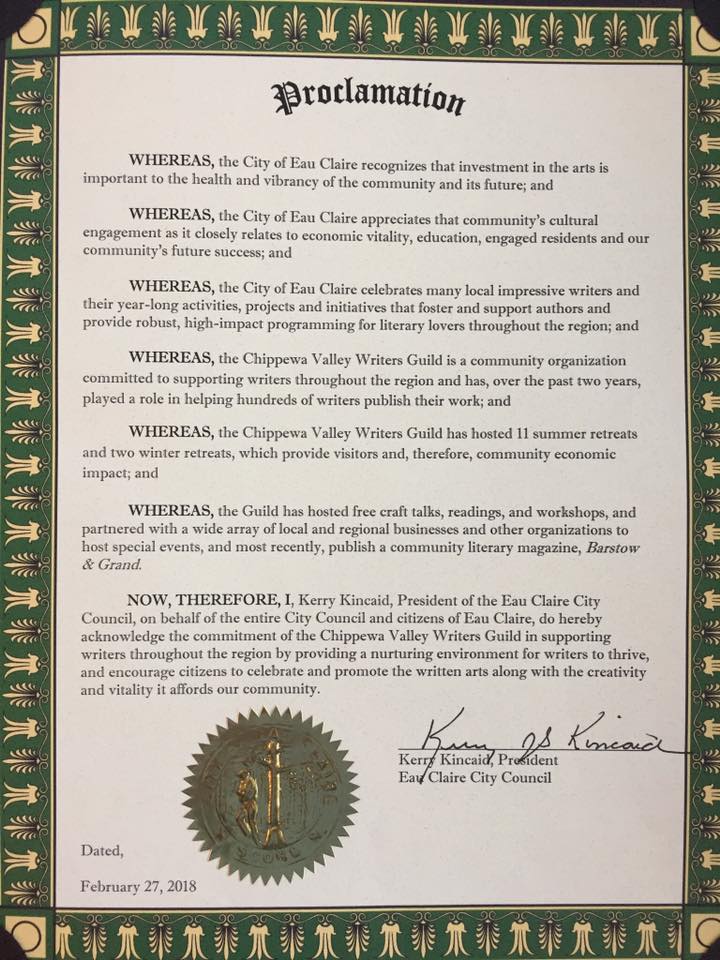
And already, our work is receiving notice.  In February, the Guild received more recognition than we could have hoped for.  For starters, on February 27 the Chippewa Valley Writers Guild received a proclamation from the City of Eau Claire in recognition for our commitment to the literary arts.  “Eau Claire values all the writers who live and work among us because they open our minds to what is familiar and challenge us to understand what is different,” said City Council President Kerry Kincaid.  “I am pleased to help elevate the craft to its rightful place among the arts.” And we’re pleased to accept such an honor.  

In addition, on February 9, I was extremely humbled to receive a Vanguard Award on behalf of the Guild’s work.  Once more, to be abundantly clear: this is your award.  Admittedly, my mug (rather embarrassingly) takes up all the air time on the recipient video (who says writing doesn’t make for good film?), but that doesn’t make this award any less yours.  For me, it’s a testament to the power of our literary community, and it’s a reminder, too, that people are paying attention.  

Now that our organization is a two-year-old, I fully except a lot of crying and temper tantrums in the days ahead.  (I imagine I’ll be the one doing both).  But on a more serious note, we’re at a point where there’s still so much to look forward to.

On that note, I’m pleased to announce the formation of 6x6, a new reading series to be held right here in the Chippewa Valley.  What’s 6x6 mean?  It means each reading will feature 6 readers for 6 minutes each.  The catch: once you read in the series, you’ll never read in it again.  This isn’t meant to be exclusionary.  Quite the opposite!  We have so many talented writers in this region that we can fill the series again and again and feature new voices every single time.

In short, we’ve already put some great days behind us, but we’ve got plenty more great days ahead.  Let’s look forward to the good work (and good writing!) ahead of us.

Cirenaica Spotlight: An Interview With Writer-in-Residence Holly Hughes

HJHughes.jpg

by Emilia Hurst

This summer the Chippewa Valley Writers Guild will be hosting five amazing writers retreat.  Over the next few months, we’ll be featuring one retreat in each of our newsletters.  This month, we’re excited to share a few behind-the-scenes details on our first retreat, “Words to Hold a Glittering World: Crossing Genres Mindfully” featuring Seattle-based writer-in-residence Holly Hughes. This retreat will take place from June 21-24.  

I recently had a chance to catch up with Holly and ask a few questions about her personal writing philosophy, as well as what potential participants can look forward to this summer:

Emilia Hurst: What do you feel is a unique experience or aspect about these retreats?

Holly Hughes: First, I appreciate the philosophy that I believe underlies Cirenaica: that we’re gathering to learn from the natural world as well as from each other;  that we’ll be combining writing instruction with time spent writing; and that the focus is on building a community of writers during the time we have together.  Writing workshops and retreats can feel intimidating, especially if participants feel that they’re in competition with each other.  I like to create a supportive atmosphere in which we’re all there to encourage each other to become the best writers we each can be.  And as a former seafarer, I love that Cirenaica means “siren of the sea.”  In my experience, the sea has provided a rich reservoir of imagery for creative work—and I think that can be true for the natural world in general.   

What part of the retreat are you most excited for?

I’m excited about all of it!  But I must admit I’m looking forward to returning to the Midwest for a few weeks—I grew up in Winona, Minnesota—so it’s a chance for me to experience the landscape of my childhood again.  Walking is definitely an important part of my writing practice, so I look forward to walking in a different landscape.   I’m also looking forward to experimenting with writing in different genres—and helping participants discover how crossing genres can feel freeing. 

What kinds of people would enjoy and benefit from this retreat?

I hope that my workshop will appeal to anyone who’s interested in words and place and how the two interact with and inform each other.  I also hope it’ll appeal to writers of both prose and poetry who share a willingness to write outside their comfort zone.  Finally, I think it will appeal to anyone who wants to experience a supportive writing community, where the focus is on exploring the craft of writing, though I will address questions about publication briefly, too.  

How would you say your latest poetry collection Passings is different from your previous publications?

Passings is unique in that it’s a chapbook focused on a specific subject:  extinct birds, an interest/passion  I share with BJ Hollars.  It’s also unique in that it’s a fine-art limited edition letterpress book—only 375 copies were printed. Like the birds, when they’re gone, they’re gone.  I hope it will raise awareness not only of the bird species we’ve lost, but those we’re in danger of losing as birds’ habitats and ranges are affected by changing weather patterns.  And finally, I included a short prose essay as a Preface to establish a context for the poems, so it’s an example of a cross-genre book.  

What can people expect to take away from this retreat?

Through the time-honored tradition of walking as a means of inspiration,   students can expect to take away a variety of strategies for connecting with both their inner and outer landscapes.  More specifically, they’ll also learn a few hybrid forms, such as the Japanese haibun, and do some collaborative writing, by working on a renga together.  I hope everyone will come to the workshop with an open, receptive mind—what the Buddhists call “beginner’s mind” -- and a willingness to try out new forms, all in an effort to hold the elusive beauty of our glittering world. 

What more could you ask for? Click here to apply today for this wonderful opportunity! 

From the Mouths of Writers 6: How do you get out of a writing funk?

pexels-photo-52608.jpeg

by Jeana Conder

Several months ago I set out on the task of asking local writers to answer a series of eight questions I compiled.  The responses I received are now creating our series, “From the Mouth of Writers.”  We hope that this series allows upcoming writers to gain knowledge from others with the same passion. 

This month’s question: How do you get out of a writing funk?

Allyson Loomis

The only cure for it is a hot shower, maybe a long walk.  Then I just have to sit right down again and stare at the glowing computer page until something occurs to me.   If I step away from a project for too long, it’s hard for me to reconnect with it.  I have to sit with it, persistently.  It’s a very boring process to watch.

Sandra Lindow

I don’t seem to have writing funks; although I sometimes go through periods of time when I don’t write much poetry, I can always write academic prose.  My critical book, Dancing the Tao:  Le Guin and Moral Development was published in 2012.  Right now I am writing about Nigerian-American writer Nnedi Okorafor.  With my poetry, I have recently turned toward modern sonnets and golden shovels for condensing my ideas.  A golden shovel takes a line from another poem or essay and those words in order become the first or the last word of each line.  Poet Ron Wallace has a book that uses haikus as golden shovels which recently inspired me to do this.  The result is a kind of conversation with the original writer over time.

Bruce Taylor

Write into it, write over it, around it, through it, just write. Get in motion, put something on the page, anything, put something else, then something else. When a writer says they can’t write, it usually means they can’t write anything that they think is “good enough.” The best advice I’ve ever heard was from William Stafford, “lower your standards.” There are, however, many different kinds of “funk” a writer can get into.

Jon Loomis

I sit down and write something.

Martha Qualey

I get out of the house.

Molly Patterson

I'm in a writing funk right now, unfortunately. I'm working on a new novel and putting words on the page, but they're terrible words and I know it, and I keep running up against dead ends. Generally, I just try to write through it. You have one bad day and the next might be better. But when it's bad upon bad for long enough, I'll take a break to work on something else. Lately, I've had edits to do on the novel that's coming out this summer, and that feels like easy work. Generating new material day after day, that's the hardest thing for me. There are no easy answers. You keep sitting down to do the work and you keep yourself from thinking that it requires magic to do it. Eventually, you'll have a good writing day—or even a good writing moment—and you'll start to come out of it.

Brett Beach

While in graduate school, I developed the habit of writing—which, if I had any wisdom to pass on, I would advise writers in a funk to do. It can be hard, I know, but I think one of the least appealing things I can do as a writer is complain to people about why I’m not writing. So I discovered that if I only wrote two days a week, say, and both days were the bad ones where the computer screen sat empty, the notebook page blank, or, worse, every line I wrote was insipid and uninspired, I’d have less reason to try again. It’s all bad, I’d think. I’ll never be a writer. I should quit.  

Instead I took a mathematical approach—probably the only time I’ve ever successfully used math. If I write five or six days a week, and three of those days are bad writing days, that’s roughly half, which is much better than one hundred percent. If one bad day is followed by a second, but I know that four more days of writing lie ahead, there’s an ease to the pain of the funk: maybe the third day won’t be so bad. Or, if it is, by sheer force of routine, I know I’ll still sit down to write on the fourth. The fifth might be good, or the sixth—and one tiny, good day is enough to make me try again the next day.

I’m also generous in what I consider a writing day: some days it is pen and paper, other times it is reading over old work. Sometimes I stare at the computer for an hour, and call it a day. Sometimes I read, and that feels worthwhile too—to remember why we do this.

Jay Gilbertson

Should this happen, and I suppose it has, I get the hell away from my desk and get thee outside! And, if it’s winter, which it is in these parts a great deal of the time, well, I can certainly find something to do. Writers are famous for finding ‘other’ things to do than write. Famous.

Nickolas Butler

I take a walk or go for a drive.

Cathy Sultan

I keep the problem in my head, mull it over and over until I have it figured out and then return to my computer.

Sandra McKinney

Sit with it; embrace it; love it and eat chocolate.

A Q&A With Poet Jeannie Roberts On Her New Chapbook, Writer’s Block, and Inspiration

Photo: Volume One

Photo: Volume One

by Emilia Hurst

Jeannie E. Roberts is the author of four poetry collections and one children’s book, her most recent being a chapbook, The Wingspan of Things. I recently had a chance to chat with her on an array of topics.  Check out what she has to say!

Emilia Hurst: What advice do you have for writers wanting to pursue poetry? 

Jeannie Roberts: My advice to writers wishing to pursue poetry is this: read as much poetry as possible, including the classics, sign-up for writing workshops, and invest in guides to understanding and writing poetry. There are a number of handbooks available. For beginning poets, The Poetry Home Repair Manual by Ted Kooser is a good one. Also, attend a local writing critique group, and write, write, write ― every day, even for a few minutes. The more you write the better you become at your craft. Lastly, if you find that poetry is truly your passion, one you'd like to make a career out of, think about obtaining a degree or two, perhaps even an MFA in creative writing.

Can you explain the process you go through when writing a poem? 

My process depends on what kind of poetry I'm writing. If it's an ekphrastic poem, words inspired by a visual image of some sort, the image really drives my words and imagination. If it's a poem inspired by an experience, usually a first line or a title emerges. From that emergence, my words tend to flow quickly. If it's a poem that requires research, which many of my poems do, I begin researching (accuracy is important). When I begin a poem, the first few drafts are handwritten, in pencil. Around the fourth draft, I transfer my words to a Word document, where I revise it. Usually it takes between 10 and 15 drafts until I'm satisfied with a poem. Toward the end of my revisions, I record myself reading the poem; I read it multiple times, listening for awkward transitions. It's here the fine-tuning takes place, small word changes, etc., until the flow and cadence feels right. A poem is meant to be read aloud; its aural integrity makes all the difference. 

Does writing energize or exhaust you?

Typically, writing energizes me, especially creative fiction; however, dry, technical writing tends to exhaust me. I love a good dip into the imagination, that is what truly enlivens and energizes me. 

What can you tell us about your latest collection? Is it more different or similar to your past collections and how so? 

My latest collection, The Wingspan of Things, is a poetry chapbook published by Dancing Girl Press (Chicago, IL). This book is dedicated to my son, includes sixteen poems, and its cover displays my nature photography. Most of the poems included in this collection have been published in journals and other online magazines, including Volume One's Local Lit section. Some of the poems in The Wingspan of Things have also appeared in my other poetry collections (Beyond Bulrush, Nature of it All, and Romp and Ceremony), but there are some new poems included, too. The work in this chapbook is similar to Nature of it All (Finishing Line Press, 2013) with many poems about nature, in particular birds, butterflies, and other winged-creatures. It contains moments surrounding and memories of my son, and suggests the fleeting nature and flight of things, including parenthood. Jason Splichal, local teacher, writer, and founder of Sky Island Journal wrote this about my chapbook: "The Wingspan of Things is a luminous journey through landscape and memory, and Roberts' elegant craft and subtle sense of rhythm are constant companions throughout the collection. Few poets can transport readers, from the tactile to the spiritual, the way she can." 

Do you believe in writer's block? 

I believe there are fallow periods for writers, not necessarily block. Fallowness can be a time of inactivity, where new ideas can develop and percolate. Thirteenth-century Persian poet Rumi sums up this idea of fallowness (which is liken to winter) quite nicely in this quote: "Do not think the garden loses its ecstasy in winter. It is quiet, but the roots are down there riotous." 

Where do you most often get your writing inspiration? 

I find inspiration just about anywhere, but especially while exploring our natural world. Outdoor activity, biking, hiking, and walking, exhilarates my Muse. I do find that prayer and meditation, quieting the mind, listening internally, has also been an integral part of my writing process and inspiration. 

I'd like to add . . . The majority of my work includes richly crafted descriptions of our natural world. Through the cycle, impact, and imagery of nature, I try to create a framework where the reader can find meaning and commonality within their own lives. My poetry is typically written in free verse, but I also enjoy exploring poetic forms, including found poems and crown sonnets. Within my work, I tend to use the same literary devices, including assonance, metaphor, simile, analogy, imagery, alliteration, internal rhyme, rhythm and rhyme.

Dear Writer - February 2017

Dear Writer, copy.png

Dear Writer,

I am a few years into taking writing seriously and I mostly have rejections to show for it. When my family asks me how the writing’s going, I always just blush and reply, “Good.” In the back of my head I am thinking something different. In fact, I wonder if I can even call myself a writer! Just about every place I have submitted to has rejected my work with nothing more than a form letter. It’s hard to say what I am doing wrong, but to put it bluntly, it feels like everything. How can a writer who is both young in age and in experience keep going when it feels like the deck is stacked against him?

Sincerely,
Young & Not Having Fun


Dear Young & Not Having Fun, 

I started writing sporadically in middle school, right around the same time I began to take running seriously. I’d run, I’d write, and I’d hope I was improving, at least a little, in both realms.  After logging enough miles, I began to see a clear correlation between the two activities.  First, running helped me develop my work ethic, something that comes in pretty handy when trying to find time to write. Since we were hitting 60+ miles a week, I had to run in the morning in addition to afternoon practices just to hit my mileage. Although I didn’t continue running competitively beyond high school, the chance to see how hard work can pay off did wonders for my writing life.

There were other similarities, too.  In particular, how distance running may seem like a solitary sport (like writing!), but the truth is, you’re always part of a team. While competing we were a team of “individuals”, though throughout the most important part—the training—we always suffered together, strengthening the bonds between us. When one person was down, we knew what they were going through because we had all been there ourselves.  We knew how to fix one another when we felt broken. 

Upon entering college, I left running behind and focused my efforts exclusivity on creative writing. In an attempt to prove myself, I’d submit everywhere, only to get rejected.  At which point I’d scream my head off at open mics only to make a fool of myself. Suffice is to say: those were some rough times in my life. Without any sort of team to fall back on, I started to question if I had made the right choice.

Up until that point, writing had always been fun. Bringing in the competitive notion of submitting sprouted so much unneeded stress that I just stopped writing creatively for a few weeks before I realized I was wasting my time by not writing. 

With a few things changing in the years following my initial experience as a writer, the most important was putting myself out there. Not always in terms of submitting or reading, but going out into the community and meeting other writers who either went through the same thing, or were going through it at the same time. Knowing that I was not alone in this endeavor to try and make something of my work reminded me of my cross country team. Regardless if you ever had a team, there is a community of writers out there who want to help you. Luckily, in the Chippewa Valley, we are full of them, and not to mention, experienced writers willing to give craft talks or workshops because they were once in your shoes.

Young & Not Having Fun, I hope we cross paths someday so we can go through this together.  For now,  just know that you are not alone.  If running taught me anything, it’s that life should be measured in miles rather than sprints.  Enjoy the journey, enjoy the scenery, and remember: we’re only young once. We should not waste it worrying.

Sincerely, 
Writer

Check Out 6x6: A Reading Series

6x6+Reading+Series.png

Welcome to 6x6: A Reading Series

What happens when we give 6 readers 6 minutes each to share their finest work? 

Welcome to 6x6, a new reading series sponsored by the Chippewa Valley Writers Guild.  Our inaugural reading will feature Jennifer Hazen, Jennifer Golat, Aimee Johnson, Anders Shafer, Paul Thomas, and Dan Zerr. It will be hosted by co-founder Jan Carroll.

“This series is all about getting new voices out in the community,” said Carroll.  “Fresh voices from a lot of different disciplines.”

P&P4.jpg

In an effort to do so, in addition to featuring 6 writers each reading, there’s another catch: once someone reads as part of the series, they'll never read in the series again.  “It’s not about being exclusive,” says BJ Hollars.  “It’s about ensuring that we can get as many new folks in front of the mic as possible.”

In a literary community as robust as ours, filling the slots will hardly be a problem.  In fact, Hollars believe the number of interested readers will likely ensure the series’ longevity for years to come.

Do you want to have your 6 minutes at the mic?  Shoot us an email at chippewavalleywritersguild@gmail.com with “Sign me up” in the subject line.  We’ll add you to the list, and you’ll hear from us soon. 

The inaugural reading will be held at The Volume One Gallery at The Local Store on Tuesday, March 6 at 7PM.  Swing by and support our 6 readers!

National Book Award Finalist Carmen Maria Machado to Be Featured In Video Discussion at The Oxbow Hotel

download.jpeg

by Emilia Hurst

On Sunday, February 25 at 7pm, Dotters Books will host National Book Award finalist Carmen Maria Machado for a Skype conversation at The Oxbow Hotel.  Machado is a short story author, essayist, and critic, and has been published several times in The New Yorker, Granta, and Lightspeed magazine to name a few. Dotters Books’ book club has selected Machado’s short story collection, Her Body and Other Parties, for their first book of 2018. 

“Last year, our book club held a virtual discussion with Bryn Greenwood, the author of All the Ugly and Wonderful Things.  It was one of the highlights of the year, as it gave us a better appreciation and understanding of the book,” says Dotters Books co-owner Elizabeth de Cleyre.  “So we jumped at the chance to have a virtual discussion with Carmen Maria Machado. Her short stories are modern fairy tales oft steeped in popular culture (like rewriting almost 300 episodes of Law & Order: SVU) and its treatment and impact on women's bodies and psyches. Since Machado's work is very of the now, a virtual discussion with her seems like the best medium.”

And for Dotters Books, this virtual conversation is only the beginning.

“Traditionally, authors went on long and exhausting book tours and then disappeared into their studio to write again. Using Skype, FaceTime, or video conferencing, we're able to connect with authors year-round, in a way that's a lot lighter on their schedules, the environment, and the bookstore's overhead. In this way, we can offer frequent and free events to the community that promote culture and ensures the sustainability of a bookstore.”

Be sure to join Dotters Books and the Chippewa Valley Writers Guild at the Oxbow Hotel Gallery on Sunday, February 25 for this exciting event!  

February 27: Chippewa Valley Writers Guild to Receive Proclamation from the Eau Claire City Council

marketing-man-person-communication.jpg

On Tuesday, February 27 at 4:00p.m. the Chippewa Valley Writers Guild will receive a proclamation from the City of Eau Claire in recognition for the Guild’s commitment to the literary arts.  “Eau Claire values all the writers who live and work among us because they open our minds to what is familiar and challenge us to understand what is different,” said Council President Kerry Kincaid.  “I am pleased to help elevate the craft to its rightful place among the arts.”

Since its founding in February of 2016, the Chippewa Valley Writers Guild has worked hard to provide an array of high-impact educational opportunities for residents of the Chippewa Valley and beyond.  By way of writers’ retreats, craft talks, a robust newsletter, and other events, the Guild has continued to showcase the vibrancy of our region’s literary community.

“It’s an honor to receive formal recognition from the City of Eau Claire,” said Guild executive director B.J. Hollars.  “This region’s support for the arts is well-known, and by working closely with city officials, I’m certain the arts can continue its upward trajectory.”

Craft Talk Preview: Hit a Home Run In Sports Writing

basketball-933173_1920.jpg

Emilia Hurst

I recently had the chance to talk with Joe Niese and Nick Erickson about their upcoming craft talk.  Here’s a preview of what we have to look forward to! The event is on Tuesday, February 20th at 6:00pm at the Galaudet Gallery (618 S. Farwell Street).  See you there!

EH:  What are your favorite sports to write about?

Joe Niese:  I’ve strictly written about baseball up until my latest book about Gus Dorais, a famous football player from Chippewa Falls. I’m always looking for a good story and would love to broaden out to other topics, whether they are sports-related or not.

Nick Erickson: I really like to cover hockey because there are so many nuances in the game that multiple plays can become instant story lines. So much goes on strategy wise that the regular viewer may not see, and it's fun to uncover them. Also, the hockey players I have spoken to have been some of the most polished and respectful people I've been around, so that always makes it a plus.

 EH: How did you get into sports writing?

Joe Niese:  I started writing shortly a few years after I stopped playing organized baseball locally. I was working at the Eau Claire Public Library and they had just digitized a bunch of early 1900s newspapers. I keyword searched “baseball” and haven’t looked back. My first article was published by the now defunct Wisconsin West Magazine over a decade ago.

baseball-454559_1920.jpg

Nick Erickson: My father was in sports media and I grew up in locker rooms, practices and games. And I think many sports writers will tell you there's a professional athlete that didn't make it in us still, so writing about it is the next best option.

 EH: What kind of tips can we expect from your talk?

Joe Niese:  I’ll talk about the marathon process that can be researching a book. I also have a background in traditional publishing and self-publishing, having done both.

Nick Erickson:  I think the most important thing in sports storytelling is the creativity it can bring out in a writer and large range of audiences you can bring in. You have to think so much more than just how a game turned out. Who were the people involved? What were their back stories? Why is this event important to so many people? That's what you constantly have to be thinking.

 EH:  What's your favorite thing about doing sports writing?

Joe Niese:  First and foremost, I enjoy the individual’s journey. I love the minutiae of people’s lives, too. For the longest time People magazine was my guilty pleasure read. I’ve always been sports-minded, though, and read dozens upon dozens of sports-related books and biographies through my teens and early-20s. Being able to emulate that has been a surprise and a great joy in my life.

Nick Erickson:  It gives you the opportunity to meet so many people, and there's a lot of adversity in sports than can make for the best stories if someone overcomes them or is trying to.

And that’s just the beginning.  For more on how YOU can become a sportswriter, be sure to check out our craft talk, “Getting The Ball Rolling: Sports Writing from 300 to 100,000 Words And All The Words In Between” at the Galaudet Gallery on February 20 at 6:00 pm!  Come for the craft talk, stay for the cracker jacks and cold ones!  (Really!  Free food and drink!)


Planners vs. Pantsers: Which Are You?

1.jpg

By Katie Venit

Rumor has it there are two types of writers: planners and pantsers. Planners outline the heck out of a piece. They know every scene, plot twist, and character’s favorite color, all before firing up the word processor. Pantsers (those who fly by the seat of their pants) don’t do any of that. They wait until the muse moves them, then they simply record what it says. They let the characters decide their own fates and are excited to write because they want to find out what happens. 

The reality is that most of us are planner/panster hybrids, and could benefit from some casual prewriting planning. Drawing graphic organizers like mind maps can generate ideas or explore unconscious connections between topics.

Start by writing a word or phrase in the middle of a piece of paper. Let’s say, “apples.” Branching from that like legs on a spider, connect “apples” to whatever associations that word brings to mind: tree, pie, fall, apple of my eye, Lowly Worm, Apple Dumpling Gang, comfort food, crisp, sweet, Gramma.

If one of your associations seems especially rich, such as “tree,” branch associations off of that: shoe trees, climbing trees, wood, carpentry, family trees, tree of life, Adam and Eve… whoa. Adam and Eve branched off of “tree,” but it also connects to “apples.” Draw a line from “Adam and Eve” back to “apples,” connecting the two. That might be an interesting theme. “Family tree” is another area that seems intriguing. How can you connect “family tree” with “apples”?  Could “Gramma” be the connection? 

Does a particular area of the map calls to you? If so, that might be a rich direction for your story. 

You can do this on your own, but it’s really fun with your writing group. Set a timer for 10 minutes and quickly map words without second guessing your choices. When everyone finishes, take the group through your map, explaining the associations and what parts intrigue you the most. 

Variations

Everyone creates a map on the same topic. Compare and contrast. This is a great team building activity that offers a window into how your groupmates think. 

Related to the above, consider having everyone draw mind maps for one of your member’s specific projects. These maps can provide inspiration when it comes time to write.

Everyone draws maps using different word prompts then share. What areas are most intriguing? Despite being drawn from different words, do the maps inform each other somehow? 

If everyone maps different topics, trade maps and spend another few minutes adding to someone else’s map.

Work simultaneously on the same map. You might not need a timer for this variation; just work until it’s finished. 

After finishing the maps, spend 30 minutes writing drafts based on the maps (trade maps or have everyone work on their own). Maybe the challenge is to write an entire piece or maybe it’s just the first paragraph. 

Distance variation: The internet has a plethora of free mind mapping tools out there. Create one, and email it to a partner. 

Dear Writer - January 2017

Dear Writer, copy.png

Dear Writer,

This is it. This is the year I start writing. The year I decide to put pen to paper and tell the story that’s been burning inside me for a long time. But how do I get started? And more importantly, how do I keep going, once I get started? 

Signed,
#NewYearNewMe


Dear #NewYearNewMe,

This is wonderful news一welcome to the world of words and writing. There’s nothing more rewarding than watching something that existed solely in your mind find its voice on paper. And, since the frigid temperatures and snow are probably keeping you indoors, there’s no better time to write. 

Your question is one that I’m sure many writers (and those who have made other kinds of resolutions) are wondering about. You’ve made the decision that 2018 will be the year of writing. But how do you do it? How do you find the motivation after an eight-hour day at work or after a full day of classes? After all, your desk isn’t nearly as comfortable as the couch, and your couch is likely positioned in front of the TV, which also, probably, has Netflix. Oh, the temptation…

I’m so glad that you’ve decided to be a writer, and that you woke up on the morning of January 1st still excited by the idea. But it’s not enough to say you want to be a writer. You also need to put in the work. You need to find the motivation even if it doesn’t seem to be there. Writing isn’t something you do my accident一you really need to sit down and make it happen.  

So, #NewYearNewMe, how do we make writing a seamless part of your life? How do we make sure that this resolution is successful and doesn’t end up like most expensive gym memberships come February (hey, no judgement! We’ve all been there)? 

My first suggestion is to schedule time into your calendar. Yes, I know that this isn’t the sexiest piece of advice I could offer, but it’s the most important. There will always be a reason not to write. You have homework. You had a long day at work and all you want to do is binge-watch reruns of your favorite show. Your house or apartment needs cleaning, or you need to make a meal for your family, or you need to bring the kids to various activities... 

There will always be something that you could be doing instead of writing. And while all of those things are important, if you’re truly committed to bringing your stories or poems or essays to life this year, you need to treat your writing like it’s important, too. 

That means scheduling in writing time, just like you would pencil in other obligations. To start, pick two or three days a week where you can set aside an hour to write. Maybe you’ll exceed that time, or maybe you’ll only get to work for half an hour一that’s okay! So long as you sit down and write some words, that’s all that matters. Whether you write a poem or an essay, or you write a letter or postcard to your best friend, write something. Set up recurring meetings in your Google calendar or iPhone, and get notifications or reminder emails sent to you so that you hold yourself accountable. 

The next thing you need to do is to find your tribe. Find the people who will help keep you accountable. The people who will be your cheerleaders while also giving you constructive (and positive!) feedback to help you grow in your writing. The people you can call up or email when you’re having writer's block, or need help deciding on which direction to take your story. 

Chances are, if you’re reading this, you live in or near the Chippewa Valley region in northwestern Wisconsin. If you do, that’s great news for you, because the perfect writing community exists right where you are. 

With the Chippewa Valley Writers Guild, you can easily find writing groups to join (or start your own!), and attend free Craft Talks that cover a wide range of topics that will enhance your writing. Remember, a strong, positive community is crucial in keeping you motivated in your work. So while you’re adding your writing time into your calendar, make sure to pencil Guild events into your calendar, too. 

So #NewYearNewMe, that’s what I have for you. You already have the most important parts of all of this (the words and creativity). Now all you need to do is set that schedule, find your people, and get to work. I can’t wait to see where your writing takes you this year. 

Good luck, and Happy New Year,
Writer


From the Mouths of Writers 5: What is your favorite book?

pexels-photo-264635.jpeg

By Jeana Conder

Several months ago I set out on the task of asking local writers to answer a series of eight questions I compiled.  The responses I received are now creating our newest series, “From the Mouth of Writers.”  We hope that this series allows upcoming writers to gain knowledge from others with the same passion. 

This month’s question:  What is your favorite book?

Allyson Loomis

My favorite book of all time is To the Lighthouse by Virginia Woolf.  Part of my loving that book has to do with my having read it for the first time long ago with a very good English teacher, who I also loved, but I’ve gone back to it again and again, and I find it increasingly gorgeous and moving.  Also, I happen to be thinking about Woolf today.  If you had asked me the same question yesterday I might have said, Ragtime by E.L Doctorow.  If you had asked me the question last Sunday I might have said Friend of My Youth by Alice Munro.  I’ve got a lot of favorite books.  Have you got six or seven hours?

Sandra Lindow

That’s a terrible question.  To single out one book out of many is like having to make Sophie’s Choice.  William Kloefkorn’s Alvin Turner As Farmer and Dave Etter’s Alliance, Illinois were very influential in the 80s as I started publishing.  Later it was Ursula K. Le Guin’s poetry and prose, particularly Always Coming Home which combines poetry and fiction to tell a story about a post-apocalyptic Northern California.  Right now my favorite book is Mary Oliver’s book of short essays Blue Pastures, which is an intimate look at the writing process.

Bruce Taylor

Maybe, the next one I read.

Jon Loomis

I don’t think I could identify a favorite.  I have lots of favorites.  I’m currently reading a lot of ancient history—the silk roads, the Vikings, the Mongols, Rome.  Fascinating stuff.  Part of our national problem, I think, is how quickly we seem to forget everything.  We’re like a country of amnesiacs, wandering around without any landmarks.  No wonder we seem so lost.   

Molly Patterson

My favorite book, without question, is Middlemarch, by George Eliot. I've read it seven or eight times, at least, and every time I love it as much or more than ever before. It's a book that you can grow with; you'll relate to different characters at twenty-two than you do at thirty-two (and presumably forty-two, and fifty-two, and sixty-two, though I haven't gotten to those ages yet). Middlemarch is set in the 1830s, but the dilemmas the characters face, the compromises they make, the flaws they display, the contradictions they encompass—it's all as relevant to me, today, as any book set in the modern period. As a writer, I admire George Eliot's perspective and voice in the novel--it's a grand, nineteenth-century narrator, not afraid to soliloquize or make pronouncements or philosophize. As a reader, I feel like these characters are friends I'm always happy to meet again, every time I open the book. 

Marsha Qualey

The Translator by Ward Just.

Brett Beach

My favorite book is the novel The Transit of Venus by Shirley Hazzard, an Australian author who unfortunately passed away in December of 2016, not long after the Irish-living in-England author William Trevor. It was a rough time for me as a reader. Hazzard is my favorite writer, without comparison, and the novel my absolute ideal. The novel tells the story of sisters, Caro and Grace Bell, tracking their lives from their orphaning in childhood through the separate paths their adult lives take, while also tracking a number of people in their lives: a prisoner of war from the Second World War, a playwright and his troubled son, a member of the United Nations, an astronomer, and the sisters’ troubled, delightfully and accidentally villainous aunt. But it is also a novel so beautifully written, so intricately plotted, and so transcendently wise and engrossing that each time I return to the book, I learn something new about how to write, and how to read.  (Though for sheer repeat-ability, I would also include George Eliot’s Middlemarch, Zadie Smith’s On Beauty and White Teeth, Edith Wharton’s The Age of Innocence, Toni Morrison’s Song of Solomon, and all of Alice Munro’s work.)

Jay Gilbertson

Other Voices, Other Rooms by Truman Capote. I read it nearly every spring. I have read all of his work. He is a master and very underappreciated. He saw humans and nature and love and hate and all the in-betweens with such clarity and openness and pain.

Nickolas Butler

There are too many favorites.  The Old Man and the Sea is a standby, for sure.  Also, East of Eden.  This is an impossible question to answer.

Sandra McKinney

Anything by Anne Lamott

Cathy Sultan

That’s a very hard question to answer because I have many but if I had to choose one it would be The Constant Gardner by John le Carré.

5 Reasons You Shouldn’t Be A Writer (and the One Reason Why You Should)

pexels-photo-261470.jpeg

by BJ Hollars

A few weeks back I was asked to join a panel of writers at GeekCon, a wonderfully successful event held on the University of Wisconsin-Eau Claire campus.  The event featured all kinds of creatives: sculptures, comic book artists, Lego builders, game players, role players, among others.  In preparing for the panel, I tried brainstorming a list of reasons why people should be writers.  About ten minutes into my brainstorm, mostly all I’d come up with were reasons why maybe we shouldn’t.  My list reads as follows:

Reasons Not to Be A Writer:

1. Most of us will never find our books at Barnes & Noble (translation: fame is rare).

2. Most of us will never make a living doing it (translation: riches are rare).

3. Most of us will never receive the recognition we think we deserve (translation: even the people who love us will likely give us little more than a skim and a “like” on social media).

4. Most of us will feel personally unrewarded for our efforts (translation: it’ll never feel good enough).

5. Most of us can barely even fess up to being called writers.  

(This last one might be related to my own personal neurosis.  When people ask me if I’m a “writer” I generally say “I write”—opting for the verb, instead.)

As I chewed on the eraser of my pencil, trying to figure out what bit of optimism I might bring to the panel, I was at last reminded of the main reason why I write.  Because for me, writing is the most direct and democratic mechanism to connect with the human heart.  For the price of a pencil and a notebook you can bypass geography and social circles and tax brackets and potentially make a difference in another person’s life.  Through your work, you might be able to offer the precise words that someone else desperately needs to hear.

On a few rare occasions in my life, I’ve been the recipient of such kindnesses.  Once, while at a conference, a stranger ran up to me with a literary magazine I’d published in, and she asked me to autograph it.  “I read this essay probably once a week,” she said—blowing my mind.  And then, in an effort to blow it further, added: “I’m a farmer, and I like to read it on the tractor.”

I lifted a skeptical eyebrow.  Not only had this person enjoyed the words I’d written enough to read them more than once, but she’d enjoyed them so much that she read them while farming!  Not in a million years could I have predicted that my humble piece might have touched a stranger so deeply.  But in this instance, it had.

And that, of course, is true for all of us.  We all possess words and stories that have the power to connect with the human heart.  And while it’s easy to get bogged down with all the reasons why we ought not to write, focus instead on the one reason why you should.  We do it to connect.  We do it because it feels good to be heard.   And sometimes, in doing so, we remember that sometimes our words matter to others, too.    

ecWIT to perform work by Local Authors This January and February

Screen Shot 2018-01-30 at 1.43.54 PM.png

by B.J. Hollars

Calling all dramatic reading lovers!  This January and February ecWIT (Eau Claire Women in Theater) will be performing work by local authors during two performances.  The first will be held at The Local Store at 7PM at January 31 with a follow-up performance at the Altoona Public Library at 2PM on February 3 at 2PM.  Adaptations of work by Karen Loeb, Rob Reid, Bergine Haakenson, Sara Bryan, Patti See, Debbie Brown, BJ Hollars, Jim Alf and Ken Szymanski will be featured at the performances.

See below for a brief statement from the ecWIT crew:

We are all local performance artists and educators who celebrate our love of reading and writing through the dramatization of interactive characterizations without set, props, or costumes. Our combined years of theater and performance involvement totals more than 200 years! This year’s winter show, “pEAUpourri” features the writings of 9 Eau Claire authors and poets, and it has been a particularly exciting and humbling writing task to do each of these amazing pieces’ justice in its adaptation to our art form of dramatic reader’s theater. Dramatic Reader’s Theater intends to bring a true theater experience anywhere to anyone without the “distractions” of a big stage experience. Our goal is to create believable characters that an audience will care about and that’s why interaction between our characters is pivotal.  

For more, check out their Facebook page here.