Sky Island Journal Offers New Way of Publishing Work

by Jeana Conder

Want to submit that flash fiction or poetry work you just created?  Don’t know where?  

Well local author and teacher Jason Splichal created a solution. Sky Island Journal is a new international online journal that accepts fiction and creative non-fiction pieces that are under 1,000 words.  Sky Island Journal will also accept up to three poems in a single document.  All submissions are made on Submittable and must be accompanied by a $3.00 fee to keep the journal advertisement free and focused on the works and writers. Sky Island Journal has a quarterly publishing with summer 2017 being their first issue; the deadline for this issue is June 30. 

The mission of Sky Island Journal is “to price our readers with a powerful, focused, advertising-free literary experience that transports them: one that challenges them intellectually and moves them emotionally.”   Jason has written six books of poetry and his works have been featured in local magazines such as Volume One.  Sky Island Journal has pages on Facebook, Twitter, and Instagram.  Questions can be fielded to skyislandjournal@gmail.com.  The Chippewa Valley Writer’s Guild is proud to support Sky Island Journal, and we hope you’ll join us in supporting the new journal.  

Link: http://www.skyislandjournal.com 
Email: skyislandjournal@gmail.com.


Craft Talk Rewind: Jumping into the Unknown with Speculative Fiction

Charles Payseur

Charles Payseur

By Karissa Zastrow

Speculative Fiction is used as an umbrella term for genres like fantasy, science-fiction, and horror. All of these genres have one thing in common: they push the boundaries of reality. Speculative fiction tends to ask the question “what if,” as do most stories, but they take it to the next level by throwing out the rulebook of reality and breaking at least one of the rules. In fact, you can create your own rule book. Write a story about dragons going scuba diving or time travel back to the Ice Age and go snowboarding—the choice is yours!

Our brains are always trying to figure out what is real and true in the world, but in reality we don’t have all the answers, which is why speculative fiction works just like fiction and non-fiction. The brain knows this and wants to believe the stories, which invoke that same type of anxiety that attracts us to a book of realistic fiction. After all, strange and unlikely stories still have things to teach us.

Charles Payseur describes speculative fiction as a genre of revolution and change. By throwing out the rule book, speculative fiction shows us that change is possible and it is happening. Speculative fiction can be applied to reality in a way that pushes people to strive for change and create a better world for the future. Imagine if people just accepted the way the world is and never pushed the boundaries.  If we want to make a difference, we need to think about how the world can change.

Within speculative fiction, there are many subgenres and there is a following for each and every subgenre out there, even in publishing. Typically, if you submit a speculative fiction story, you don’t have to pay a reading or submission fee and if they choose to publish your story, you are going to get paid. Most places pay 6 cents or less. If you are paid 6 cents or higher, you are considered to be writing at the professional level and to be recognized by the Science Fiction & Fantasy Writers of America you need to get paid at the professional level for 10,000 words.

Payseur offers a lot of advice when it comes to what you should do after you are done writing a story:

  1. Don’t panic.

  2. Consider finding a place to workshop it. There a lot of places to get support for your story. In Eau Claire, there is the Chippewa Valley S.P.A.C.E.C.A.T.s, which Payseur founded. They meet every three weeks in person. There are also online options such as Critters.org, or once you have published something, you can join Codex.

  3. Submit! Once you have completed your story, it’s time to submit to different publications. He suggests using a site like Submissions Grinder or Ralan.com to track your submissions.

  4. Submit More! You will get rejections and it will suck, but you have to take it with a grain of salt. Yes, rejection is hard, but you have to keep going. Sometimes editors offer advice. You can choose to listen to them or not. Ultimately, it is your story, so you can make the decisions. If you get rejected, you can always send your story out again.

  5. Sell (or not). Not every story will sell, but that’s okay. If it does sell, remember to read the contract. Pay attention to what rights you have and how long they will have possession of your story. Usually, they will have your story somewhere between 3 and 6 months. Another detail to look for is when they will pay you for your work. One you sell, don’t be afraid to promote your writing and get your name out there.

  6. Write a New Story!

Payseur urges writers to find ways to keep you going, even when you get rejection.

Remember, there are people out there who like your writing and support what you do, like the Chippewa Valley Writers Guild. So writers, are you ready to throw out the rule book and jump into the unknown?

5 Reasons to Sign Up for Marsha Qualey’s Young Adult Fiction Residency – Today!

Marsha Qualey • Image: Addendum

Marsha Qualey • Image: Addendum

by Erin Stevens

Have you dreamed about writing the next big Young Adult fiction novel? Wish you had to a professional, YA author to learn tips and tricks of the genre? Say no more! Now, with the 2017 season of residencies at Cirenaica only a few short months away, writers who have an interest in writing YA will have the opportunity to learn from THE Marsha Qualey, a prolific YA author.

➜ Learn about Marsha Qualey's Summer (2017) Writer's Residency at Cirenaica

Here are five reasons to spend three days working on your craft with Marsha Qualey this summer:

1. Qualey brings her numerous accolades to Cirenaica.

She has two Minnesota Book Awards and appeared on numerous best-of-the-year lists, including ALA Quick Picks and Best Books for Young Adults, IRA Young Adults' Choices, New York Public Library's Books for the Teen Age, and School Library Journal's Best Books of the Year. Her novel, Thin Ice, was nominated for an Edgar Award by the Mystery Writers

2. Work with an MFA professor.

Yes, you read that right! Marsha Qualey is a professor at Hamline's low res MFA program. This is your opportunity to learn from a real-life MFA professor. Not only will you get great feedback, but this is your chance to ask your burning questions about applying to and being enrolled in MFA programs. 

3. A chance to wow the crowd.

On the last night of the residency, you and your residency attendees will have the chance to read your original at a reading that is free and open to the public. This is your moment to let the world (okay, maybe not the world, but at least residents of the Chippewa Valley) hear what you have been working so hard on!

4. Take a break from “adulting” to be a kid again.

If you’ve been spending too much time in the adult world, getting lost in the work problems, trading in your writing time for paying bills, the YA writing residency at Cirenaica will allow you take a timeout from your regular day to be a kid again. Work on your own YA novel, or reconnect with the books and authors who inspired you to start writing YA. 

5. Special Guest Julie Bowe will make an appearance.

Eau Claire’s very own middle-grade author will stop by to discuss and answers any questions you may have about writing stories for young readers! 

If all these reasons sound great to you, what are you waiting for? Mark your calendars for July 21-24, and get your application in right away! Spots are filling quickly and our May 1 application deadline is just around the corner, so brush off your manuscript and submit right away! 

5 Reasons To Sign Up For New York Times bestselling author June Melby’s Memoir Residency

June Mebly (Image: Parker Deen)

June Mebly (Image: Parker Deen)

by Erin Stevens

When writing memoir you have to stick to the truth.  You can’t invent characters, or make your mother into a Soviet spy.  You might have an uncle who’s interesting, but he’ll shoot you if you tell. So, how do you keep the reader riveted?  Are you expected to reveal your most embarrassing family secrets?  What are the ethical lines, and how do you keep from crossing them? Join New York Times bestselling author June Melby (My Family and Other HazardsHenry Holt, 2014) for three days focused on writing and revising highly readable narratives from real events in your life.  

Learn about June Melby's Summer (2017) Writer's Residency at Cirenaica

See below for five fantastic reasons to spend three days working on your craft with June Melby this summer:

1. Share your work with a New York Times bestselling memoirist

It takes a special kind of writer to make the New York Times bestseller list, and June is that special kind of writer!  Her debut memoir, My Family and Other Hazards has been hailed as “enchanting” and “an outpouring of tender, witty memories” according to Publisher’s Weekly.  Click here for an excerpt.

2. She knows Wisconsin

Having grown up in Wisconsin, June knows our region well.  And not just geographically, mind you, but emotionally as well.  As proof, check out this delightful piece, “Don’t Go To Wisconsin,” featured on Wisconsin Public Radio’s “Wisconsin Life” by clicking here

3.She was the voice of the alien Bang in Space Jam

Maybe it’s a stretch to say June co-starred alongside Michael Jordan in the movie Space Jam, but her voice certainly did!  In addition to being a fine writer, June has also done some cool voice work, recorded CDs, won poetry slams, and much more.  According to her website, she is a writer, spoken word artist, and yes, even a mammal!  To learn more about her diverse talents, click here.

4. She loves chocolate

Or at least calls upon chocolate for the answer to any truncated questions by us!  See this interview for more about chocolate, her influences, and what to expect this summer at Cirenaica.

5. Special Guest BJ Hollars

Yes, the Chippewa Valley Writers Guild’s founder and UWEC’s very own BJ Hollars will swing by to talk about his latest nonfiction project.  And if you ask nicely, maybe he’ll even regale you with stories on extinct birds, Bigfoot, and his typewriter collection.  (Well, he’ll probably “regale you with stories” on these subjects whether you ask nicely or not…don’t say we didn’t warn you!)

What are you waiting for?  Give yourself the gift of time, support and community this summer.  Click here to apply for June Melby’s “The Art of Memoir” today!

Living to Write

by Karissa Zastrow

I think the best advice I was given about writing had little to do with the technique of writing at all. As a creative writing student, I was given a lot of advice on how to write, such as kill your darlings, put every word on trial, and show, don’t tell. All of those recommendations are important, but looking back, the best piece of advice I received had nothing to do with how I was writing. On the last day of my fiction writing workshop class, our professor told us in order to become better writers, all we had to do was get out there and live.

At the time, I thought I was living. After all, I was going to class, working, doing homework with coffee, and drinking every night, sacrificing sleep because you never know what could happen. Yes, those were fun and exciting times, and I always had plenty to write about, but you can’t live like that forever.

Four months later, I found myself in my first full-time job, where I let my life be ruled by work, unable to figure out how to find a decent work/life balance. I saved the weekends for trying to keep up with my old lifestyle, but even then, it wasn’t the same. I thought that once I graduated, I would have all this time to write and then be well on my way to having something that was publishable. I fell into an endless routine and slowly, my creativity dwindled and writing was put on the back burner. Many times, I would sit down to write, but my words would run dry a sentence or two into typing. Feeling stuck and uninspired, I was ready to give up on writing completely. 

That’s when I needed a change. I quit my job and traveled to Europe, which I had been dreaming of for years. The second day into my journey, my brain started swirling with ideas for poems, short stories, and the need to document my adventures. Whenever we weren’t out exploring, I was writing—on the train rides, buses, planes, hanging out in parks, before bed, and after I woke up. I was bursting with creativity and for the first time in a long while, I felt alive. After coming back, that creative energy carried over and I worked four very different part time jobs to make ends meet. I didn’t have much time, but there was no shortage of ideas when I started to write. 

About six months ago, I took a full time job and I found myself falling back into a routine. My life wasn’t exciting and when I started to write, I couldn’t find the words. I was back in a slump, and I didn’t know how to change it. But, in February, I attended the Winter Writers Retreat at The Oxbow, and set aside that whole weekend for myself and my writing. The day of the retreat, I produced a piece of nonfiction and was pleasantly surprised with how it turned out. I started setting aside time to write a little more. Three weeks later, I traveled to the east coast to interview at a graduate school where I had been accepted for creative writing. While wandering the streets of Pittsburgh, ideas started popping into my head and between the interview and the informational meetings, I made myself comfortable on the campus terrace and wrote until I didn’t have anything left to say.

In the last few weeks, I have found more to write about than I have in the last three years. All of these different experiences, made me realize that a change of scenery, meeting new people, and trying new things inspires me to write and develop new ideas for all sorts projects. Since February, I’ve been seeking out new experiences locally, and so far, I have watched a soccer game in a snowstorm, pet stingrays in Iowa, visited Minneapolis, and made a trip down to Platteville. All these experiences have somewhat pushed me out of my comfort zone and given me a lot of inspiration for pieces that I wouldn’t have created if I had just stayed at home. Getting out of my comfort zone and pushing myself has not only taught me a lot about myself, but also about my writing and creativity.

It’s been almost four years since I sat in my fiction workshop and was told to go out and live, and I’m finally starting to figure out what my professor meant. Living is a way to figure out what inspires you as a writer and what gives you material for your work. As I mentioned earlier, through living, I learned what fuels my writing. Every writer is different and what feeds their creativity is different as well. Some writers are able to keep the routine of everyday life and are inspired by the beautiful, little things they find each day. Plus, if we don’t live, how are we going to be able to describe our experiences to our readers? So, my fellow writers, let’s get out there and live! I can’t wait to hear all of your stories.

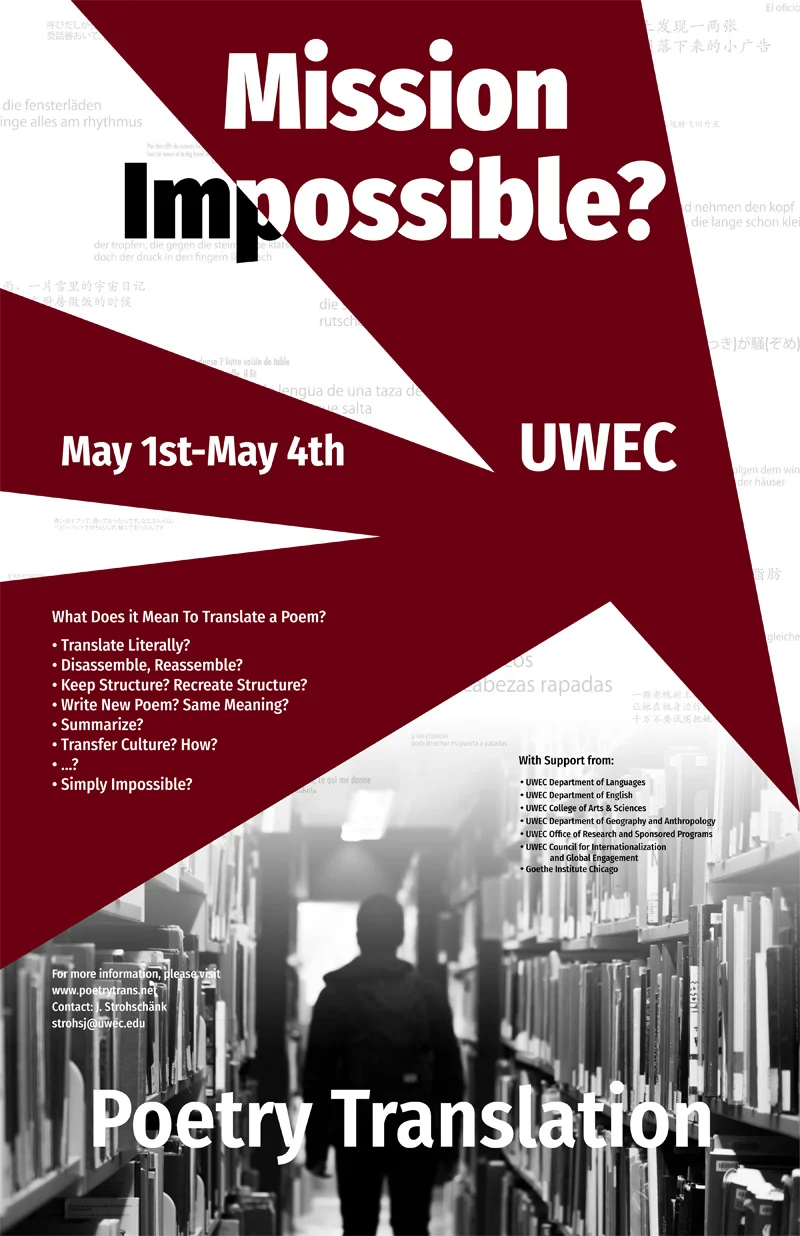
May 1–4: Mission Impossible? Poetry Translation

How does one translate a poem? In an effort to find out, the Department of Languages at the University of Wisconsin - Eau Claire will host a Symposium titled, Mission Impossible?  Poetry Translation from Monday, May 1 through Thursday, May 4.

The symposium will feature an array of events, many of which will be hosted by guest scholars Dr. Samuel Frederick of Pennsylvania State University and Dr. Graham Foust of the University of Denver.

The goal, explains University of Wisconsin-Eau Claire German professor and symposium organizer, Dr. Johannes Strohschank, is to “acquaint and familiarize both faculty and students, as well as a general audience, with the intricacies, problems, and benefits associated with the translation of poetry, in this case from the German to the English language.” 

“This symposium is not only for experts in German and English poetry but for lovers of poetry in all languages,” stresses Strohschank.  “German as a source language here only serves as an example from which to deduce the enormous difficulties, but also sweet rewards, associated with poetry translation, in general.”

The four-day event includes a reception and panel discussion, master classes in the Departments of Languages and English, and an evening with readings of international poetry as part of the International Poetry Reading on May 3.  More information on the time and place of these events will be released soon, which we’ll share on CVWG social media.

Exploring Boundaries and Identities in José Alvergue's New Book precis

Dr. José Alvergue (Image via theforeworduwec.com)

Dr. José Alvergue (Image via theforeworduwec.com)

by Jeana Conder

José Alvergue was born in San Salvador, El Salvador and was raised on the U.S./Mexico border.  He is a graduate of Buffalo Poetics and CalArts Writing programs.  José has written other works such as gist : rift : drift : bloom.  José currently teaches at the University of Wisconsin Eau Claire.

His latest work precis, released on April 1, tells the tale of a girl that was killed by a drunk driver in San Diego’s Sidro neighborhood.  José takes the reader on a journey between the literal U.S. and Mexico border and the border between individuals, bodies, and communities.  Below is a brief interview with José on the content of his new book and the thought behind the format. 

CVWG: Precis, by simple definition means a concise summary of essential points, statements, or facts. How do you feel the title of your book reveals itself within your work and impacts the meaning?

Alvergue: The definition of the word was really important for me when thinking about the composition of the book. It’s an indication of knowledge, or knowing when it comes to people, place, and history. But it’s also an indication of genre in the sense that genre choreographs certain cultural expectations, values, and reveal reading practices: for example, the ways a cultural belief around “criminality” or “precarity” forms reading practices related to “border literature” or “immigrant literature.” I want to disrupt the continuity of these expectations with the story/-ies in the book. In many ways this is very similar to the Russian avant garde practice of factography from the 1920s, but it is also influenced by current day postlyric practices that treat language between its concreteness, and its social identity. You can’t summarize the assembly of the social, even if concreteness wants to show ‘the social’ as a static body––this gets even more entangled the more specific we are about the particular assembly in question. In this case, borders. There’s a review of the book I read recently and it sort of frustrated me because it assumed the names in the book are of immigrants, all of them. But this is not the case. There are Americans that live at the border too, yet the narratives concretized around border experiences are of immigrant contexts, which, as an expectation, not only reduces the heterogeneity of lives, but also essentializes one immigrant experience as a summary the many. So I include various instruments of summary: maps, etymological definitions, linguistics, industrial organization flow charts, finger tips, and ‘story’, both invented and non-fiction, but do not allow the gratification of the summary to complete expectation.

From the excerpt I read on the Omnidawn website, precis seems to be different than your average novel. Precis plays with structure, creating different emotions. From newspaper clippings, blacked out text, and more, how do you hope the reader will receive your message from such a unique format?

The first thing I guess is that I don’t imagine it as a novel. There’s a really great description of one of my favorite books, Theresa Cha’s Dictée, by a prominent scholar, who calls the book a recit. I really like this way of talking about books that are conscious of genre only if for the intent of unsettling genre as boundary––or I guess treating genre exactly as that, boundaries that can be approached without destroying what makes them such––a boundary. Like walking along that dynamic terrain where a body of water territorializes and recedes from a terrain. It gets cloudy and one leaves an imprint, but the wash always resets the boundary. That’s the beauty of genre. You can’t break them. I would hope that potential readers understand that. Experimental or conceptual work won’t undo identity, particularly a reader’s identity; they seek to expand the topology or landscape we envision ourselves to inhabit. Poetry is about nuance, not reduction. I think these existential questions related to Literature must also account for area literature, like US Ethnic literature; it’s not just for the big white authors of ‘Western Civilization’. I would hope that they understand the politics of this intervention as well.

Precis focuses on the literal border between the United States and Mexico, but also focuses on the boundaries between individuals and communities. Do you think one has to understand the broader aspects of divides to truly understand the impacts of the border between the two countries?

I don’t know if one needs to understand “divides” but rather be comfortable with the prospect of caesuras that are unbreachable. We can exist within difference without imposing homogeneity. The existentialism of this is important when it comes to considering legislation, because the ‘planning’ or the beliefs undergirding the support for political institutionalisms feeds into the feedback loop, which we experience as phobias. I think these fears, homophobia, xenophobia, and more specifically Islamophobia, are partially existential––a deep fear that the mere acknowledgement or presence of a person that exists in a state of difference to the normative will unrattle the veneer behind which Americaneity often resides. We all experience “divides,” but we also can’t level them as being the same. What we should be thinking about is the way a constructed fear is appropriated as a personal way of being American.

You start off your synopsis of the book by describing the border as "a policed realm, neoliberal market." With the newly founded Republican controlled government, do you hope Precis can make a political stand against the erasure of identity of those effected by the border?

The stand can never be structural to the degree necessary for actual protection against the policies that will prey and are currently preying on the already precarious. The project of conceptual poetry is one of meaning; it’s meant to encourage an enchantment with language in a manner that invites the invention of meaning on behalf of another, another who is not the writer or the lyric persona of the text: in other words, the reader. We often don’t realize that we place meaning back in the world with the ways we interact with representation. It’s not about purely binary, good/bad, do something/don’t do something responses. It’s about nuance. I think the stand against erasure begins with a recognition––as a self-care––of our own capacity to involve ourselves in the making of meaning.

From the Mouths of Writers 1: The Best Advice You Ever Received

mentor-2062999_1920.png

by Jeana Conder

A couple of weeks ago I set out on the task of asking local writers to answer a series of eight questions I compiled.  The responses I received are now creating our newest series, “From the Mouth of Writers.”  We hope that this series allows upcoming writers to gain knowledge from others with the same passion. This week’s question:

What is the best advice you have received about writing?

Allyson Loomis

A poet once told me that all you have to do to be a writer is (1) LIVE (2) READ (3) WRITE (4) THINK ABOUT WRITING (5) REPEAT UNTIL DEAD.  I’ve always thought that was a sound checklist.  I routinely share it with my students.

Sandra Lindow

When I was a sophomore in high school, my English teacher said that I didn’t need to “try to be different”.  He believed that I was “different enough” to become a successful writer by just writing the truth about myself.

Molly Patterson

The best advice given to me as a writer was to try different techniques, to push myself outside of my comfort zone. I used to live in San Francisco and had been writing for some time when I took a class with the Writers Studio. Their model was based on reading a published writer's piece, breaking down the various techniques in terms of voice, point of view, style, and approach, and then using those techniques as guidelines for beginning a piece of your own. This method helped me become much smarter as a writer and reader: by forcing me to take on different styles and voices, I expanded my range. The surprise is that in the process, I developed my own voice as a writer. I would recommend this process to anyone.

Bruce Taylor

“A fool on a fool’s journey would be a fool to stop.” Kurt Vonnegut Jr.

Jon Loomis

Read everything and write every day.  I don’t necessarily follow it, but it’s great advice.  

Marsha Qualey

I have been teaching for ten years in a low-residency MFA program. Twice a year the students and faculty meet on campus (Hamline University) and the writing talk flows. I have taken in so much great advice, but possibly the most eternally pertinent to my own writing comes from a faculty colleague, Claire Rudolf Murphy, who likes to pound the podium and urge “Cut the exclamation marks.” That caution is about much more than punctuation, of course. My writing leans toward the emotional and I need to monitor that aspect all the time. Looking for exclamation marks is a good approach.

Sandra McKinney

Write every day; in a journal or otherwise. Meditation.  

Jay Gilbertson

I have been given a ton. As any published writer who has been around will tell you. I suggest you attend workshops or take classes and read writing books (or any book, for that matter) and look over the acknowledgements to see what inspired that particular author. Don’t Stop Writing! Oh, and read and read and read and NOT just in your genre.

Nickolas Butler

Read, read, read.  There's no way you're going to become a great writer, without first becoming a great reader. 

Brett Beach

In an interview on the Longform podcast, Cheryl Strayed talked about the success of her memoir, Wild. Paraphrasing here, she notes that the success was one part luck—extraordinary luck of the kind that so rarely happens, it should not be a thing people wish for—but, more importantly, she had written the best book she could, so that when luck came, she was ready. In other words, she had worked hard. Really, she had worked her butt off.

I think about this all the time: that of all the things writers believe they can control, in truth the only thing we can do is work, and do the best work possible. I believe deeply in working hard. I take writing seriously, and do not romanticize it (no lit candles, no prayers to a muse, no special pen, no writer’s block). Nor do I treat writing an occasional hobby. The writers I know, and respect the most, have all found ways to make space in their lives for writing. Writers prioritize writing—are sometimes even selfish about it. (Ha! Ha! you laugh. Does he have kids yet?) The act of creation can be wonderful, and frustrating, and euphoric, but it is also a choice I make each day when I sit down: I am a writer. I am here to write. So I do the work.  

Cathy Sultan

Things: Always be honest. Your reader will know if you aren’t; Write about something you know and are passionate about.

7 Questions with Cirenaica’s Memoir Writer-in-Residence June Melby

Credit: Parker Deen

Credit: Parker Deen

Love memoir?  Mini-golf? Wisconsin? Then allow us to introduce you to New York Times bestselling author June Melby, who we’re proud to host as a writer-in-residence at Cirenaica this summer!  June’s residency— “The Art of Memoir: Keep it Honest, But Keep it Interesting”—will teach writers of all levels great techniques for keeping readers riveted within the memoir form.  The author of My Family and Other Hazards (hailed as a “summer delight” and an “ode to Wisconsin” according to the Minneapolis Star Tribune) is a must-read for all Wisconsinites (though especially those who want to hear about June’s adolescence amid golf balls and tricky putts).

We recently caught up with June and learned a ton about her writing style, her influencse and how to handle a truncated question (spoiler alert: her answer is “chocolate”).

You grew up in Iowa, but spent much of your career as a writer in California. Do you think your move back to the Midwest has affected how you write?

Sure, because I have a lot more time now that I’m not stuck on California freeways half the day.  But seriously, I think that moving period has helped me as a writer.  I have found that throwing yourself in an unfamiliar environment is incredibly stimulating.  Anything that makes you challenge your own assumptions is a good thing.  Moving away helped me get the distance I needed to really think about growing up in the Midwest.  Moving back has given me perspective on the years I spent in California.  Buy mostly, I admit that moving back to the Midwest had a huge impact on my writing, because I came back to attend graduate school and get my MFA.  That experience was about as educational (and humbling) as it gets.  I learned to hold my work up to a higher standard.  Best of all, in Iowa City I got the chance to hear many great authors give talks about writing.  I think that was school in itself. 

How has your background in standup comedy influenced your writing style?

Yes.  It got me wonderfully prepared for rejection.  Ha.  But seriously, I think that comedy was a wonderful place to start.  For one, you learn how to be concise.  Comedy is a lot like poetry actually.  You learn to pay attention to each word, as well as the rhythm.  Also, it’s empowering to write and then not have to wait around for a publisher to give you the go-ahead. 

What would you say is the most…

The question is truncated, but in any case, the answer is “chocolate.””

Your Cirenaica residency is titled The Art of Memoir: Keep it Honest, But Keep it Interesting. How have you struck that balance in your own memoir writing?

It may sound simplistic, but I discovered that I got stuck when I was trying to say things that weren’t exactly true.  And in this case, I don’t mean true to facts, but true to what I am really trying to understand about the events and people in my life. I am very interested in this topic, because in my experience, it is nothing short of a wonderful miracle that if you write about the things you are curious about, if you really try to grapple with this strange miracle of life,  the reader will be engrossed and travel with you.  However, on the other hand, if you write to impress people, it’s not going to happen.  If you are bored while writing something, guess what, the reader will be too!

Who (or what) most influences your writing?

This is a toughy to answer. But I will say that recently I got the chance to travel, and it was just wonderful for giving me ideas.  Putting yourself in a situation when you feel off-balance, humbled, or even just plain lost can be a very stimulating thing.  It makes you think.  Question your assumptions.  It’s almost impossible to say where inspiration and ideas really come from.   So I’ll just add this quote from Dorothy Parker, “Writing is the art of applying the ass to the seat.” 

Is there anything you’re working on currently?

Yes.  I have three projects in the works!  A collection of humorous essays, a new memoir, and a collection of short fiction in the form of fairy tales.

 How would you describe My Family and Other Hazards in one sentence?

I grew up on a miniature golf course that my family ran for thirty years (and which I hated), but when my parents sold it I freaked out, fell apart, and wrote this book in an effort to make sense of it all. 

Want to share your work with June this summer?  Then apply today by clicking here.

And check out an excerpt from My Family and Other Hazards by clicking here.

Oh, and a special treat for those who read till the end: for each referral application, receive 10.00 off your own potential acceptance! Just have your friend type in your name in the "referral" box on his or her application.

5 Reasons Why Applying for Allyson Goldin Loomis’s Nonfiction and Memoir Residency is a must!

by Erin Stevens

As a University of Wisconsin-Eau Claire alumna, I'm well aware of Allyson Goldin Loomis's prowess as an incredible teacher and writer.  Which is why signing up for her residency is a must.  Check out 5 reasons below!

  1. Allyson is an accomplished writer. Whether it be fiction or nonfiction, Allyson has published great deal of amazing work一 she was even an honorable mention in the 2016 edition of Best American Short Stories. Check out her essay, “Learning to Sleep” published in The Sun.

  2. She is a great instructor. Allyson is a beloved professor at UWEC who has earned the praise and adoration of her students. From her knowledge and passion for writing, to her interest and enthusiasm in student work, Allyson will be great for writers of all experience levels.

  3. You’ll learn how to really bring your nonfiction piece to life. If you’ve been struggling with writing about the details that will really bring your memoir or essay to life, Allyson will talk about different techniques you can try to make your piece as strong as it can be.

  4. You’ll have hours of designated, uninterrupted time to work on your writing. In our day-to-day lives, it’s easy to push our writing to the side. We have jobs to work, children to raise and various other commitments pulling us away from the keyboard and the stories, essays and poems we want to be crafting. Think of Cirenaica as the vacation/getaway that you and your writing need. No distractions, no work or kids一 just you and the memoir you’ve been dying to write. While there will be plenty of time reserved for workshop and instruction from Allyson, you’ll also have an abundance of time to write something new or revise the piece you submitted with your Cirenaica application. Find a sunny spot on the deck to enjoy your morning coffee and write a few pages, or pick one of the many comfortable chairs inside the cabin to and and type the morning away.  If you're really adventurous, try writing in a hammock!

  5. Special guest John Hildebrand. In addition to working closely with Allyson, you'll also get to meet writer-in-residence alumnus John Hildebrand, author of The Heart of Things  and  A Northern Front,  will be joining Allyson during the weekend to offer advice about all things nonfiction writing.

Don't delay!  Apply today!  Click here for more information!

5 Reasons Why NOT Signing up for Nickolas Butler’s Fiction Residency Will Be the Biggest Regret of your Life

                                                                      &nbs…

                                                                                                                                                                                 Credit: Jeff Rogers

by Erin Stevens

Okay, okay, forgive the hyperbole.  But as someone who attended Nick Butler's residency last year, I can tell you it's not something to be missed.  

Read below for 5 "must know" reasons to apply today!

1.) New Book Alert. When Nickolas Butler’s Fiction Residency rolls around, he’ll be hot off of a tour for his brand new book. The Hearts of Men, which was released in March and has been receiving rave reviews. While at the residency, you’ll have the opportunity to ask him about his new book, his writing process, the publishing process, and more.

2.) Opportunity for Local Publication. Did you know that the Chippewa Valley now has it’s very own literary journal? Special guest Eric Rasmussen, founder of Barstow & Grand, will talk to fiction residency attendees about the new addition to Eau Claire’s growing literary scene. Whether you have lived in Eau Claire your entire life, or you’re attending a residency in our corner of the world, any writer with a connection to the Chippewa Valley is encouraged to submit their fiction, nonfiction or poetry. And since you’ll be workshopping and revising your piece at the residency, you’ll be just in time to submit for the spring submission period!


3.) It’s a great place to ease into a writing group. Don’t believe us? Check out this testimonial: "This was my first exposure with any kind of writing group outside of a strictly business context. I have to say that [Nick’s workshop] was quite a life-changing experience. I learned so many things in regards to not only writing, but life in general. A fantastic experience recommended to all, not only those who consider themselves 'writers.'”

                                                                      &nbs…

                                                                                                                                                                               Credit: Justin Patchin


4.) Learn from a successful author in a supportive environment. Book List has called Butler "the front ranks of contemporary American writers of literary fiction..." His debut novel, Shotgun Lovesongs was a New York Times Bestseller. And while this might seem intimidating, it shouldn’t be. Cirenaica is perfect for writers of all skill levels, and our writers-in-residence are here to make your workshop/residency experience enjoyable. Whether you’re a New York Times best-selling author, or you’ve written your very first short story, we promise that Cirenaica will b e great for you.


5.) Your fiction piece will thank you. Having attended Butler’s residency last summer, I can promise you that these three days will be instrumental in improving your fiction. Not only will you receive invaluable critique from Butler himself, but you’ll also have nine other readers carefully considering and offering feedback on your work.


Now’s your opportunity to learn from the best, while also forming a writing community that you can call upon long after the residency has ended.

Apply for Nickolas Butler’s fiction residency today!

                                                                      &nbs…

                                                                                                                                                                              Credit: Justin Patchin

Teaching and Learning in Writing 101

By Brady Krien

On my first day of teaching college writing I handed out 3x5 note cards to my students and asked them to give me a little bit of information to help me get to know them. I asked for their name, their major, why they chose Marquette, and their favorite Tom Hanks movie. I also asked a few questions aimed at getting a sense of who they were as writers, asking what they struggled with most, what their semester goals were, and if there was anything that I should know about them as writers.

The responses were mostly unsurprising. Students were anxious about commas and the higher stakes of college, many just wanted to get through the class and improve their writing a little (or, in one case, to improve their “grammer”), and none of them had heard of Joe versus the Volcano. What I did not expect was the number of students who claimed that they were “bad writers.” Over half the class claimed to be poor writers.

Looking back, having repeated some version of this same activity with each of my classes, I should not have been surprised. This was the most common response that I received at Marquette and continues to be the most common response I receive at my current institution in Iowa. The odd thing is that very few, if any, of the students that I work with are bad writers. There are writers who occasionally produce bad writing, writers who’ve convinced themselves that they “write better on the first draft” and never revise, and writers who don’t yet understand a topic well enough to make a compelling argument about it, but there are few out-and-out bad writers. 

What I’ve come to understand is that this bad writer claim is less a confession of compositional incompetence than a request for help. It’s a way of saying that 1) writing is really hard, and 2) writing scares the bejeezus out of me. These sentiments are not uncommon, even (or perhaps especially) among people who write a lot. As I’ve worked with students to overcome these challenges, I’ve found that my own understanding of writing has profoundly changed. The three most salient writing lessons I’ve taken from this experience are: 

1. Revision is Key. So many of my students come to college believing that they draft so well that revision is unnecessary (I confess that I shared in this delusion once upon a time). A significant portion of my teaching is devoted to converting them to the school of Anne Lamott: write shitty first drafts and revise extensively. As I’ve preached this particular writing gospel, my own revision process has expanded dramatically. I now devote at least as much time to revising as I do to drafting (and often more) and I’ve come to find an extensive revision process to be incredibly liberating for both myself and my students because it dramatically reduces the pressure to produce high-quality drafts.

2. Silence the Critic. I work with a lot of students who struggle to start writing. They’ll sit down, write a sentence or a paragraph, hate it, and delete it. They will then repeat some version of this process again and again until they either give up and go watch Netflix or the deadline forces them to accept work that they hate. I’ve found that silencing this inner critic by forbidding deleting anything during the drafting process (after all you’ll come back and revise it, right?) goes a long way toward getting words on the page, a necessary prerequisite to producing any writing.

3. Write for Time. I tell all my students set time rather than output goals. Anyone can commit to write for two half-hour blocks during the course of a day and this helps to alleviate the dread of sitting down and writing out the entirety of a ten-page paper which often leads to procrastination and no writing at all. I’ve found that committing to write for a little while every day drives writing productivity way up and the frequency of late night writing binges way down. Energy drink companies will suffer, but you will prosper.

I’m convinced that I’ve learned more about writing from my students than they ever learn from me. Observing their writing struggles and helping them to overcome them has been the best part of teaching writing and has helped my own writing dramatically. It’s helped me to understand that, while we all have very writing processes, there are a lot of shared roadblocks and talking about them, sharing them, and helping others to overcome them is sometimes the best way to move forward with your own writing.

Photo by Caleb Roenigk: https://flic.kr/p/brNqFE

Scribble (March): "The ABC’s of Writing"

Scribble.jpg

Each month we’ll offer a low-stakes writing prompt applicable to all genres. Upon completing the prompt, send your piece (500 words or less please) to chippewavalleywritersguild@gmail.com for potential publication in next month’s newsletter!

Without further ado, here is your March Scribble challenge ....

When it comes to writing, rigid rules can produce fascinating results! Your task this month is to write a fictional short story that is 26 sentences long, each sentence beginning with the next letter of the alphabet. 

Photo by Marcie Casas

An Ocean of Time

An Ocean of Time

By Walter Rhein

I graduated from UWEC in 2001 and moved to Lima, Peru. I stuck around because the women were beautiful, the exchange rate was favorable, and the food was better than anything I’d ever tasted. My expenses consisted of the $100 a month I paid for rent, and whatever else I needed to spend to keep myself fed. That was it. I had no insurance payments, no car payments, no electricity payments, nothing.

I’d only been using email for a couple years, and Facebook didn’t yet exist. It was possible to disappear then, something that’s becoming increasingly difficult to do today.

Back home, they all thought I was nuts—that I was giving up a lot. Honestly, on occasions when I returned to the US to visit, it was fun to sit and “veg out” on cable TV or Netflix. ‘American Idol’ was in season 3 before I ever even heard of it.

“What are you getting in exchange for missing out on the American dream?” my friends would ask. They were scrambling to cover student debt, car payments, mortgage payments, and constantly terrified of losing a job they hated. Somehow, in their minds, I was the one missing out.

“An ocean of time,” I’d reply.

I can still see the eternity of that era stretching out before me. It’s a beautiful image. With modest savings and minimal expenses my time was mine, as much as I wanted. Enough time to bathe in. I was young. I was healthy. I had no obligation but to live.

Some said I was living in squalor. I had a single room, no hot water, and early on I assassinated a colony of bed bugs with a spray can of raid. I wore my clothing to rags. My delights came from spinning tales. In the mornings or evenings I could dance my fingers on my keyboard until my mind cooled off. Sometimes I wrote till dawn and slept through the day. Sometimes I wrote with pen and paper while enjoying a fine breakfast at an outdoor cafe. For a change, my time was not squandered.

“When I was young,” one of my friends in Peru said over a beer at night on a side street in Miraflores, “my parents made me sit in the corner when I was bad. That wouldn’t have been a punishment for you would it? You’d just have sat there and made up stories.”

True.

I lose track of where I am sometimes. People disappear in front of me. Jungles and mountains and super novas spring up all around and steal my attention. Sometimes my wife has to shake my arm to bring me back to her. I’m on the other side of the universe while sitting beside her on the couch.

“Oh, sorry dear, what did you say?”

It made her mad at first but she’s used to it now. She understands my mind is not entirely under my control. In the greater scheme of things, my affliction is low on the list of detrimental quirks. 

Stories and articles got sent off into cyberspace. Sometimes I’d get paid. Mostly no. I do the same thing today and get paid marginally more often. These days I strive for hits and comments and reviews. I find them all equally invigorating. 

I think the ocean of time is as big as it ever was, but I’ve come to understand a little more how insignificant I am beside it. When I stared writing I had a definition for “success.” Now my definition has changed. One reader is as good as a million if that reader finds nourishment in your work. I didn’t believe that long ago. I do now.

Walter Rhein writes for Perseid Press. His most recent release is Reckless Traveler, an expat novel about his time in Peru. He’s also the author of Beyond Birkie Fever, which deals with America’s greatest cross-country ski race: The American Birkebiener. He’s a regular contributor to SilentSports.net, and Singletracks.com, and maintains a travel blog about Peru at StreetsOfLima.com. Please write and request a review copy. He can be reached at walterrhein@gmail.com

Recap: Winter Writers’ Weekend at The Oxbow

A public reading was just part of February's Winter Writing Weekend at The Oxbow Hotel.

A public reading was just part of February's Winter Writing Weekend at The Oxbow Hotel.

By Karissa Zastrow

During the first weekend in February, the Chippewa Valley Writers Guild held their first Winter Writers Weekend at The Oxbow Hotel in downtown Eau Claire. Utilizing the gallery, all writers were checked in and ready to go bright and early Saturday morning. During the introduction, B.J. Hollars described how writing should be, in the words of Ray Bradbury, like “jumping off a cliff and building your wings on the way down.”  This means starting with any idea and seeing where it takes you. In the end, you might not be anywhere near where you started, but you created something as you went and build off that initial idea. 

The goal of the day, was to create something brand new to present at the reading that evening. To help writers, B.J. Hollars introduced the FIB technique when working on smaller pieces:

• Focus- Depth is better than length, so focus on a singular scene.
• Image Driven- Strive for specificity. Make it a cherry coke, not a just a coke.
• Bold- Show what is happening; don’t tell. 

Using this technique, the writers had a full morning of writing prompts to get their creative juices flowing. Writers were given about 20 minutes to focus on each of the 5 writing prompts. Between activities, writers had a chance to share what they wrote. The wide range of writing prompts produced great ideas and, in some cases, pushed writers out of their comfort zone. 

After exercising their brains and taking a break to eat lunch at The Lakely, the writers had a little over two hours to work on their piece for their workshop later. Sprawling out over the first floor of The Oxbow and The Lakely, writers filled the nooks and crannies while creating something that would be revised and presented later in the evening. Whispered conversations turned into the sound of clacking keys as everyone got to work. 

Once everyone had a piece they were comfortable with and sent their piece out to their workshop group, the attendees split up, ready to start the revision process. Each person had about 15 to 20 minutes for their piece to be workshopped. First, the writers would read their piece out loud to the group. Then while the group gave feedback, the writer stayed silent, except to answer questions the group had at the end. Once their time was up, it was on to the next piece.

CVWG Director BJ Hollars

CVWG Director BJ Hollars

When the workshop session was over, there was a break for writers to get dinner and work on their piece before the reading in the gallery that night. Some rushed off to go get food, while others went straight to their rooms to polish their pieces. At 7 p.m. the writers and audience members gathered in the gallery, which was now set up with rows of chairs, ready to house the reading. With only standing room left, the reading kicked off with special guest, Bruce Taylor. For the next two hours, the writers showcased what they created that day—poems, stories, memories, and even a short play. After each writer presented their piece, they had the opportunity to record their piece for the Blugold radio. Once the reading was over, the writers celebrated their successes with drinks and jazz at The Lakely.

The next morning, the writers reconvened in The Lakely for breakfast before the final and educational session. Featuring Joey McGarvey from Milkweed Editions, a publishing company based in the Twin Cities, the writers learned valuable information about the publishing process and how to get their work published. The best advice Joey had for the writers was to be aware of what the publishing company is looking for and make sure your piece fits their guidelines and genre. She describes getting a publisher’s attention is like finding a secret password to get you “in.” Sometimes the secret password could be comparing your work to the right author, or sometimes it is in the hook of your work—it all depends on the publisher. 

After a weekend of great people, writing, boundary pushing, and showcasing our work, it was time to say goodbye. All the writers gained something from that weekend, whether it was a piece of writing, new friends, or motivation. I think it’s safe to say, everyone left inspired. I know I will definitely be attending again next winter and I hope to see you there. 

For more information on this summer’s writing residencies at Cirenaica, click here.

New Horror Writing Group Forming in the Chippewa Vallee

Horror Writing Group, Conder.jpg

By Jeana Conder

Do you enjoy writing about things that go bump in the night? Enjoy mysteries and thrillers? A new horror-writing group in the Chippewa Valley is for you.

This new writing group, founded by Joshua Macmillan, is designed for writers who would like help producing their works. Joshua is interested in helping (co-)produce with others to create stories that elicit the darker side of human emotions. Genres of interest in this group are horror, mystery, thriller, and dystopian, and these works do not have to be fiction. Any non-fiction or memoir style stories will be welcome.   

Joshua is looking for a crowd of writers willing to share their works and become “beta readers” for others. He hopes to have the group edit and critique stories with the hope of promoting finished stories out of this company.

Joshua is a 28-year-old resident of Eau Claire, Wisconsin, with roots in San Antonio, Texas. When it comes to horror, he is a lifelong fanatic but an amateur writer, and he wants to learn as much from others as he can. He would also like to help other authors achieve their own writing dreams. Right now, Joshua and his twin brother are collaborating on a graphic novel series, screenplays, a horror fiction series, and what Joshua hopes to be his first novel. His most notable contributions are on the horror website Dread Central.  His goal for the year is to increase his creative output and make writing his career.

If you have similar ambitions to Joshua and would love to be a part of a group of writers with similar interests and objectives, you can contact Joshua at joshmacmillan88@gmail.com.

A Fond Reflection on Time Well Spent: Looking Back at Cirenaica 2016

By Tony Dee

Having spent the year leading up to Cirenaica teaching first-year writing courses, it was a delight to be on the “other side” of the classroom. Although in this particular instance, the “classroom” was a warm common area in a cabin (cannot stress this enough: on architecture and furnishings alone, Cirenaica scores a home run) and the teaching was a blissful break from my lectures on comma splices. Max Garland, poet-in-residence, had this magical ability to engage with our cohort on numerous levels—hard, theoretical, college seminar-prosody stuff—but made sure the humane integrity of the art remained intact. Discussion was both critical and generative, and I hadn’t spent that much time hunched over a notebook furiously burning through pages and wrist-strains since middle school (speaking of eras wrought with nostalgia and preciousness). Max was cheerleader and champion, scholar and peer; at several points he was also a park ranger (that was my second favorite Max) on a number of field trips, most memorably into the Wisconsin woods to behold Big Falls.

Despite the fast friendships, often, the best time was spent alone. The area surrounding the cabin offered many trails, opportunities to lose oneself if one was so inclined; had I conquered those grounds I suppose I would have taken advantage of one of the few up-for-grabs bicycles and rode into downtown Fall Creek, as one of my fellow writers did one morning.  I opted to go on a social trip to a bar in Fall Creek with several of my newest friends; from what I remember, we had a really, really good time. On our walk back up the hill to the cabin, we sat, laid back, and admired the stars, the moon, and probably discussed art, God, Her capability to create such a subtle spectacle. You know how writers are, yes?

Long days of discussion, invention, discovery, and revelry were fueled by gallons of coffee and some of the finest cooking I’ve ever had the pleasure to enjoy, and enjoying food is my passion if poetry isn’t. Chef Brent will forever hold a dear space in my heart as the mastermind behind cold oatmeal. Yes folks, cold oatmeal. Where creativity was being nourished, our physical bodies were being absolutely satiated. I’d say spoiled, but frankly, we deserved the delights if for no reason other than the talent and camaraderie on constant display during impromptu or planned readings, sharings, and workshops.

I now humbly submit, what could be a journal entry or piece of intentional writing, as my honest to gosh recounting of my arrival at Cirenacia last summer:

“Portrait of a writer in motion: vehicle peeling itself off the long expanse of yet another Midwestern highway that surely I would write a poem about after a day’s worth of driving. Well past Chicago by breakfast time, Detroit, Michigan, was time-zones away in the rear view mirror. My little car buckled getting onto a local highway, parts of which were dirt. One of the many talented Eau Claire bands I’d brought with me were quietly playing to the added percussion of anticipation and small stones underneath my tires. Clouds obscured the otherwise tremendous expanse of land that makes up the vistas of Fall Creek, Wisconsin. I thought back to my M.F.A. friends in California, trying their best for my benefit but just not getting the treasures our pastoral landscapes offer. As if to snap my attention from the often reviled throws of nostalgia and preciousness, a bolt of lightning punctuated the long sentence of a thunderstorm.

I’ll blame the torrent of rain rather than human error, despite my ever gracious hosts making it abundantly clear how to locate the difficult to spot entrance to Cirenaica; I had to turn around in the neighbor’s driveway, which was quite far away from the bold and blue letters announcing my temporary new home. A dirt driveway snaked up and away from the road, into a row of trees, suggesting what woods lie beyond. Through the clearing there appeared as if by magic the kind of cabin that would turn a person into a poet: sharp edges on a vaulted roof, logs and bricks, long windows offering gaze into our isolated surroundings. Rain pattered in puddles in the sloping lawn, leaves danced on their branches, and, fully embracing the (now) nostalgia of hyperbole, I realized I had arrived at a home like which I had never resided."

The stuff oozes out of me after the weekend of reinvention, hard work, and good writing. The details of my arrival are abundantly more available to me because, after being ushered in by an impossibly energetic and welcoming host (local Wisconsin beer in outstretched hand, I might add) BJ Hollars, the individual moments of the Max Garland Poetry Residency begin to blur. I’m positive I did some of the best writing I’ve ever done in my life; that’s including time spent in a graduate program for creative writing.

Two memories stick out most profoundly to me. First, the very same friend (from graduate school) who made Michigan-me aware of this little writing residency all the way in western Wisconsin, also heartily recommended visiting Eau Claire’s Pizza del Rey. Like I said, poetry and food are my passions. I was determined to visit this landmark. Not wanting to be anti-social, I offered to my new group of companions that, despite having just finished an enormous (and delicious) meal, I’d be going into town for some pizza, “anybody want to tag along?” Two full cars went from the cabin into town, and the rest of that tale is found between boozy and cheesy poems written in some journal, somewhere.

The second is bittersweet. I had quite a long drive ahead of me, so my last morning at Cirenaica was a short one. Hurried coffee, tossing clothes and books back into my bag, tossing that into the trunk, another hurried coffee, then goodbyes.

I drove away barely remembering the apprehension I’d driven into town with; if there’s a more likely group of friendly strangers than writers, I couldn’t guess who they’d be. Full of spirit, creative energy, and eyes fully locked on the rear view mirror well beyond the numerous state borders I crossed on my journey, the Spirit of Cirenaica, I knew, would be a constant companion for the many months ahead.

Until, hopefully, next summer.

Interview: Nickolas Butler

Nickolas Butler | Photo: Jeff Rogers

Nickolas Butler | Photo: Jeff Rogers

By Alison Wagener

Local writer Nickolas Butler's debut novel, Shotgun Lovesongs received international acclaim, a spot on the New York Times Bestsellers list, and a deal with Fox Searchlight. Raised in Eau Claire, Butler attended UW-Madison and then the acclaimed Iowa Writers Workshop before publishing the book, which contains multiple references to the Chippewa Valley. His second novel—The Hearts of Men—is poised to release on March 6.

This summer, Butler will return to Cirenaica to host a writer residency on the theory and practice of fiction. Details here!

We recently sat down with Butler to ask him a few questions...  

CVWG: The essential first question: did you always know you wanted to be a writer?

Butler: I think writing’s always been a big part of my life. I don’t think that I ever thought it could be my job maybe until I went to Iowa, and I started gaining a momentum, and I could see there was some kind of path for me moving forward. But I think when you grow up in the Midwest, the notion of dreaming of becoming a writer seems sort of far-fetched. So maybe even if that’s what I wanted to do, I never would have vocalized that.

So it just clicked for you sometime during college, you decided to pursue writing in grad school and everything fell into place?

I mean when I was going to grad school, my wife and son were living north of the Twin Cities, and I was commuting down to Iowa City from there. And it just felt like there was a lot at stake for my time in Iowa. What was my wife sacrificing for? Why was I away from my family if not to really work hard all the time? So I used my time really efficiently during that two years and was able to write two books while I was there, and I was lucky enough to get an agent halfway through my time there, so everything just kind of clicked, yeah.

Both Shotgun Lovesongs and your new book The Hearts of Men are set in the Chippewa Valley, the Eau Claire area. Is that you writing what you know best, or do you think it’s something more of a tribute?

It’s writing what I know best. This book takes place mostly north of Eau Claire; it’s in a Boy Scout camp kind of near Rice Lake. But it also ranges to Vietnam, to South Africa, to Botswana—so it’s kind of more around the world than Shotgun Lovesongs was. It’s what I know the best, but it’s also just what comes naturally, too. I’m not really interested in writing about anything else right now.

Were you a Boy Scout growing up? Do you think that played into your idea of what men should be?

Mm-hmm. Cub Scouts, Boy Scouts, ultimately an Eagle Scout, so yeah, I was going to camp from when I was eight until I was 16 or 17… I don’t know that I could say that I thought Boy Scouts necessarily was instructive of what I thought masculinity was going to be. For me it was ultimately more about being a good person than a good man or a good woman. The book is interested in masculinity, but I think that’s sort of separate from the Boy Scouts. It’s convenient that the Boy Scouts are there. But they’re not the same thing.

I think I was thinking about masculinity from more of the standpoint of being a young father, and thinking about the job my own dad did, and the job that I have to do moving forward. I don’t know that Boy Scouts really colored my idea of what masculinity is. At least I don’t think. Nobody’s asked me that before.

As I read, it seemed like Nelson sort of became a paragon of masculinity over time, even though he’d certainly gone through his own troubles and his own transformation. I was just wondering if for you, is what Nelson becomes your ideal of what men should be? Does that ideal even exist?

I don’t know that I think about Nelson as a paragon necessarily—I think what’s good about him and what’s good about most of the characters is that they’re trying to do their best, and it doesn’t always work out. But they’re trying. The notion that he has some kind of code, or thinks about a code, is what’s most important.

And the funny thing is, like, people think about the Boy Scouts as like a punch line, you know? If someone thought you were a dimwitted rube, they might say oh, you’re such a Boy Scout: you’re not complicated enough to act in an indecent way, or something like that. Like, what’s wrong with trying to have a code? What’s wrong with trying to be your best person? And also, is that possible? What happens when you fail – are you a bad person when you fail your code, if you can’t live by it all the time?

There’s quite a spectrum of morality and masculinity within your characters. Maybe I was reading a bit too much into the masculinity theme, but the book is very male-centric, with characters who do and don’t try to follow that code. What do you hope the men in your book collectively convey about what it means to live morally?

My dad, who was not always a very good dad, shares some of the same qualities as Johnathan. My dad’s dad, my grandpa, was often gone on merchant marine ships. He wasn’t around for my dad’s childhood. And I think even when he was around, he didn’t know what to do. He didn’t know what to do because his own dad died in a coal mining accident before he was born. So he had no exemplar. My dad used to tell me, “I’m not a good dad, but hopefully you’ll be better than me, and your son will be better than you.” So I think part of the job of the book, especially because it takes place over sixty years of history, is asking if we’re trying to become better.

Masculinity is a hyper-loaded word, and I never set out to make any sort of statement on that. I like to think about myself as a pretty sensitive person, and I’m raising both a son and a daughter right now. But I think the project of the book and of these characters is just to improve over time, to try and set a moral code out for themselves, and then try their best to live by it.

Can you tell us some more details about the release?

It’s coming out nationally March 7. There’s going to be a reading at Volume One March 6, so that’s kind of fun. By all rights, everything seems to be going just as well as it could be. We’ve gotten three-starred reviews from Library Journal, Kirkus, Publisher’s Weekly—Publisher’s Weekly called it one of the top ten books to look forward to this spring. It was nominated for the highest foreign literary achievement in France—this one actually meant a lot to me—it was nominated for another one of France’s highest foreign literary achievements by an all-female jury. It’s called the Prix Femina. It’s an award that’s always been selected by a female jury, so I love that. Made me feel good that this book that is kind of dominated by male characters was accepted that way, and I think they could see that I was critiquing male behavior, not celebrating it necessarily. So you never know, the New York Times could take a big shit on it tomorrow, and that would stink. But I wrote the book I wanted to write, and so far it seems to be going pretty good.

Cirenaica writer's retreat, Summer 2016

Cirenaica writer's retreat, Summer 2016

So let’s shift a bit. Last year, what do you think went best with your Cirenaica residency? Do you think there’s some things you’ll do differently this coming summer?

The one thing I was fortunate to have last year was a great group dynamic. We had about ten people who really seemed to get along right from the start. That’s really important to me, whether it’s teaching at Cirenaica or teaching at UW-Eau Claire, whatever it is. You need to make everyone in the workshop feel valued and feel comfortable, because it’s not about just listening to me pontificate. There would be no point in having a workshop, then. It would be better if it was just one-on-one teaching. I need everybody to be invested in the group, and I need everyone to be comfortable listening to one another’s criticisms. We were very lucky that last year went that way. I hope that this summer’s group has that same kind of camaraderie and spirit. In terms of what could be improved on? I don’t know. I thought we had a really good first year. There’s going to be air conditioning this year, which is a big step up. There’s gonna be a printer, which is a big deal. The first year, we were just trying to feel things out, like what is this space, how do we use this space, what do we need, what do we have? I don’t mean to paint too rosy of a picture, but it really was a nice experience for everyone.

Well it sounds like an amazing break from real life – you get to go sit in the middle of the woods and do what you love for a few days.

Yeah, and we had a range of talents, which I frankly think is good, because if you’re just starting off your writing, and you’re exposed to somebody who’s doing really good, advanced writing and exposing you to something you can strive for, I think if everybody comes in at the same level, then there’s more room for jealousy or petty bickering or something like that. I’m looking forward to it.

Have you thought about what you’re going to be focusing on yet, what you’ll do during the residency?

I’m going to conduct it the same way I did last year, which is basically that everyone gets a workshop, everyone gets a one-on-one meeting with me. Everyone gets a handwritten critique from me, and then I’ll just be around to chat. And I think sometimes a workshop is for the piece and for the person who’s being critiqued, but sometimes the most important stuff that a person learns is from casual conversations when you’re having a beer. How did you do that? How did you find an agent? How did you get published in a literary journal? Questions like that. And it’s hard to find a casual resource for some of those questions. But that’s what this thing is for, to learn how to break through and make your way.

Anything else?

I mean, I hope we fill up the Volume One store March 6. It will be a fun night, and then everyone is invited to go across the street to the Lakely, and we’ll have drinks afterwards. I think it’s pretty special that the release date is a day early, and it’s here in Eau Claire, which is cool. As far as Cirenaica goes, my hope is that at the end of the weekend, my workshop feels like they’ve created nine or ten new friends. That these people communicate with each other and move forward after that. And I hope that they get good feedback from me, and that it’s – I’ve been told that my workshops are very useful. We don’t waste a lot of time. The idea is to give you positive feedback right off the bat and then work with you about what’s not working quite as well. So I think people will come out of it feeling like they’ve got direction moving forward, and that they’ve also got a support group moving forward. And it’s set in a beautiful spot, it’s pretty cheap. People should use it.

Craft Talk Rewind: Self-Publishing With Katherine Schneider & Cecelia Zorn

Hillcrest Greens.

Hillcrest Greens.

The Chippewa Valley Writers Guild started off 2017 with a craft talk focused around self-publishing by inviting Katherine Schneider and Cecelia Zorn, two accomplished self-published authors, to provide insight on the increasingly popular publishing option. Self-publishing is where authors publish without a publishing house being involved. This means the author is in control of most of the process, which comes with both advantages and disadvantages, depending on the way the author looks at it.

While going through the self-publishing process, many authors learn quite a bit about the process that they would not have considered before. One advantage of self-publishing is that it is often quicker to get a book made, marketed, and sold. At times, self-publishing can be a stepping stone to getting noticed by a traditional publisher. If a self-published book sold well, a publisher might want to pick up the book or be interested in the author’s other works. With self-publishing, authors tend to get a bigger chunk of money, but that does not mean they make a ton of money. One of the biggest advantages of self-publishing is that it allows the author to have creative freedom throughout the whole process. The author can choose the price, the size of the book, the font, how they want to market it, and design the cover, all of which is part of the fun in self-publishing a novel.

While there are many advantages to self-publishing, some authors may not be thrilled about all the work they have to do on their own. In some cases, authors hire out help to assist them with the many tasks associated with self-publishing. This can cost even more money on top of the fee that authors need to have upfront when they publish their novel. Typically, authors need to have $1,000 to $2,000 to start the self-publishing process. One challenge for authors can be self-marketing and getting your book out there. Since all the marketing is up to the author, they really have to learn the best way to market their book to their target audience and, even if they do, it can be difficult to get established in bookstores and libraries.

Once an author has decided to self-publish, there are a few ways to find a self-publishing company to work with. Many people use word of mouth to discover reliable self-publishing companies. Katherine and Cecelia both have worked with Dog Ear publishing and Katherine has also worked with Beaver Pond. Create Space through Amazon is another popular option, but authors should be careful of formatting. Authors will sometimes look at self-published books in the library to see the quality of books the company produces and utilize reviews on the internet to make their choice. When it comes time to choose a self-publisher to work with, there are several questions authors need to ask themselves:

* Do you own the rights to your book and are you able to read and understand your contract?
* Do you set your own price and when are you paid?
* How is the customer service they provide?
* Where does the company make their money and what is the company getting?
* Who has the creative control and who is in charge?
* What will it cost you?

These questions will assist in discovering what you expect from a self-publishing company and ultimately, what publisher you will choose to work with.

Marketing a book is perhaps one of the aspects of self-publishing that can be fun, but also incredibly challenging. First, the author has to define who the target audience is. Then they have to determine where they go, what the best way to reach them is, and how to get their attention. In terms of marketing, all the little things matter—from the size of the book, to the look and style of the cover, to how many books the author orders at a time, it all makes a difference. Another detail authors need to take in to consideration when marketing is how much they want to spend on marketing techniques. Some methods to consider are e-mail lists, giveaways, taking a book tour, book marks with information on them, a blog, T.V., radio, and using social media to get their book out there. Authors shouldn’t be afraid to use who they know to help get the word out. Whether it is asking friend, who also an author, to write review for their book, or inviting someone to come on their book tour with them, any help can go a long ways.

Perhaps the best advice Katherine and Cecelia offered during the craft talk, was that if you are going to self-publish, make it fun. Enjoy the process from finally writing your novel and editing it, to creating the cover and the size of the book, to getting your book out to the public. After all the hard work you put in to achieving your goal, the least you can do is have a little fun with it!